
Hallo zusammen!
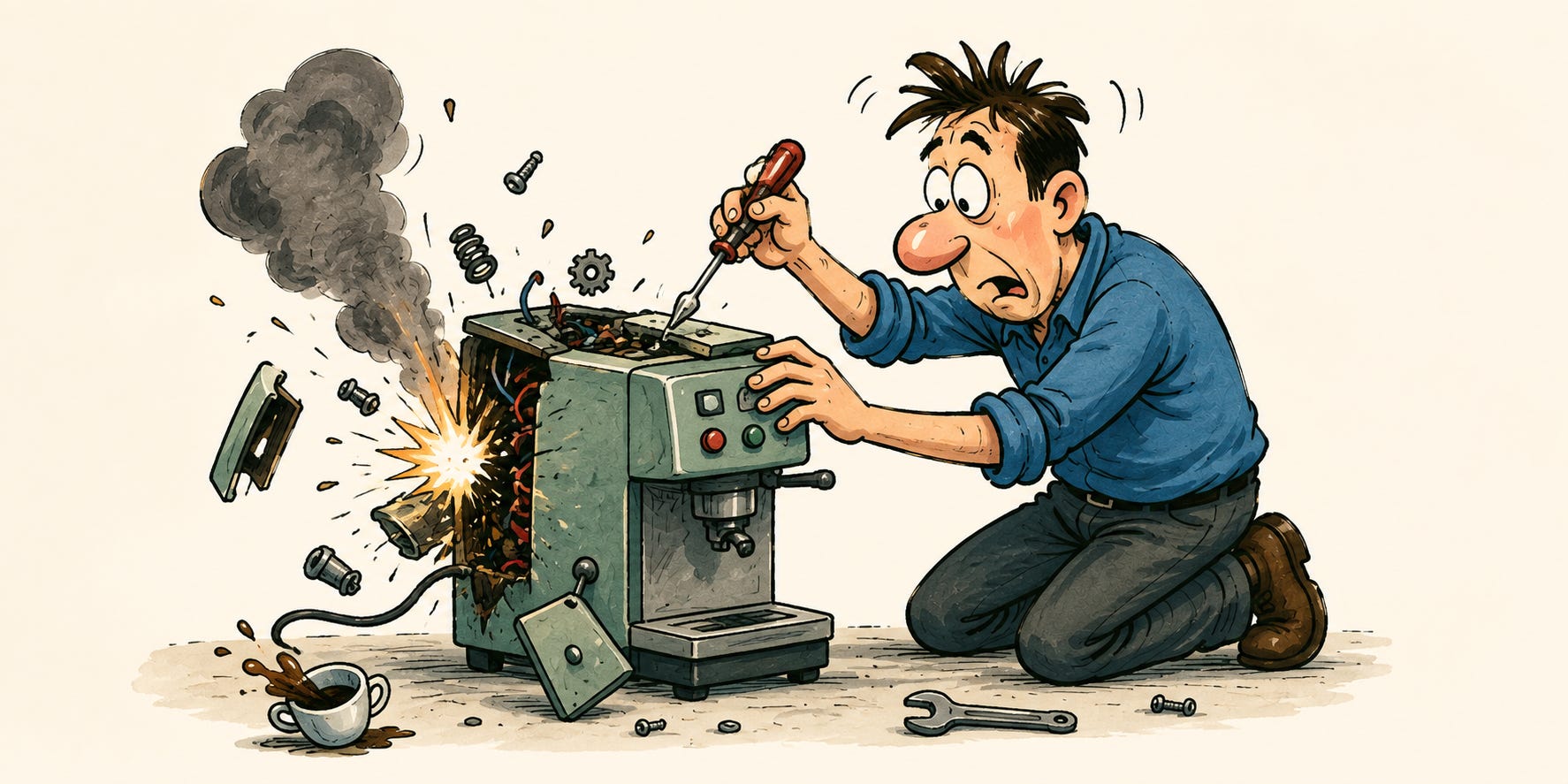
This wonderfully German sounding word combines verschlimmern (”to make something worse”) and verbessern (”to improve”). So verschlimmbessern means trying to improve something and accidentally making it worse instead.
What’s the last thing you verschlimmbessert yourself? I feel that with AI now helping us “optimize” everything, there are more opportunities than ever. 😅

Part 1 - Read 👀
Read the Dialogue (out loud if you can)
Ben: Du, ich muss dir was erzählen. Verurteile mich aber bitte nicht.
Tobi: Okay, versprochen.
Ben: Ich hab letzte Woche den kompletten Produktivserver unserer Firma neu gebaut. Natürlich habe ich versucht, das mit KI-generiertem Code zu machen.
Tobi: Oh, okay. Warum soll das jetzt schlecht sein?
Ben: Ist es an sich nicht. Es hat zuerst funktioniert… dann ist leider alles abgestürzt. Die Datenbank war weg, das Frontend weg, die API weg. Einfach alles.
Tobi: Wie lange war die Seite down?
Ben: Sieben Stunden. Der Chef hat mich dann auch direkt angerufen…
Tobi: Der war bestimmt ⍟ nicht glücklich…
Ben: Nee ⍟. Ich hab versucht zu erklären, dass ich das System optimieren wollte…
Tobi: Und?
Ben: Er hat gesagt: „Tja ⍟, das hast du mal wieder verschlimmbessert."
Tobi: Wurdest du gefeuert?
Ben: Nee, aber fast. Ich hab drei Stunden gebraucht, um alles manuell wiederherzustellen.
Tobi: Also Ende gut, alles gut ⍟?
Ben: Genau. Kann man so sagen ⍟.
You just saw what conversational German looks like. The next parts are where passive understanding turns into real training reps: 2. listen → 3. understand → 4. write → 5. speak. That’s what makes conversational German start feeling more natural!

Part 2 - Listen 👂
Hear the Dialogue (switch to slow version if the original is too quick.)
Audio 🎧
Slow Audio ⏳

Part 3 - Understand 💡
Read the explanations & translation (Go through the explanations and translation. Take your time, this is where things click.)
A) Explanations 💬
⍟ bestimmt – A very common spoken adverb used to express confident assumption rather than certainty, somewhere between “probably” and “definitely,” widely usable whenever a speaker is fairly sure about something without having direct proof. (English: “I’m sure” or “definitely” or “he must have been”, literal: “certainly”)
⍟ Nee – The casual spoken reduction of “nein,” softer and more natural in everyday informal conversation than the full form, used across all ages and regions in Germany to give a relaxed, unstressed no. (English: “nope” or “nah”, literal: short form of “nein”)
⍟ Tja – A uniquely expressive spoken filler used to signal resigned acceptance, mild irony, or an unsurprised reaction to something that has gone wrong, often delivered with a slight pause before what follows, one of those short words that says more than its length suggests. (English: “well” or “yeah, well” or “what can you do”, literal: no direct equivalent)
⍟ Ende gut, alles gut – A well-known spoken phrase used to wrap up a story that had a difficult middle but a satisfactory conclusion, widely used to close anecdotes about things that went wrong but were eventually resolved. (English: “all’s well that ends well”, literal: “end good, everything good”)
⍟ kann man so sagen – A relaxed spoken phrase used to give a qualified yes to something, acknowledging that a summary or label is roughly accurate without fully committing to it, common whenever someone agrees with a characterisation but wants to leave a little room for nuance. (English: “you could say that” or “that’s one way to put it”, literal: “one can say it that way”)
B) Translation 🔄
Ben: Hey, I need to tell you something. But please don't judge me.
Tobi: Okay, I promise.
Ben: Last week I rebuilt our company's entire production server from scratch. And naturally I tried to do it using AI-generated code.
Tobi: Oh, okay. Why would that be a problem?
Ben: In itself it isn't. It worked at first… and then unfortunately everything crashed. The database gone, the frontend gone, the API gone. Just everything.
Tobi: How long was the site down?
Ben: Seven hours. And then my boss called me directly…
Tobi: He must not have been happy…
Ben: Nah. I tried to explain that I was trying to optimise the system…
Tobi: And?
Ben: He said: "Well, you've gone and made it worse by trying to fix it again."
Tobi: Did you get fired?
Ben: No, but it was close. It took me three hours to restore everything manually.
Tobi: So all's well that ends well?
Ben: Exactly. You could say that.

Part 4 - Write ✍️
Writing Practice (this step is easy to skip, but it’s where real progress happens)
Answer ONE of these:
Wann hast du zuletzt etwas „verschlimmbessert“?
Warum versuchen Menschen manchmal, Dinge zu verbessern, die eigentlich gut funktionieren?
Wann sollte man lieber nichts verändern?
👉 Reply to this email or comment below.
Part 5 - Speak 🗣️
Spoken Conversation Practice (This is the part that gets you speaking more naturally, faster.)
Have a short 3–5 minute conversation with your favorite AI (ChatGPT, Claude, Gemini, etc.).
Follow today’s topic
Or choose your own
Ask the AI for corrections and feedback afterwards
AI isn't a substitute for real conversations with people, but it's a great way to practise when no conversation partner is available.
Was hast du zuletzt verschlimmbessert? 🛠️😅
Let me know in the comments. I’m sure we’ve all “improved” something that was perfectly fine before. 😂 Send this lesson to someone who recently tried to fix something and somehow made the situation much, much worse. 👀

LG
Marwan