

Hallo zusammen!
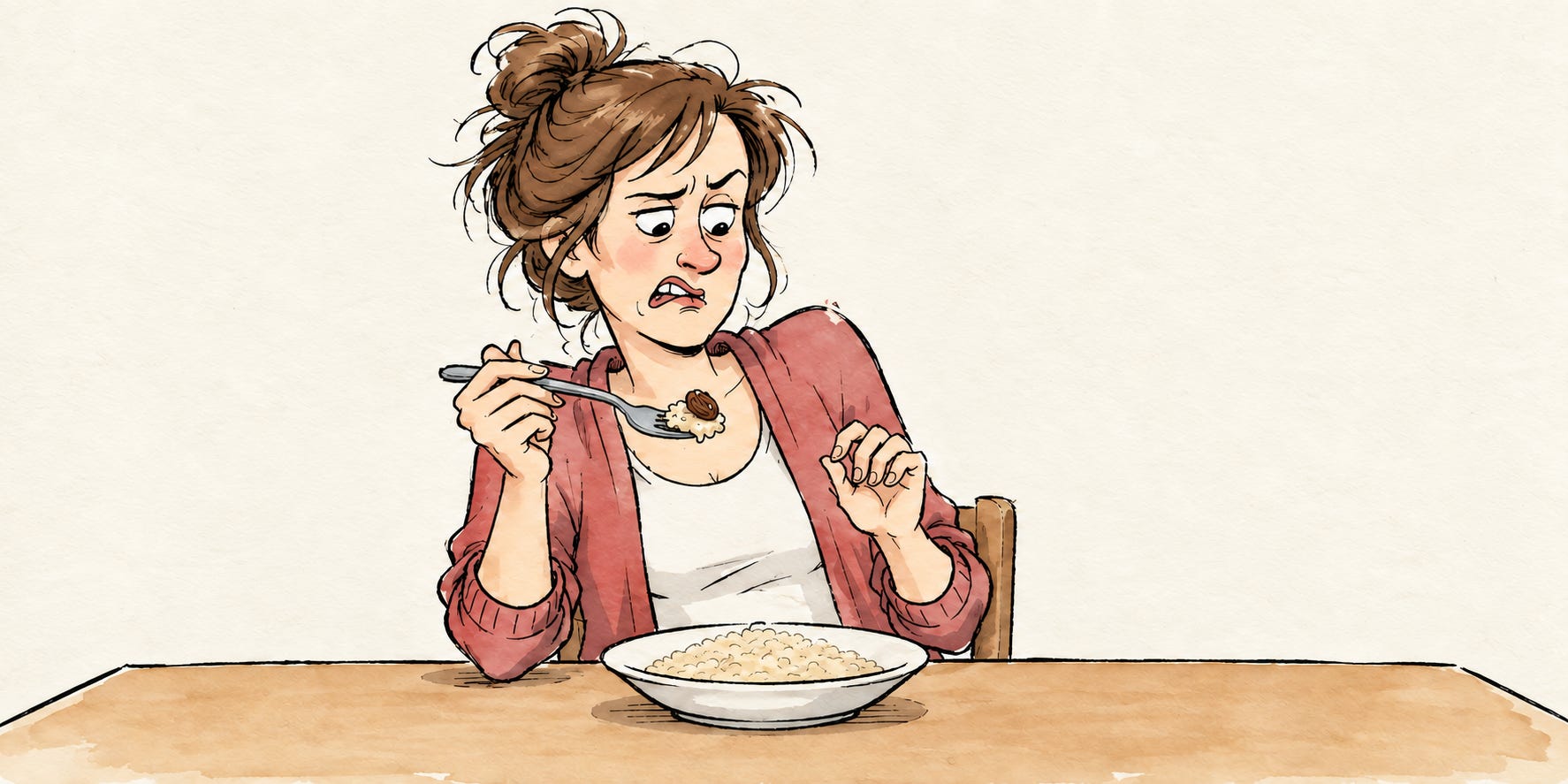
Igitt (or the more expressive Igittigitt!) is an interjection used when something disgusts you. It’s essentially a sound word. You’ll also hear „Bah!“ another short word meaning “Eww!” / “Yuck!”, especially as an immediate reaction to something disgusting: „Bah, Rosinen!“
Los geht’s - let’s learn some new words today!
New A1, A2, B1 & B2 group classes start on 2 November!
Want to join? Reply to this email or comment “GWM”, and I’ll send you all the details.
⏰ Early Bird prices end in 4 days (30 September)!

Part 1 - Read 👀
Read the Dialogue (out loud if you can)
Lena: Bah ⍟, ich kann Rosinen nicht sehen. Ich weiß, das klingt kindisch, aber immer, wenn ich in etwas reinbeiße und plötzlich auf eine Rosine stoße, ist der Tag für mich gelaufen ⍟.
Maike: Du, ich versteh das total. Diese kleinen, schrumpeligen ⍟ Dinger kann ich auch nicht sehen.
Lena: Aber sowas von! ⍟ Und du? Was findest du eklig, obwohl andere es ganz normal finden?
Maike: Schwämme. Genauer gesagt: Küchenschwämme. Ich kann die nicht anfassen, wenn sie feucht sind. Ich krieg Gänsehaut ⍟, wenn ich nur dran denke.
Lena: Aber du putzt doch die Küche.
Maike: Ja, aber nur mit Handschuhen.
Lena: Okay, das ist konsequent. Mein Freund findet meine Sache mit den Rosinen lächerlich.
Maike: Mein Mann auch. Der sagt, ich soll einfach drüber hinwegkommen. Als ob ich das einfach so entscheiden könnte.
Lena: Nee, so funktioniert das nicht.
Maike: Danke. Endlich sagt's mal jemand.
You just saw what conversational German looks like. The next parts are where passive understanding turns into real training reps: 2. listen → 3. understand → 4. write → 5. speak. That’s what makes conversational German start feeling more natural!

Part 2 - Listen 👂
Hear the Dialogue (switch to slow version if the original is too quick.)
Audio 🎧
Slow Audio ⏳

Part 3 - Understand 💡
Read the explanations & translation (Go through the explanations and translation. Take your time, this is where things click.)
A) Explanations 💬
⍟ Bah – A spontaneous spoken exclamation used to express disgust or revulsion at something unpleasant, often the first word out when something triggers a strong physical or emotional reaction of distaste, common across all ages in informal speech. (English: “ugh” or “yuck”, literal: an instinctive sound of disgust)
⍟ ist der Tag für mich gelaufen – A vivid spoken phrase used to say that a day or experience is already ruined beyond recovery, often delivered with comic exaggeration over something relatively minor, widely usable whenever a small but deeply unpleasant thing tips the scales. (English: “the day is done for me” or “that’s the day ruined”, literal: “the day has run for me”)
⍟ schrumpelig – A descriptive spoken adjective used to describe something small, wrinkled, and shrivelled in an unappealing way, applied in everyday speech to anything that has dried out or shrunk unpleasantly, and especially effective when the speaker wants to convey mild disgust through the sound of the word itself. (English: “wrinkly” or “shrivelled”, literal: “shrunken-wrinkly”)
⍟ aber sowas von! – A spoken intensifier used to emphatically confirm or amplify something just said, going beyond simple agreement to signal that the feeling is even stronger than the other person expressed, widely usable in any context where you want to say “absolutely” or “you have no idea how much.” (English: “absolutely” or “tell me about it” or “you have no idea”, literal: “but something of the sort!”)
⍟ Gänsehaut – A very common spoken noun used to describe the physical reaction of goosebumps triggered by something cold, creepy, or deeply unpleasant, used both literally for the physical sensation and figuratively to convey a strong feeling of discomfort or revulsion. (English: “goosebumps” or “the creeps”, literal: “goose skin”)
B) Translation 🔄
Lena: Ugh, I can't stand raisins. I know that sounds childish, but every time I bite into something and suddenly hit a raisin, the day is done for me.
Maike: I completely get that. I can't stand those little shrivelled things either.
Lena: Absolutely! And you? What do you find disgusting that other people think is totally normal?
Maike: Sponges. Kitchen sponges, to be precise. I can't touch them when they're wet. I get the creeps just thinking about it.
Lena: But you do clean the kitchen.
Maike: Yes, but only with gloves.
Lena: Okay, fair enough – at least you're consistent. My boyfriend thinks my raisin thing is ridiculous.
Maike: Mine too. He says I should just get over it. As if I could just decide to.
Lena: No, that's not how it works.
Maike: Thank you. Finally someone says it.

Part 4 - Write ✍️
Writing Practice (this step is easy to skip, but it’s where real progress happens)
Answer ONE of these:
Was findest du richtig eklig, obwohl andere es völlig normal finden?
Warum ekeln sich Menschen vor so unterschiedlichen Dingen?
Kann man lernen, etwas nicht mehr eklig zu finden?
👉 Reply to this email or comment below.
Part 5 - Speak 🗣️
Spoken Conversation Practice (This is the part that gets you speaking more naturally, faster.)
Have a short 3–5 minute conversation with your favorite AI (ChatGPT, Claude, Gemini, etc.).
Follow today’s topic
Or choose your own
Ask the AI for corrections and feedback afterwards
AI isn't a substitute for real conversations with people, but it's a great way to practise when no conversation partner is available.
Was findest du richtig eklig, obwohl andere es völlig normal finden? 🤢
Tell me in the comments, and if you enjoyed today’s training, leave a like!
⏰ My new A1, A2, B1 and B2 group classes start on 2 November! Comment “GWM” or reply to this email, and I’ll send you all the details. Early Bird prices end in 4 days (30 September)!

LG
Marwan