
Hallo zusammen!
Today’s topic is Rabenmutter, a rather harsh German word for a mother who is seen as neglecting her children or not caring for them “properly.”
Literally, Rabenmutter means “raven mother.” The expression comes from an old belief that ravens were bad parents who abandoned or neglected their young. That image made its way into German and has been used for centuries. The irony? Ravens are actually attentive parents, so the expression is based more on myth than reality.
Today, Rabenmutter is often used critically or ironically, especially when mothers feel judged for working, taking time for themselves, or not being “perfect.”

Part 1 - Read 👀
Read the Dialogue (out loud if you can)
Sandra: Ich muss dir was gestehen. Ich glaub, ich bin eine Rabenmutter.
Tanja: Was? Warum denn das?
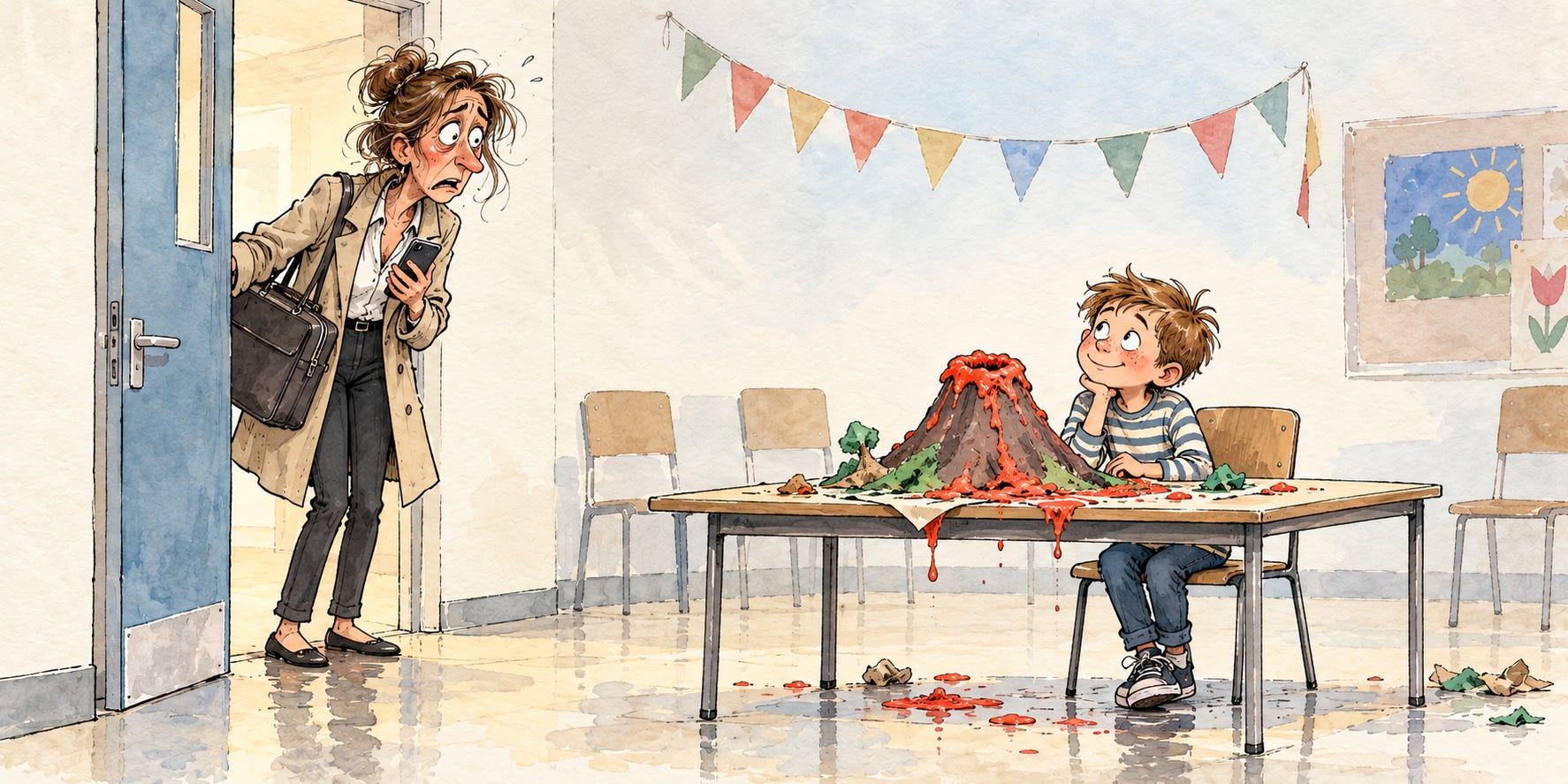
Sandra: Leon hatte gestern sein Schulfest. Und ich hab's total verpeilt ⍟. Er stand da mit seinem selbst gebastelten Vulkan, ganz allein, während alle anderen Eltern Fotos gemacht haben.
Tanja: Oh nein. Das tut mir leid ⍟.
Sandra: Er hat mich danach angerufen und ganz lieb gesagt: „Mama, macht nichts ⍟. Der Vulkan ist auch ohne dich explodiert."
Tanja: Das ist eigentlich ganz süß.
Sandra: Das ist eine emotionale Reife, die ein Kind nicht haben sollte!
Tanja: Ach komm. Du arbeitest Vollzeit, du machst alles allein. Ein vergessenes Schulfest macht dich nicht zur Rabenmutter.
Sandra: Letzte Woche hab ich ihm Tiefkühlpizza als „selbst gekocht" verkauft ⍟.
Tanja: Das machen alle.
Sandra: Und neulich hab ich ihn kurz im Auto gelassen, weil ich noch zehn Minuten Ruhe wollte.
Tanja: Sandra. Das solltest du wirklich nicht machen.
Sandra: Er hat den Vulkan übrigens mit nach Hause gebracht. Mit einem Zettel drauf.
Tanja: Was stand drauf?
Sandra: „Für Mama. Nächstes Mal kommst du."
Tanja: Der wickelt dich um den Finger ⍟.
Sandra: Total.
You just saw what conversational German looks like. The next parts are where passive understanding turns into real training reps: 2. listen → 3. understand → 4. write → 5. speak. That’s what makes conversational German start feeling more natural!

Part 2 - Listen 👂
Hear the Dialogue (switch to slow version if the original is too quick.)
Audio 🎧
Slow Audio ⏳

Part 3 - Understand 💡
Read the explanations & translation (Go through the explanations and translation. Take your time, this is where things click.)
A) Explanations 💬
⍟ total verpeilt – A casual spoken phrase used to describe having completely forgotten or missed something through carelessness or distraction, common in informal conversation when someone admits to a lapse that was entirely their own fault. (English: “totally forgot about it” or “completely spaced on it”, literal: “totally missed it”)
⍟ das tut mir leid – The standard spoken phrase for expressing genuine sympathy or regret, used both as an apology and as a warm reaction to someone else’s misfortune, one of the most essential and versatile expressions in everyday German. (English: “I’m sorry” or “that’s awful”, literal: “that does me sorrow”)
⍟ macht nichts – A warm, reassuring spoken phrase used to wave away a mistake or apology, telling someone that no harm has been done and there is nothing to worry about, widely used in everyday situations where you want to put someone at ease. (English: “it doesn’t matter” or “no worries” or “that’s okay”, literal: “makes nothing”)
⍟ verkauft – Used here in the colloquial spoken sense of passing something off as something it is not, the verb “verkaufen” functioning informally to mean presenting a lesser thing as something better, widely usable whenever someone has pulled off a small, harmless deception. (English: “passed off” or “sold him on the idea that”, literal: “sold”)
⍟ der wickelt dich um den Finger – A very common spoken idiom used to describe someone who has you completely wrapped around their little finger, implying they know exactly how to get what they want from you through charm rather than force. (English: “he’s got you wrapped around his little finger”, literal: “he winds you around his finger”)
B) Translation 🔄
Sandra: I have to confess something. I think I'm a terrible mother.
Tanja: What? Why would you say that?
Sandra: Leon had his school fair yesterday. And I completely forgot about it. He stood there with his homemade volcano, all on his own, while all the other parents were taking photos.
Tanja: Oh no. I'm so sorry.
Sandra: He called me afterwards and said very sweetly: "Mum, it's okay. The volcano exploded without you too."
Tanja: That's actually really sweet.
Sandra: That's an emotional maturity no child should have to have!
Tanja: Oh come on. You work full time, you do everything on your own. One forgotten school fair doesn't make you a terrible mother.
Sandra: Last week I passed off a frozen pizza as something I cooked myself.
Tanja: Everyone does that.
Sandra: And the other day I left him in the car for a bit because I needed ten minutes of peace.
Tanja: Sandra. You really shouldn't do that.
Sandra: He brought the volcano home by the way. With a note on it.
Tanja: What did it say?
Sandra: "For Mum. Next time you're coming."
Tanja: He's got you completely wrapped around his little finger.
Sandra: Totally.

Part 4 - Write ✍️
Writing Practice (this step is easy to skip, but it’s where real progress happens)
Answer ONE of these:
Warum werden Mütter oft strenger beurteilt als Väter?
Was macht für dich eine gute Mutter aus?
Wie haben sich die Erwartungen an Mütter im Laufe der Zeit verändert?
👉 Reply to this email or comment below.
Part 5 - Speak 🗣️
Spoken Conversation Practice (This is the part that gets you speaking more naturally, faster.)
Have a short 3–5 minute conversation with your favorite AI (ChatGPT, Claude, Gemini, etc.).
Follow today’s topic
Or choose your own
Ask the AI for corrections and feedback afterwards
AI isn't a substitute for real conversations with people, but it's a great way to practise when no conversation partner is available.
Findest du den Begriff „Rabenmutter“ noch zeitgemäß? 🐦⬛
Send this dialogue to someone whose parenting advice always starts with “Also, ich würde ja…” 😅

LG
Marwan