

Hallo zusammen!
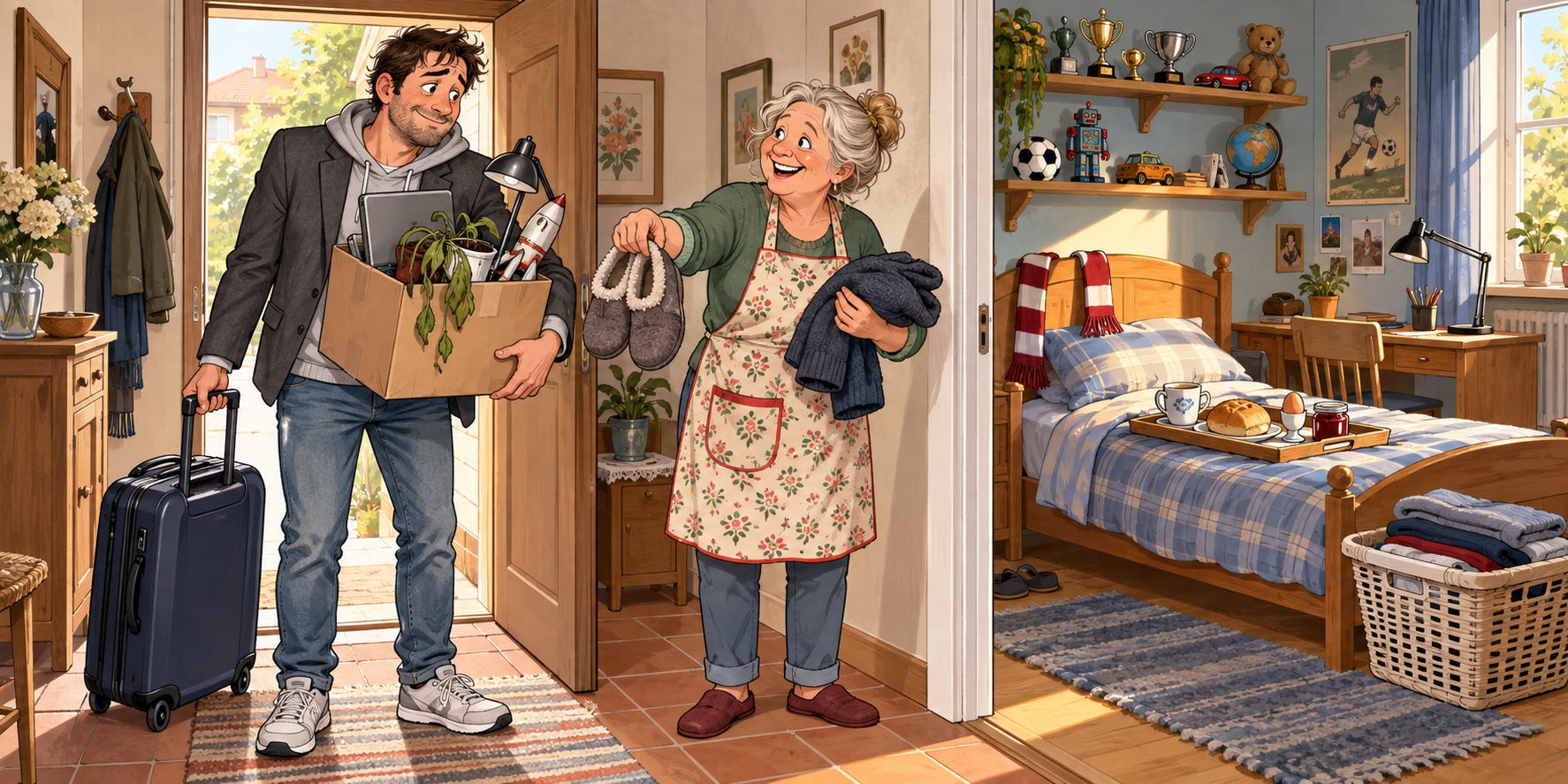
Hotel Mama is a humorous German expression for living with your parents as an adult. Let’s see what other new words you can find today!
Viel Spaß!
New A1, A2, B1 & B2 group classes start on 2 November. If you want to join, reply to this email or comment “GWM” and I’ll send you the details.

Part 1 - Read 👀
Read the Dialogue (out loud if you can)
Jan: Ich schmeiß das Handtuch ⍟. Das mit dem Start-up hat nicht funktioniert. Ich zieh nächste Woche aus meiner Wohnung aus.
Felix: Wohin denn?
Jan: Zurück zu meiner Mutter.
Felix: Ah, Hotel Mama also.
Jan: Ja, Hotel Mama. Ich bin zwar pleite ⍟, krieg aber trotzdem noch schön ein Zimmer mit Frühstück. Und meine Mutter wird mich bestimmt auch wieder ⍟ die ganze Zeit fragen, ob ich warm genug angezogen bin.
Felix: Was ist denn mit der Start-up-Idee passiert? Mit der App?
Jan: Die App war revolutionär. Sie hätte die Welt verändert. Leider wollte die Welt das nicht.
Felix: Wie viele Downloads?
Jan: Vierundzwanzig.
Felix: Vierundzwanzigtausend?
Jan: Nee, nur vierundzwanzig. Das war wohl nichts ⍟.
Felix: Und was sagt deine Mutter zu dem Ganzen ⍟?
Jan: Sie hat mein altes Zimmer schon vorbereitet. Sie freut sich.
Felix: Das klingt eigentlich gar nicht so schlecht.
You just saw what conversational German looks like. The next parts are where passive understanding turns into real training reps: 2. listen → 3. understand → 4. write → 5. speak. That’s what makes conversational German start feeling more natural!

Part 2 - Listen 👂
Hear the Dialogue (switch to slow version if the original is too quick.)
Audio 🎧
Slow Audio ⏳

Part 3 - Understand 💡
Read the explanations & translation (Go through the explanations and translation. Take your time, this is where things click.)
A) Explanations 💬
⍟ ich schmeiß das Handtuch – A very common spoken idiom used to announce that you are giving up on something after a sustained effort, the image of throwing in the towel borrowed from boxing and widely usable in everyday German whenever someone admits defeat. (English: “I’m throwing in the towel” or “I’m calling it quits”, literal: “I’m throwing the towel”)
⍟ pleite – A direct, informal spoken adjective used to describe being completely broke or bankrupt, common in everyday conversation when someone wants to state financial ruin plainly and without euphemism. (English: “broke” or “skint” or “flat broke”, literal: “bust”)
⍟ bestimmt auch wieder – A spoken construction used to predict that something annoying or familiar is going to happen yet again, with “bestimmt” expressing confident expectation and “auch wieder” adding the weary sense that this is an old pattern repeating itself. (English: “will definitely start doing it again” or “is bound to do it again”, literal: “certainly also again”)
⍟ das war wohl nichts – A resigned spoken phrase used to accept that something has failed or come to nothing, with “wohl” softening the admission slightly and giving it a tone of rueful self-awareness rather than self-pity. (English: “well, that didn’t work out” or “guess that was a bust”, literal: “that was probably nothing”)
⍟ zu dem Ganzen – A natural spoken phrase used to refer to a whole situation or set of events without having to name each part again, common whenever someone wants to ask for or give a reaction to everything that has just been described. (English: “about all of it” or “about the whole thing”, literal: “about the whole thing”)
B) Translation 🔄
Jan: I'm throwing in the towel. The start-up didn't work out. I'm moving out of my flat next week.
Felix: Where to?
Jan: Back to my mum's.
Felix: Ah, Hotel Mum then.
Jan: Yeah, Hotel Mum. I'm broke, but I still get a nice room with breakfast. And my mum is bound to start asking me again the whole time whether I've dressed warmly enough.
Felix: So what happened with the start-up idea? The app?
Jan: The app was revolutionary. It would have changed the world. Unfortunately the world wasn't interested.
Felix: How many downloads?
Jan: Twenty-four.
Felix: Twenty-four thousand?
Jan: Nah, just twenty-four. Guess that was a bust.
Felix: And what does your mum say about all of it?
Jan: She's already got my old room ready. She's happy about it.
Felix: That actually doesn't sound so bad.

Part 4 - Write ✍️
Writing Practice (this step is easy to skip, but it’s where real progress happens)
Answer ONE of these:
Wie lange sollte man deiner Meinung nach bei den Eltern wohnen?
Welche Vor- und Nachteile hat das „Hotel Mama“?
Warum ziehen manche Erwachsene wieder bei ihren Eltern ein?
👉 Reply to this email or comment below.
Part 5 - Speak 🗣️
Spoken Conversation Practice (This is the part that gets you speaking more naturally, faster.)
Have a short 3–5 minute conversation with your favorite AI (ChatGPT, Claude, Gemini, etc.).
Follow today’s topic
Or choose your own
Ask the AI for corrections and feedback afterwards
AI isn't a substitute for real conversations with people, but it's a great way to practise when no conversation partner is available.
Würdest du als Erwachsener wieder ins Hotel Mama einziehen? 🏨
And send this dialogue to someone who still enjoys free accommodation, breakfast and laundry service at Hotel Mama. 😅
If you’d like to join my A1, A2, B1 or B2 group classes starting 2 November, comment “GWM” or reply to this email and I’ll send you the details.

LG
Marwan