

Hallo zusammen!
When was the last time you were really unlucky?
German speakers call that Pech haben. Today, it simply means to have bad luck, but the word has an interesting origin. Pech originally meant pitch or tar, the sticky black substance used for waterproofing wood and ships for example. If you got Pech on your hands or clothes, it was incredibly difficult to get rid of. Over time, Pech haben became a metaphor for being stuck in an unfortunate situation or having a streak of bad luck.
In this dialogue, you’ll learn how German speakers talk about bad luck, frustrating days, and those moments when nothing seems to go your way...

Part 1 - Read 👀
Read the Dialogue (out loud if you can)
Max: Ich sag dir, gestern war ich kurz davor, einfach wieder ins Bett zu gehen und den Tag zu streichen ⍟.
Lena: Was ist passiert?
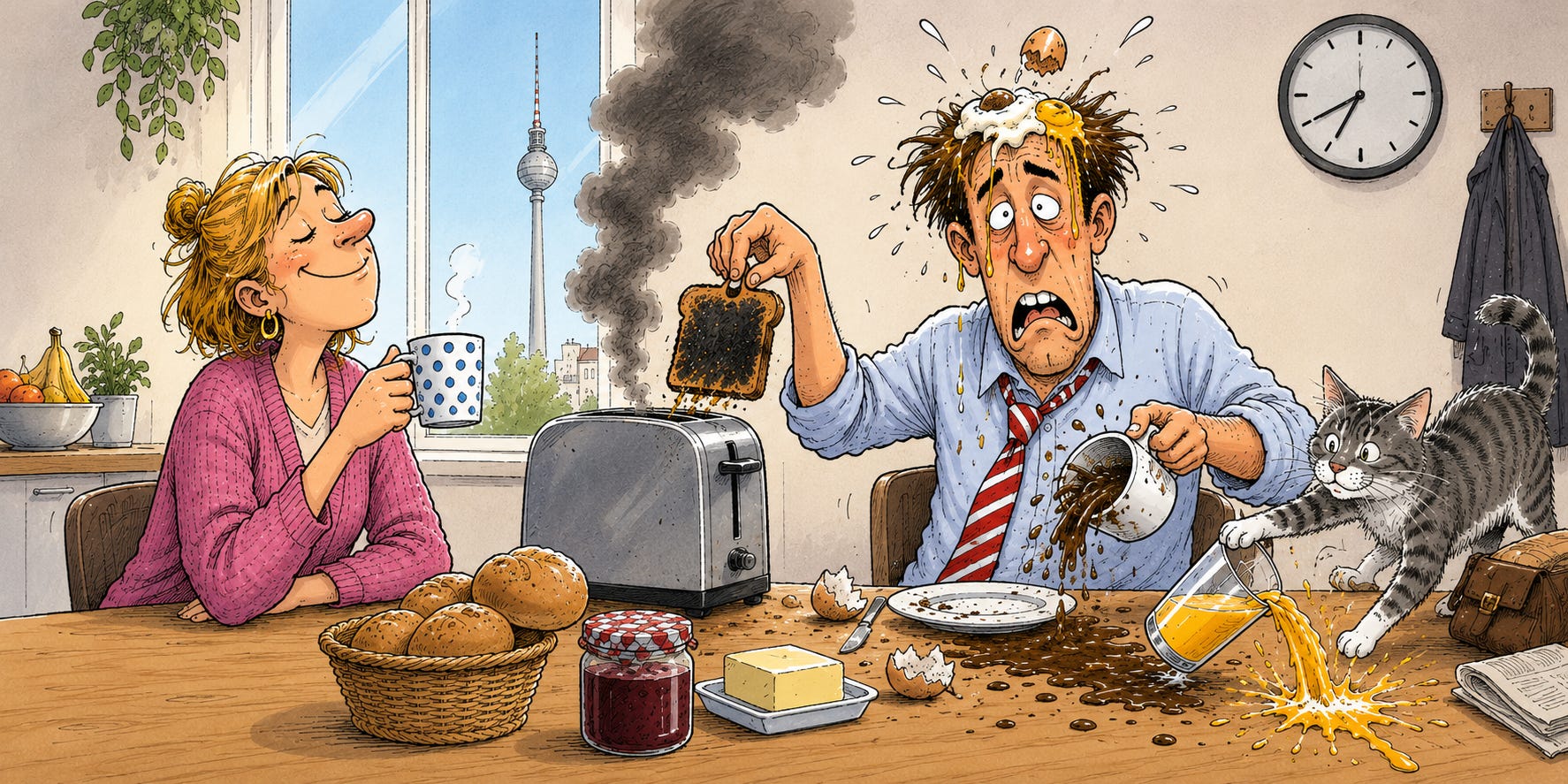
Max: Wo soll ich anfangen ⍟. Morgens hab ich verschlafen, weil mein Handy nachts lautlos war – keine Ahnung wie und warum. Ich bin aufgestanden, hab Kaffee gemacht, und direkt die Kanne umgestoßen. Die komplette Tasse auf das neue Hemd.
Lena: Nein.
Max: Doch. Dann schnell umgezogen, raus zur Bahn – eine Minute zu spät. Ich hab sie noch gesehen, wie sie weggefahren ist. So eine Situation, wo die Türen zu gehen und du weißt, die warten nicht.
Lena: Das ist das Schlimmste.
Max: Genau. Nächste Bahn war zwanzig Minuten später. Ich steh im Regen, ohne Schirm, weil ich den natürlich auch nicht mal ⍟ eingepackt hab. Endlich im Büro, fragt der Kollege, ob ich das Meeting vergessen hab. Welches Meeting?
Lena: Oh Gott ⍟.
Max: Um neun, mit dem Kunden. Stand natürlich im Kalender. Ich hab's einfach nicht gesehen. Der Kunde war nicht mal unfreundlich, was irgendwie noch unangenehmer war.
Lena: Weil man sich dann nicht mal richtig beschweren kann.
Max: Genau. Mittagspause, Portemonnaie vergessen. Kollege hat mir was geliehen, und dann hab ich auf dem Weg zurück noch eine Vogelbekanntschaft gemacht.
Lena: Ein Vogel hat dich…
Max: Mitten auf ⍟ die Schulter. Frisch geputzte Jacke.
Lena: Das soll eigentlich Glück bringen.
Max: Ja, das hab ich auch gedacht. Und dann hab ich den Bus nach Hause verpasst...
You just saw what conversational German looks like. The next parts are where passive understanding turns into real training reps: 2. listen → 3. understand → 4. write → 5. speak. That’s what makes conversational German start feeling more natural!

Part 2 - Listen 👂
Hear the Dialogue (switch to slow version if the original is too quick.)
Audio 🎧
Slow Audio ⏳

Part 3 - Understand 💡
Read the explanations & translation (Go through the explanations and translation. Take your time, this is where things click.)
A) Explanations 💬
⍟ zu streichen – A casual spoken expression used to describe writing something off entirely as a loss, here applied to a whole day, widely usable in any context where someone decides to cancel, abandon, or simply give up on something that has gone irretrievably wrong. (English: “to write off” or “to cancel”, literal: “to cross out”)
⍟ Wo soll ich anfangen – A very common spoken phrase used at the start of a story to signal that there is so much to tell that the speaker barely knows where to begin, often delivering the first hint that whatever follows will be a long list of disasters or complications. (English: “where do I even start” or “where do I begin”, literal: “where should I start”)
⍟ nicht mal – A compact and very frequent spoken intensifier used to emphasise that something did not even reach the minimum expected level, adding a layer of exasperation or disbelief to the statement it modifies, common across all kinds of everyday contexts. (English: “not even”)
⍟ Oh Gott – A universal spoken exclamation used to react to bad news, an awkward revelation, or anything mildly to moderately alarming, neither particularly religious nor dramatic in everyday use, just the natural spoken response when something lands badly. (English: “oh God” or “oh no”)
⍟ mitten auf – A spoken phrase used to pinpoint exactly where something hit, landed, or happened, with “mitten” emphasising the dead centre of the target and making the impact feel even more precise and therefore more comic or unfortunate. (English: “right on” or “smack in the middle of”, literal: “in the middle onto”)
B) Translation 🔄
Max: I'm telling you, yesterday I was this close to just going back to bed and writing the whole day off.
Lena: What happened?
Max: Where do I even start. In the morning I overslept because my phone had been on silent all night – no idea how or why. Got up, made coffee, and immediately knocked the pot over. The entire cup all over my new shirt.
Lena: No.
Max: Yes. Quickly got changed, rushed to the train – one minute too late. I could still see it pulling away. One of those situations where the doors are closing and you just know they're not waiting.
Lena: That's the worst.
Max: Exactly. Next train was twenty minutes later. I'm standing in the rain, no umbrella, because I hadn't even packed one. Finally get to the office and a colleague asks if I forgot about the meeting. What meeting?
Lena: Oh God.
Max: Nine o'clock, with the client. In the calendar, obviously. I just hadn't seen it. The client wasn't even unfriendly, which was somehow even more uncomfortable.
Lena: Because then you can't even properly complain about it.
Max: Exactly. Lunchbreak, forgot my wallet. A colleague lent me something, and then on the way back I had a close encounter with a bird.
Lena: A bird got you…
Max: Right on the shoulder. Freshly cleaned jacket.
Lena: That's supposed to bring good luck, actually.
Max: Yeah, I thought that too. And then I missed the bus home...

Part 4 - Write ✍️
Writing Practice (this step is easy to skip, but it’s where real progress happens)
Answer ONE of these:
Wann hattest du zuletzt richtig Pech? Was ist passiert?
Glaubst du an Glück und Pech? Warum (nicht)?
Wie gehst du mit Rückschlägen oder Pech im Leben um?
👉 Reply to this email or comment below.
Part 5 - Speak 🗣️
Spoken Conversation Practice (This is the part that gets you speaking more naturally, faster.)
Have a short 3–5 minute conversation with your favorite AI (ChatGPT, Claude, Gemini, etc.).
Follow today’s topic
Or choose your own
Ask the AI for corrections and feedback afterwards
AI isn't a substitute for real conversations with people, but it's a great way to practise when no conversation partner is available.
Wann hattest du zuletzt richtig Pech? 🍀❌
If this dialogue made you smile, leave a ♥ and share it with someone who seems to have Dauerpech lately.

LG
Marwan