
Hallo zusammen!
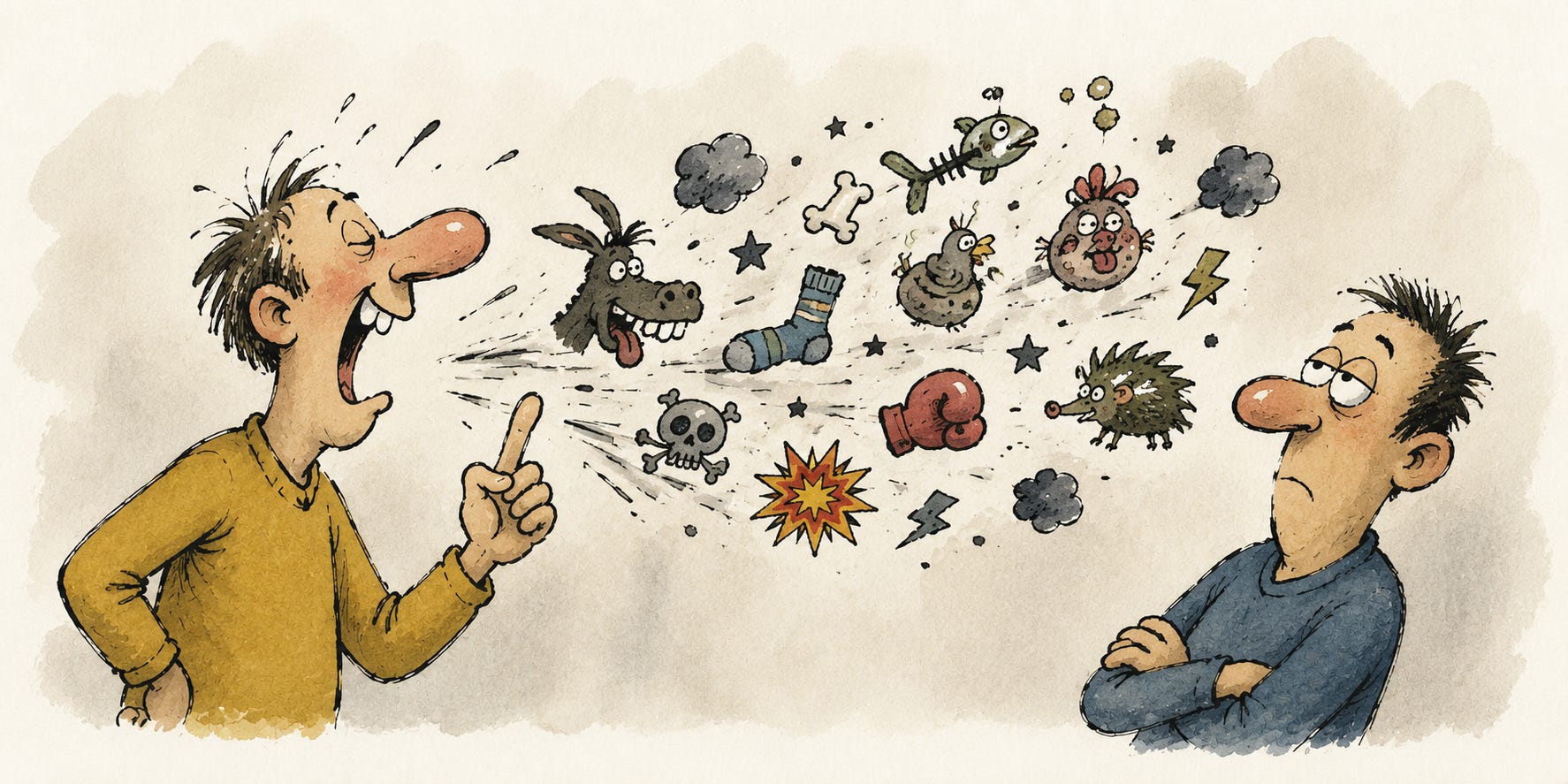
We all know it: one of the first things people usually learn in a new language is... the insults.
German has plenty of creative ones, and many of them are quite harmless when you look at their literal meaning.
In this dialogue, you’ll discover where some of the most common insults come from, what they literally mean, and how German speakers actually use them in everyday conversations, along with useful words, phrases, and a bit of linguistic history.

Part 1 - Read 👀
Read the Dialogue (out loud if you can)
Tobi: Boah, heute hab ich mich richtig aufgeregt und jemanden einen Warmduscher ⍟ genannt. Mir tat's dann aber auch direkt leid.
Sara: War er keiner?
Tobi: Doch, total. Aber ich hab danach kurz drüber nachgedacht – Warmduscher. Was ist das eigentlich? Jemand, der warm duscht. Das ist… das ist doch normal.
Sara: Ja, aber als Beleidigung trifft's irgendwie trotzdem. Genau wie Weichei ⍟.
Tobi: Ja… Weichei – also, ein weiches Ei. Als ob ein hartes Ei irgendwie besser wäre.
Sara: Mein Favorit ist immer noch Flasche. Du bist eine Flasche. Warum? Was hat die Flasche getan?
Tobi: Oder Pappnase. Ich mein – eine Pappnase ist doch eigentlich Karnevalszubehör. Lustig, harmlos. Und trotzdem klingt „du Pappnase" richtig beleidigend.
Sara: Vollpfosten ⍟ schlägt das alles, find ich. Ein Pfosten. Ein Pfosten, der bis oben voll ist – womit auch immer. Das ist so bildlich, das funktioniert einfach.
Tobi: Und Hohlkopf. Also ein Kopf, der hohl ist. Das ist eigentlich eine anatomische Diagnose.
Sara: Äh, Trottel ⍟. Woher kommt Trottel überhaupt? Das klingt wie jemand, der so ein bisschen trottelt.
Tobi: Ich glaub, das kommt tatsächlich von trotten – also langsam, schwerfällig gehen. Was wiederum perfekt passt.
Sara: Und Depp ⍟.
Tobi: Ja, Depp hat so eine gewisse... Eleganz. Du brauchst kein zweites Wort. Depp. Fertig.
Sara: Meine Oma hat immer Schafskopf gesagt. Ich hab als Kind echt nachgedacht, ob Schafe besonders dumm sind.
Tobi: Sind sie angeblich nicht, übrigens.
You just saw what conversational German looks like. The next parts are where passive understanding turns into real training reps: 2. listen → 3. understand → 4. write → 5. speak. That’s what makes conversational German start feeling more natural!

Part 2 - Listen 👂
Hear the Dialogue (switch to slow version if the original is too quick.)
Audio 🎧
Slow Audio ⏳

Part 3 - Understand 💡
Read the explanations & translation (Go through the explanations and translation. Take your time, this is where things click.)
A) Explanations 💬
⍟ Warmduscher – A mildly comic spoken insult used to call someone soft or lacking toughness, based on the implication that only a weak person needs warm water to shower, commonly used in informal contexts when someone is being overly cautious or precious. (English: “wimp” or “softie”, literal: “warm showerer”)
⍟ Weichei – A very common informal insult used to describe someone who lacks courage, grit, or the willingness to deal with discomfort, widely used in everyday speech across all ages and situations where someone is seen as too timid. (English: “wimp” or “pushover”, literal: “soft egg”)
⍟ Vollpfosten – A vivid and popular spoken insult used to call someone thoroughly stupid or incompetent, with the image of a post filled entirely to the top suggesting there is no room for anything useful inside, a go-to word in informal German when “Idiot” feels too plain. (English: “complete idiot” or “total numskull”, literal: “full post”)
⍟ Trottel – A mild, slightly affectionate spoken insult used to describe someone who is clumsy, slow-witted, or just behaving foolishly, softer in tone than “Idiot” and often used with a hint of exasperation rather than real anger. (English: “twit” or “doofus” or “numpty”, literal: related to “trotten” meaning to trudge or plod)
⍟ Depp – One of the most versatile and satisfying spoken insults in everyday German, used to call someone an idiot or fool in a way that feels complete and final on its own, common across all registers from mild annoyance to genuine frustration. (English: “idiot” or “fool” or “dimwit”)
B) Translation 🔄
Tobi: Boah, I got really wound up today and called someone a wimp. Then I immediately felt bad about it though.
Sara: Was he not one?
Tobi: He totally was. But afterwards I thought about it for a second – Warmduscher. What is that actually? Someone who showers with warm water. That's… that's normal.
Sara: Yeah, but it still lands as an insult somehow. Just like Weichei.
Tobi: Yeah… Weichei – a soft egg. As if a hard egg were somehow better.
Sara: My personal favourite is still Flasche. You're a bottle. Why? What did the bottle ever do?
Tobi: Or Pappnase. I mean – a cardboard nose is basically carnival gear. Fun, harmless. And yet "du Pappnase" sounds genuinely offensive.
Sara: Vollpfosten beats all of them, I think. A post. A post that's completely full – of whatever. It's so vivid, it just works.
Tobi: And Hohlkopf. A head that's hollow. That's basically an anatomical diagnosis.
Sara: Oh, Trottel. Where does Trottel even come from? It sounds like someone who kind of trottels along.
Tobi: I think it actually comes from trotten – walking slowly, heavily. Which in turn fits perfectly.
Sara: And Depp.
Tobi: Yeah, Depp has a certain… elegance. You don't need a second word. Depp. Done.
Sara: My grandma always used to say Schafskopf. As a kid I genuinely wondered whether sheep were particularly stupid.
Tobi: Apparently not, by the way.

Part 4 - Write ✍️
Writing Practice (this step is easy to skip, but it’s where real progress happens)
Answer ONE of these:
Warum benutzen Menschen Schimpfwörter?
In welchen Situationen sind Schimpfwörter akzeptabel oder nicht?
Gibt es Schimpfwörter in deiner Sprache, die besonders interessant oder lustig sind?
👉 Reply to this email or comment below.
Part 5 - Speak 🗣️
Spoken Conversation Practice (This is the part that gets you speaking more naturally, faster.)
Have a short 3–5 minute conversation with your favorite AI (ChatGPT, Claude, Gemini, etc.).
Follow today’s topic
Or choose your own
Ask the AI for corrections and feedback afterwards
AI isn't a substitute for real conversations with people, but it's a great way to practise when no conversation partner is available.
Welches deutsche Schimpfwort ist dein Favorit?
If this dialogue made you laugh, leave a ♥ and share it with someone who only knows "Scheiße" and thinks they're already fluent. 😄

LG
Marwan