
Hallo zusammen!
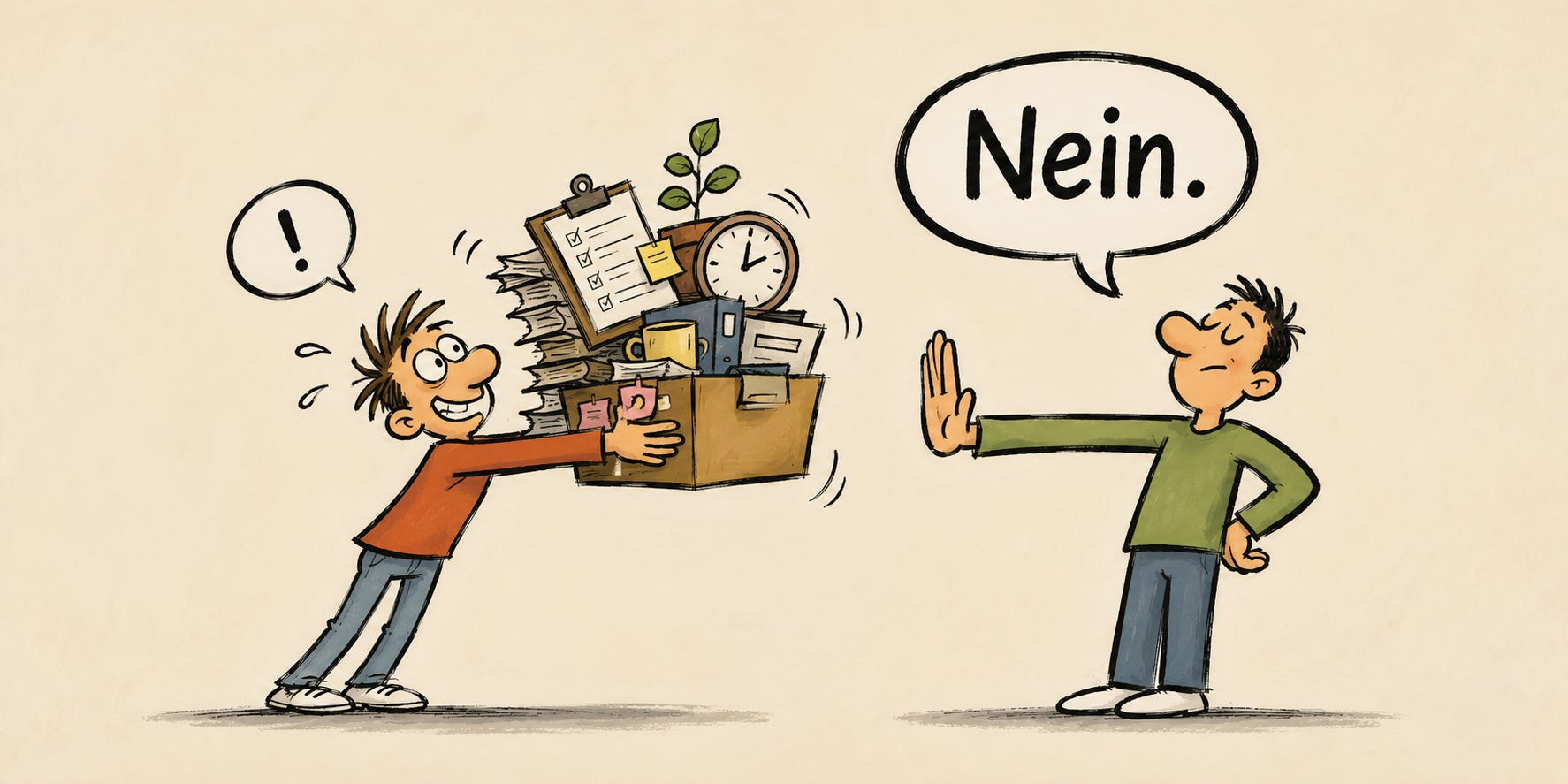
I’m sure you have said “yes” many times to something before, even though you actually wanted to say “no”. Maybe because you didn’t want to disappoint someone? Seem unhelpful? Or avoid an awkward moment?
In German, saying Nein isn’t usually seen as that rude. In fact, many people value a clear, honest answer over a hesitant “yes” that you don’t really mean.
In this dialogue, you’ll learn how German speakers talk about setting boundaries, feeling guilty, and saying no with confidence, along with useful words, phrases, and natural ways of expressing these situations in everyday conversation.

Part 1 - Read 👀
Read the Dialogue (out loud if you can)
Lara: Ich hab heute wieder Ja gesagt. Projektpräsentation nächste Woche, zusätzlich zu allem anderen, was ich schon hab. Ich hab nicht mal nachgedacht, ich hab einfach Ja gesagt.
Felix: Warum?
Lara: Keine Ahnung. Reflexartig ⍟. Mein Chef hat gefragt, ob ich's übernehmen kann, und ich hab gespürt, dass er Ja erwartet – und dann kam's einfach raus.
Felix: Und jetzt?
Lara: Jetzt bereue ich's ⍟. Ich hab diese Woche schon Überstunden, ich bin müde, und irgendwo tief drin wusste ich schon beim Ja-Sagen, dass es falsch war.
Felix: Das kenn ich so gut. Dieses kurze Zögern – und dann überrollt man's. Weil man nicht der Mensch sein will, der Nein sagt.
Lara: Genau. Als ob Nein gleichbedeutend wäre mit: ich bin nicht engagiert, ich bin schwierig, ich bin faul. Dabei ist es ja einfach nur ehrlich.
Felix: Ich hab das lange so gemacht. Alles angenommen, alles geschluckt, nie gemeckert – und dann irgendwann gemerkt, dass ich permanent überfordert war und gleichzeitig ein schlechtes Gewissen ⍟ hatte, wenn ich auch nur kurz daran gedacht hab, mal Nein zu sagen.
Lara: Woher kommt das überhaupt? Dieses Gefühl, dass man es allen recht machen muss.
Felix: Ich glaub, das wird einem früh beigebracht. Sei hilfsbereit, sei zuverlässig, sag nicht nein. Das klingt nach guten Werten – aber irgendwann kippt's ⍟ und wird zur Falle.
Lara: Und wie hast du's gelernt? Das Nein-Sagen.
Felix: Langsam. Ich hab angefangen, erst einmal gar nicht sofort zu antworten. Kurze Pause, durchatmen, nachdenken. Und dann – wenn's zu viel war – hab ich Nein gesagt. Ohne große Erklärung ⍟.
Lara: Ohne Erklärung? Das trau ich mich nicht.
Felix: Du musst dich nicht rechtfertigen. „Das schaff ich diese Woche nicht" ist ein vollständiger Satz.
Lara: Das klingt so einfach, wenn du's sagst.
Felix: Ist es nicht. Aber es wird leichter. Und die meisten Leute respektieren ein klares Nein mehr als ein halbherziges Ja, das man dann doch nicht ordentlich durchzieht.
Lara: Ich glaub, ich muss morgen nochmal mit meinem Chef reden.
Felix: Ja?
Lara: Ja. Ich sag ihm, ich hab zu viel auf dem Tisch. Entweder verschiebt sich was, oder jemand anderes macht die Präsentation.
You just saw what conversational German looks like. The next parts are where passive understanding turns into real training reps: 2. listen → 3. understand → 4. write → 5. speak. That’s what makes conversational German start feeling more natural!

Part 2 - Listen 👂
Hear the Dialogue (switch to slow version if the original is too quick.)
Audio 🎧
Slow Audio ⏳

Part 3 - Understand 💡
Read the explanations & translation (Go through the explanations and translation. Take your time, this is where things click.)
A) Explanations 💬
⍟ reflexartig – A precise spoken adverb used to describe a reaction that happened automatically and without any conscious thought, like a reflex, common when someone looks back at a decision they made before they even had time to consider it. (English: “reflexively” or “on autopilot”, literal: “reflex-like”)
⍟ jetzt bereue ich’s – A direct spoken phrase used to admit almost immediately that a decision was a mistake, often said with a mix of frustration and self-awareness rather than deep regret, common whenever someone recognises too late that they should have said something different. (English: “now I regret it” or “I’m already regretting it”, literal: “now I regret it”)
⍟ ein schlechtes Gewissen – A very common spoken phrase used to describe the nagging guilt that comes from feeling you’ve done something wrong or let someone down, widely usable in any situation involving moral discomfort or self-reproach. (English: “a guilty conscience” or “guilt about it”, literal: “a bad conscience”)
⍟ irgendwann kippt’s – A natural spoken construction used to describe the moment when something that has been building gradually suddenly tips over into something else, capturing a quiet but decisive turning point, widely usable whenever a quality, situation, or relationship crosses a line. (English: “at some point it tips over” or “eventually it flips”, literal: “at some point it tilts”)
⍟ ohne große Erklärung – A calm, freeing spoken phrase used to describe doing or saying something without feeling the need to justify it at length, often said approvingly to suggest that a simple, direct response is enough on its own. (English: “without a big explanation” or “without going into it”, literal: “without a big explanation”)
B) Translation 🔄
Lara: I said yes again today. Project presentation next week, on top of everything else I already have. I didn't even think about it, I just said yes.
Felix: Why?
Lara: No idea. Reflexively. My boss asked if I could take it on, and I could feel he was expecting a yes – and then it just came out.
Felix: And now?
Lara: Now I regret it. I've already got overtime this week, I'm tired, and somewhere deep down I knew even as I was saying yes that it was wrong.
Felix: I know that feeling so well. That brief moment of hesitation – and then you just bulldoze past it. Because you don't want to be the person who says no.
Lara: Exactly. As if no were somehow the same as: I'm not committed, I'm difficult, I'm lazy. When really it's just honest.
Felix: I did that for a long time. Took everything on, swallowed it all, never complained – and then at some point realised I was permanently overwhelmed and at the same time felt guilty any time I even briefly thought about saying no.
Lara: Where does that even come from? That feeling that you have to keep everyone happy.
Felix: I think it gets taught early. Be helpful, be reliable, don't say no. That sounds like good values – but at some point it tips over and becomes a trap.
Lara: And how did you learn it? The saying no.
Felix: Slowly. I started by not answering straight away at all. Brief pause, take a breath, think. And then – when it was too much – I said no. Without a big explanation.
Lara: Without an explanation? I wouldn't dare.
Felix: You don't have to justify yourself. "I can't manage that this week" is a complete sentence.
Lara: That sounds so simple when you say it.
Felix: It isn't. But it gets easier. And most people respect a clear no more than a half-hearted yes that you end up not following through on properly anyway.
Lara: I think I need to talk to my boss again tomorrow.
Felix: Yeah?
Lara: Yeah. I'll tell him I've got too much on my plate. Either something shifts, or someone else does the presentation.

Part 4 - Write ✍️
Writing Practice (this step is easy to skip, but it’s where real progress happens)
Answer ONE of these:
Warum fällt es vielen Menschen schwer, Nein zu sagen?
In welchen Situationen solltest du öfter Nein sagen?
Wie kann man höflich Nein sagen, ohne andere zu verletzen?
👉 Reply to this email or comment below.
Part 5 - Speak 🗣️
Spoken Conversation Practice (This is the part that gets you speaking more naturally, faster.)
Have a short 3–5 minute conversation with your favorite AI (ChatGPT, Claude, Gemini, etc.).
Follow today’s topic
Or choose your own
Ask the AI for corrections and feedback afterwards
AI isn’t a substitute for real conversations with people, but it’s a great way to practise when no conversation partner is available.
Fällt es dir leicht, Nein zu sagen? 🚫
Was fällt dir schwerer: Nein zu sagen - oder ein Nein zu akzeptieren?

LG
Marwan