

Hallo zusammen!
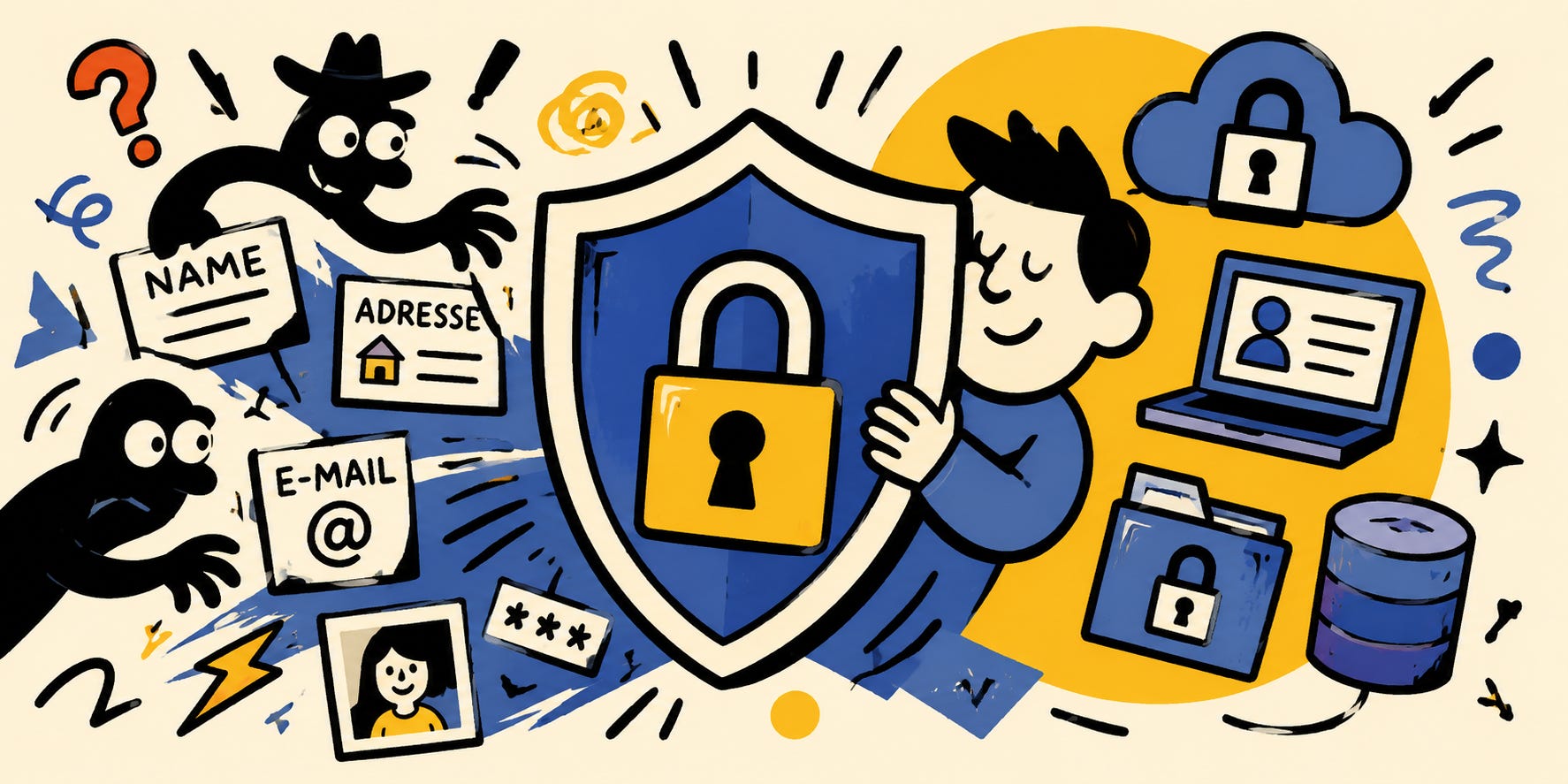
Have you ever wondered why Germany seems to take Datenschutz (data privacy) so seriously?
One reason lies in Germany’s history. During both the Nazi dictatorship and later in East Germany, governments collected vast amounts of personal information to monitor and control people. Those experiences created a deep mistrust of surveillance that still shapes German society today.
In this dialogue, you’ll discover how Germans talk about data privacy, while picking up natural words, phrases, and expressions you can use in real conversations. Let’s go!

Part 1 - Read 👀
Read the Dialogue (out loud if you can)
Kai: Ich hab heute wieder zwanzig Minuten mit einem Cookie-Banner gekämpft. Alles ablehnen war natürlich grau hinterlegt und dreimal kleiner als Alles akzeptieren.
Mara: Das ist Absicht ⍟. Das nennt sich Dark Pattern – die machen das bewusst so, dass man einfach klickt, weil man keine Lust hat. Und die meisten klicken halt.
Kai: Ich auch, meistens. Ich bin doch ehrlich. Aber danach hab ich so ein schlechtes Gefühl, weil ich eigentlich gar nicht weiß, was ich da gerade zugestimmt hab.
Mara: Siebenunddreißig Drittanbieter. Ich hab's mal gelesen, bei einem ganz normalen Nachrichtenartikel. Siebenunddreißig Firmen, die dann meine Daten kriegen. Für einen Artikel, den ich zwei Minuten gelesen hab.
Kai: Das ist das Ding, was mich wirklich stört. Es geht ja nicht darum, dass jemand weiß, dass ich Schuhe mag. Es geht darum, dass aus zehntausend kleinen Datenpunkten ein Profil entsteht, das mich besser kennt als ich mich selbst.
Mara: Und das wird dann genutzt, um mir genau die Werbung zu zeigen, bei der ich schwach werde ⍟. Oder – und das ist der Teil, der mich mehr beunruhigt – um zu beeinflussen, was ich lese, glaube, wähle.
Kai: Aber du hast doch auch Instagram. Und Google Maps. Ich auch. Wir reden gerade über Datenschutz auf Smartphones.
Mara: Ja, ich weiß. Das ist der Widerspruch, in dem wir alle leben. Vollständige Privatsphäre bedeutet, komplett rauszufallen aus allem. Kein Navi ⍟, kein Online-Shopping, kein Social Media. Das macht kaum jemand.
Kai: Deutsche versuchen's wenigstens. Kein anderes Land hat so viele Cookie-Ablehnungen pro Kopf, glaub ich ⍟.
Mara: Wir lehnen ab und installieren dann die App trotzdem.
Kai: Weil Bequemlichkeit fast immer gewinnt. Ich würd's nur gern nicht zugeben müssen.
Mara: Du bist halt das Produkt. Wir alle sind das Produkt. Das ist unangenehm – aber es stimmt.
Kai: Schöner Freitagabend-Gedanke, danke dir ⍟.
You just saw what conversational German looks like. The next parts are where passive understanding turns into real training reps: 2. listen → 3. understand → 4. write → 5. speak. That’s what makes conversational German start feeling more natural!

Part 2 - Listen 👂
Hear the Dialogue (switch to slow version if the original is too quick.)
Audio 🎧
Slow Audio ⏳

Part 3 - Understand 💡
Read the explanations & translation (Go through the explanations and translation. Take your time, this is where things click.)
A) Explanations 💬
⍟ das ist Absicht – A blunt spoken phrase used to accuse someone or something of acting deliberately rather than through carelessness or coincidence, often delivered as a flat, knowing statement that shuts down any charitable interpretation. (English: “that’s deliberate” or “that’s on purpose”, literal: “that is intention”)
⍟ bei der ich schwach werde – A candid spoken construction used to describe the specific thing you can’t resist, whether an offer, a product, or a situation, common whenever someone admits to a personal weakness without making a big deal of it. (English: “that I can’t resist” or “where I cave every time”, literal: “at which I become weak”)
⍟ Navi – The standard everyday spoken shortening of “Navigationsgerät,” used so universally in casual German that the full word would sound stiff and unusual in conversation, a good example of how German speakers routinely shorten compound nouns in daily speech. (English: “sat nav” or “GPS”, literal: short for “navigation device”)
⍟ glaub ich – A very common spoken tag added at the end of a statement to soften a claim and signal that the speaker is fairly confident but not certain, natural across all registers and ages whenever someone wants to avoid sounding too definitive. (English: “I think” or “I reckon” or “I believe”, literal: “I believe”)
⍟ danke dir – A slightly warmer and more personal spoken alternative to the standard “danke,” using the dative pronoun “dir” to direct the thanks more specifically at the person, common in casual conversation and often delivered with a dry or ironic tone as it is here. (English: “thanks to you” or just “thanks”, literal: “I thank you”)
B) Translation 🔄
Kai: I spent twenty minutes fighting a cookie banner again today. "Reject all" was greyed out and three times smaller than "Accept all," obviously.
Mara: That's deliberate. It's called a dark pattern – they design it on purpose so you just click because you can't be bothered. And most people do.
Kai: Me too, most of the time. I'm being honest. But afterwards I feel bad because I don't actually know what I just agreed to.
Mara: Thirty-seven third-party providers. I read through it once, on a completely normal news article. Thirty-seven companies that then get my data. For an article I read for two minutes.
Kai: That's the thing that genuinely bothers me. It's not about someone knowing I like shoes. It's about a profile being built from ten thousand tiny data points that knows me better than I know myself.
Mara: And then that's used to show me exactly the ads I can't resist. Or – and this is the part that worries me more – to influence what I read, believe, vote for.
Kai: But you've got Instagram. And Google Maps. So do I. We're literally talking about data privacy on smartphones.
Mara: Yeah, I know. That's the contradiction we all live with. Full privacy means dropping out of everything completely. No sat nav, no online shopping, no social media. Barely anyone does that.
Kai: Germans at least try. No other country has as many cookie rejections per capita, I think.
Mara: We reject the cookies and then download the app anyway.
Kai: Because convenience almost always wins. I'd just rather not have to admit it.
Mara: You're the product. We all are. That's uncomfortable – but it's true.
Kai: Great Friday evening thought, thanks for that.

Part 4 - Write ✍️
Writing Practice (this step is easy to skip, but it’s where real progress happens)
Answer ONE of these:
Warum ist Datenschutz heute so wichtig?
Wie viel Privatsphäre würdest du für mehr Komfort aufgeben?
Wo sollte deiner Meinung nach die Grenze zwischen Sicherheit und Datenschutz liegen?
👉 Reply to this email or comment below.
Part 5 - Speak 🗣️
Spoken Conversation Practice (This is the part that gets you speaking more naturally, faster.)
Have a short 3–5 minute conversation with your favorite AI (ChatGPT, Claude, Gemini, etc.).
Follow today’s topic
Or choose your own
Ask the AI for corrections and feedback afterwards
AI isn’t a substitute for real conversations with people, but it’s a great way to practise when no conversation partner is available.
Ist Datenschutz manchmal übertrieben? 🔒
Send this dialogue to someone who still puts tape over their webcam… 😄
LG
Marwan