
Hallo zusammen!
Today’s dialogue was inspired by a conversation I had with one of my students about the Netflix series Dark. It’s one of the most popular German series among learners and, if you enjoy mysteries, definitely worth watching.
And one more thing: if we’re not connected on Instagram yet, I’d love to see you there! I regularly share short German tips, quizzes, and everyday expressions.
You can follow me here:

Part 1 - Read 👀
Read the Dialogue (out loud if you can)
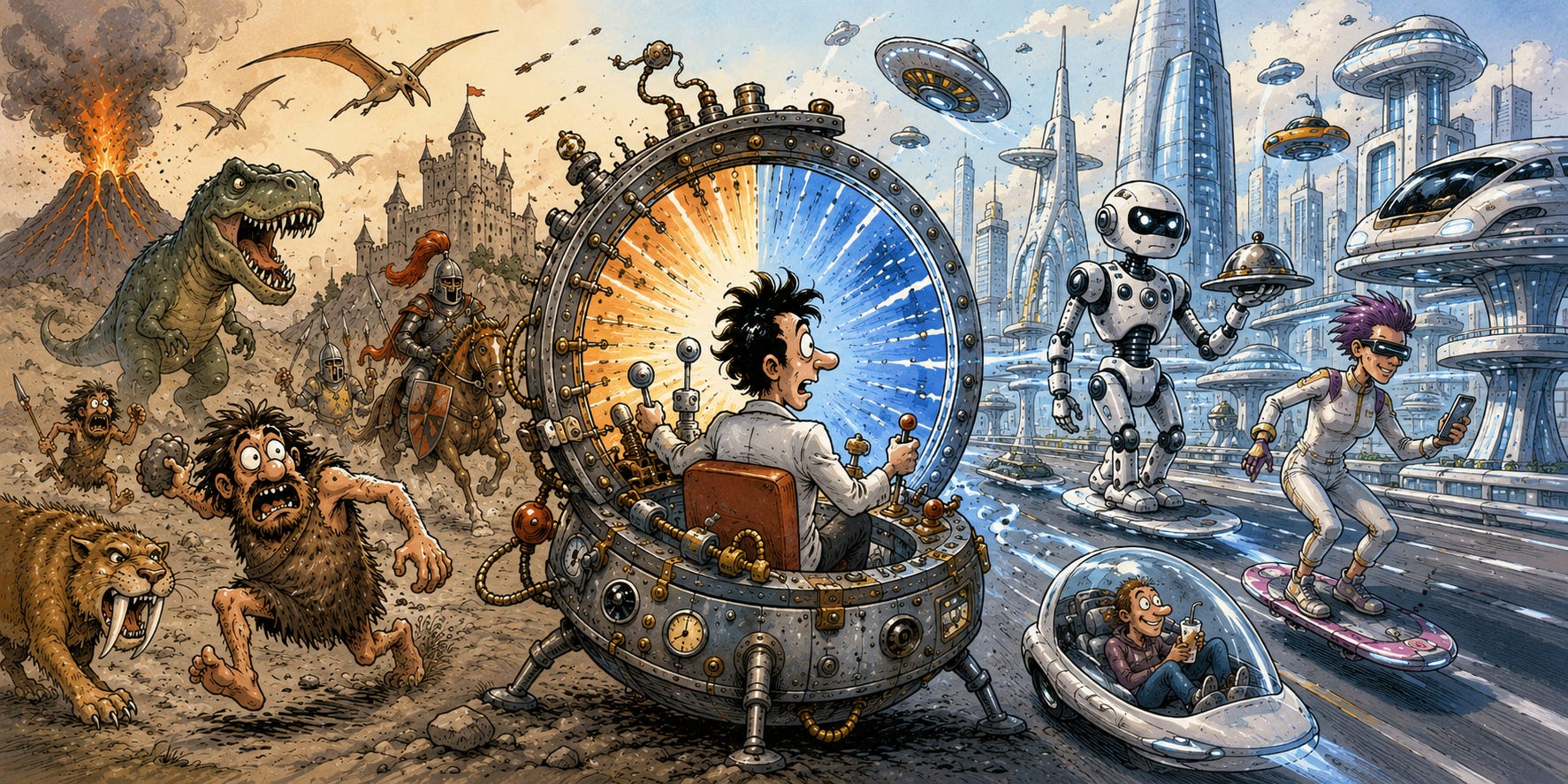
Nora: Okay, ich hab mal eine Frage. Wenn du in der Zeit reisen könntest, wohin würdest du gehen wollen?
Felix: In die Zukunft natürlich!
Nora: Wirklich? Ich würd in die Vergangenheit.
Felix: Natürlich würdest du das. Wohin?
Nora: Nach Berlin, in die 1920er. Da war Berlin noch Teil der Weimarer Republik, kurz bevor alles schief lief. Diese Energie, diese Kunstszene damals – Cabaret und Expressionismus. Das muss unglaublich ⍟ gewesen sein.
Felix: Und gleichzeitig gab's aber auch die Inflation, politische Gewalt und totale Instabilität. Du weißt, wie's ausgeht.
Nora: Ja, eben. Man weiß's, aber die Menschen damals wussten's nicht. Das find ich so faszinierend – dieses Mittendrin-Sein ⍟, ohne zu wissen, was kommt.
Felix: Das klingt für mich nach einem Albtraum, ehrlich gesagt. Ich will lieber wissen, was kommt.
Nora: Und? Wohin würdest du denn?
Felix: So hundert Jahre nach vorne. Also 2130 ungefähr. Ich will einfach wissen, ob wir's hingekriegt haben.
Nora: Hingekriegt – also Klimawandel und so? ⍟
Felix: Ja, genau. Schaut's gut aus oder nicht mehr? Leben wir noch auf der Erde oder schon irgendwo anders? Und wie sieht eine Stadt aus – Berlin zum Beispiel. Gibt's die noch so?
Nora: Das ist aber riskant. Was wenn du hinkommst und es ist… nicht schön?
Felix: Dann weiß ich's wenigstens. Unwissenheit find ich schlimmer als schlechte Nachrichten.
Nora: Ich glaub, ich wär da anderer Meinung. Manchmal ist nicht wissen ganz angenehm.
Felix: Typisch – du gehst lieber in die Vergangenheit, weil du weißt, was dich erwartet.
Nora: Na ja, so hab ich das noch nicht gesehen.
Felix: Und was würdest du in Berlin in den Zwanzigern machen? Einfach rumlaufen?
Nora: Ins Café setzen, Zeitung lesen, Leute beobachten. Vielleicht in irgendeine Galerie. Einfach fühlen, wie die Zeit tickt ⍟.
Felix: Das klingt sehr nach dir.
Nora: Und in dein Zukunfts-Berlin würd ich übrigens auch kurz reinschauen ⍟ wollen.
Felix: Nur kurz?
Nora: Ja. Und dann schnell wieder zurück in die Zwanziger.
You just saw what conversational German looks like. The next parts are where passive understanding turns into real training reps: 2. listen → 3. understand → 4. write → 5. speak. That’s what makes conversational German start feeling more natural!

Part 2 - Listen 👂
Hear the Dialogue (switch to slow version if the original is too quick.)
Audio 🎧
Slow Audio ⏳

Part 3 - Understand 💡
Read the explanations & translation (Go through the explanations and translation. Take your time, this is where things click.)
A) Explanations 💬
⍟ unglaublich – One of the most common spoken intensifiers in everyday German, used to express that something is extraordinary, impressive, or hard to believe, functioning equally well as a standalone exclamation or as a modifier within a sentence across all registers. (English: “incredible” or “unbelievable” or “amazing”)
⍟ Mittendrin-Sein – A spoken nominalisation used to describe the experience of being right in the thick of something as it unfolds, without distance or hindsight, the “-Sein” suffix turning the adverb “mittendrin” into a noun that names the feeling itself. (English: “being right in the middle of it” or “being caught up in it”, literal: “the being-in-the-middle-of-it”)
⍟ und so? – A short, casual spoken tag used to gesture at a wider set of related things without listing them all, here used to confirm understanding of what has just been said, natural and economical in everyday conversation whenever the context makes the rest clear. (English: “and all that?” or “and that sort of thing?”, literal: “and so?”)
⍟ die Zeit tickt – A vivid spoken expression used to describe the feel or rhythm of a particular era or moment, more atmospheric than simply saying “how things were,” common when someone wants to convey immersion in a place or period rather than just facts about it. (English: “how time ticks” or “the pulse of the era”, literal: “time ticks”)
⍟ reinschauen – A casual spoken verb used to describe dropping in somewhere briefly or taking a quick look at something, without committing to a full visit or deep engagement, widely usable in everyday contexts involving a short, informal appearance. (English: “to pop in” or “to have a quick look”, literal: “to look in”)
B) Translation 🔄
Nora: Okay, I've got a question. If you could travel through time, where would you want to go?
Felix: The future, obviously!
Nora: Really? I'd go to the past.
Felix: Of course you would. Where?
Nora: Berlin in the 1920s. Back when Berlin was still part of the Weimar Republic, just before everything went wrong. That energy, that art scene – cabaret and expressionism. It must have been incredible.
Felix: And at the same time there was hyperinflation, political violence, and total instability. You know how it ends.
Nora: Exactly, that's the thing. We know, but the people back then didn't. That's what I find so fascinating – being right in the middle of it without knowing what comes next.
Felix: That sounds like a nightmare to me, honestly. I'd rather know what's coming.
Nora: And? Where would you go then?
Felix: About a hundred years forward. So around 2130. I just want to know whether we managed it.
Nora: Managed it – as in climate change and all that?
Felix: Yeah, exactly. Does it look okay or not anymore? Are we still living on Earth or somewhere else by then? And what does a city look like – Berlin, for example. Does it still exist the way it does now?
Nora: That's risky though. What if you get there and it's… not pretty?
Felix: Then at least I know. I find not knowing worse than bad news.
Nora: I think I'd feel differently about that. Sometimes not knowing is quite comfortable.
Felix: Typical – you'd rather go to the past because you know what to expect.
Nora: Well, I hadn't thought about it that way.
Felix: And what would you actually do in 1920s Berlin? Just wander around?
Nora: Sit in a café, read the newspaper, watch people. Maybe visit some gallery. Just feel how the era ticks.
Felix: That sounds exactly like you.
Nora: And I'd actually quite like to pop into your future Berlin for a moment too, by the way.
Felix: Just a moment?
Nora: Yes. And then straight back to the twenties.

Part 4 - Write ✍️
Writing Practice (this step is easy to skip, but it’s where real progress happens)
Answer ONE of these:
Wohin würdest du reisen, wenn Zeitreisen möglich wären? Warum?
Welche Vorteile und Risiken hätten Zeitreisen?
Würdest du lieber in die Vergangenheit oder in die Zukunft reisen? Warum?
👉 Reply to this email or comment below.
Part 5 - Speak 🗣️
Spoken Conversation Practice (This is the part that gets you speaking more naturally, faster.)
Have a short 3–5 minute conversation with your favorite AI (ChatGPT, Claude, Gemini, etc.).
Follow today’s topic
Or choose your own
Ask the AI for corrections and feedback afterwards
AI isn't a substitute for real conversations with people, but it's a great way to practise when no conversation partner is available.
Wenn Zeitreisen möglich wären... ⏳
Würdest du lieber 100 Jahre in die Vergangenheit oder 100 Jahre in die Zukunft reisen?
If this dialogue bent your brain a little, leave a ♥ and share it with someone who'd definitely create a time paradox. 😄

LG
Marwan