

Hallo zusammen!
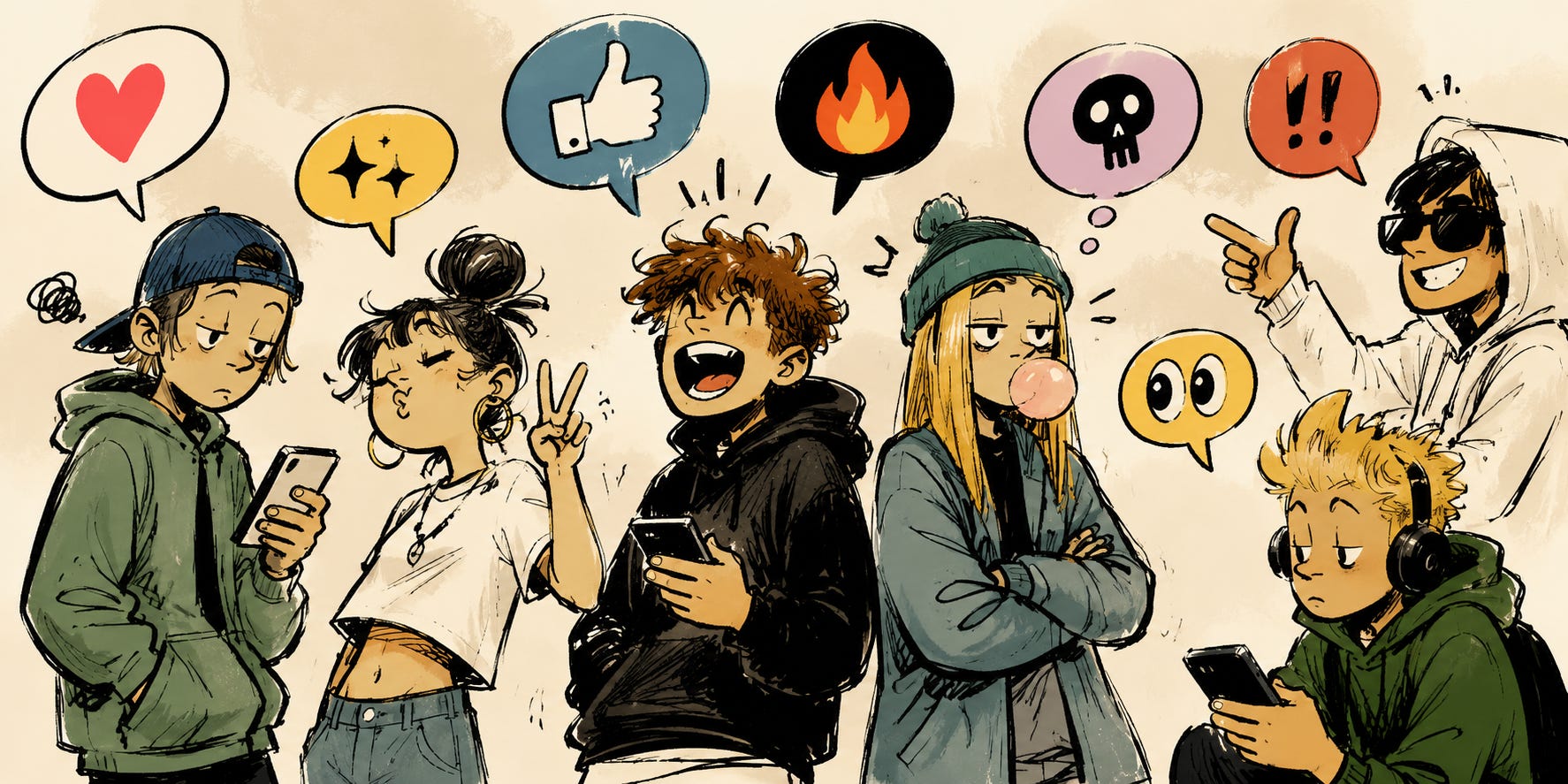
Have you ever heard a younger person say something like “Aura” and wondered if they were still speaking German? 😄
Like many languages, German constantly picks up new words, especially from English, social media, and gaming culture.
In this dialogue, you’ll learn what some of today’s most common youth expressions actually mean, when Germans use them, and how people react to them, along with useful words, phrases, and natural ways of talking about language, generations, and modern slang.

Part 1 - Read 👀
Read the Dialogue (out loud if you can)
Markus: Mein Neffe hat mich gestern gefragt, ob ich Aura hab. Ich hab gesagt, ich glaub nicht, ich bin gut versichert. Er hat mich so angeschaut… ⍟
Britta: Aura ist das neue cool, glaub ich. Wenn jemand Aura hat, ist der halt – keine Ahnung – charismatisch? Präsent? Ich hab's auch erst nachgoogeln ⍟ müssen.
Markus: Ich google mittlerweile alles, was meine Praktikanten sagen. Letzte Woche meinte einer, meine Präsentation war „lowkey fire". Ich hab mich bedankt, wusste aber nicht genau, ob das gut oder schlecht war.
Britta: Das ist gut. Sehr gut sogar. Fire ist gut, lowkey heißt so ein bisschen heimlich beziehungsweise ⍟ mehr als erwartet. Also ungefähr: überraschend stark.
Markus: Okay. Und was ist Rizz? Das hab ich dreimal gehört diese Woche.
Britta: Rizz ist so eine Art Ausstrahlung beim Flirten. Wenn jemand Rizz hat, kann der Leute einfach so für sich gewinnen. Charmant, locker, das kommt einfach rüber.
Markus: Hab ich wahrscheinlich auch nicht.
Britta: Du hast Aura. Das reicht.
Markus: Danke. Ich glaub. – Was mich wirklich verwirrt, ist NPC. Meine Tochter hat gesagt, ihr Lehrer ist ein totaler NPC. Ich hab gefragt, was das heißt, und sie hat mit den Augen gerollt ⍟.
Britta: NPC kommt aus Videospielen – Non-Player Character. Also eine Figur, die einfach dasselbe immer wieder macht, keine eigene Meinung hat, nur seine Rolle abspult.
Markus: Okay, ich kenn ein paar NPCs.
Britta: Wir alle kennen welche. Und pass auf mit „cringe" – das benutzen wir Alten jetzt auch schon, und damit ist es für die Jugend natürlich sofort gestorben.
Markus: Warte, cringe ist nicht mehr cringe?
Britta: Es ist cringe, cringe zu sagen. So funktioniert das.
Markus: Ich geb auf ⍟.
Britta: Das ist die einzig richtige Reaktion.
You just saw what conversational German looks like. The next parts are where passive understanding turns into real training reps: 2. listen → 3. understand → 4. write → 5. speak. That’s what makes conversational German start feeling more natural!

Part 2 - Listen 👂
Hear the Dialogue (switch to slow version if the original is too quick.)
Audio 🎧
Slow Audio ⏳

Part 3 - Understand 💡
Read the explanations & translation (Go through the explanations and translation. Take your time, this is where things click.)
A) Explanations 💬
⍟ so angeschaut… – A spoken construction where “so” combined with a trailing pause does more expressive work than any adjective could, conveying a look of disbelief, pity, or mild contempt without needing to spell it out, widely used when recounting a moment where someone’s reaction said everything. (English: “he just looked at me…” or “he gave me that look…”, literal: “looked at me like that…”)
⍟ nachgoogeln – A natural spoken verb used to describe looking something up online after the fact, either because you didn’t understand it in the moment or wanted to verify it later, common and completely unselfconscious in everyday German conversation. (English: “to google it afterwards” or “to look it up”, literal: “to google after”)
⍟ beziehungsweise – A precise and very common spoken connector used to clarify, refine, or offer a more accurate alternative to something just said, functioning as a smarter version of “or” when the speaker wants to be more exact. (English: “or rather” or “or more precisely” or “that is to say”, literal: “respectively”)
⍟ mit den Augen gerollt – A vivid spoken description of an eye-roll, used to convey that someone reacted with silent, theatrical disdain rather than bothering to answer, common when recounting a moment where a question was treated as beneath a response. (English: “rolled her eyes”, literal: “rolled with the eyes”)
⍟ ich geb auf – A short, resigned spoken phrase used to throw in the towel on understanding or keeping up with something, common in casual conversation when someone reaches the point of cheerful defeat rather than genuine distress. (English: “I give up”, literal: “I give up”)
B) Translation 🔄
Markus: My nephew asked me yesterday whether I have aura. I said I didn't think so, I had good insurance. He just looked at me…
Britta: Aura is the new cool, I think. If someone has aura they're just – I don't know – charismatic? Present? I had to google it myself afterwards too.
Markus: I google everything my interns say these days. Last week one of them said my presentation was "lowkey fire." I said thank you but wasn't entirely sure if that was good or bad.
Britta: That's good. Very good, actually. Fire is good, lowkey means kind of quietly – or rather more than expected. So roughly: surprisingly strong.
Markus: Okay. And what's rizz? I heard it three times this week.
Britta: Rizz is a kind of natural charm when it comes to flirting. If someone has rizz, they just win people over without even trying. Charming, relaxed, it just comes across.
Markus: Probably don't have that either.
Britta: You have aura. That's enough.
Markus: Thanks. I think. – What's really confusing me is NPC. My daughter said her teacher is a total NPC. I asked what it meant and she rolled her eyes.
Britta: NPC comes from video games – non-player character. So a figure that just keeps doing the same thing over and over, has no opinion of their own, just runs through their role.
Markus: Right, I know a few NPCs.
Britta: We all do. And watch out with "cringe" – even we old ones are using it now, which of course means it's immediately dead for the younger generation.
Markus: Wait, cringe isn't cringe anymore?
Britta: It's cringe to say cringe. That's how it works.
Markus: I give up.
Britta: That's the only correct response.

Part 4 - Write ✍️
Writing Practice (this step is easy to skip, but it’s where real progress happens)
Answer ONE of these:
Welche Jugendwörter kennst oder benutzt du?
Warum verändern sich Jugendwörter so schnell?
Sollten ältere Menschen Jugendwörter benutzen? Warum (nicht)?
👉 Reply to this email or comment below.
Part 5 - Speak 🗣️
Spoken Conversation Practice (This is the part that gets you speaking more naturally, faster.)
Have a short 3–5 minute conversation with your favorite AI (ChatGPT, Claude, Gemini, etc.).
Follow today’s topic
Or choose your own
Ask the AI for corrections and feedback afterwards
AI isn't a substitute for real conversations with people, but it's a great way to practise when no conversation partner is available.
Welches Jugendwort hörst du ständig? 😄
If you learned a new expression today, leave a like and share this with someone trying to keep up with modern German.

LG
Marwan