

Hallo zusammen!
Schadenfreude combines Schaden (harm, damage, or misfortune) and Freude (joy). Literally, it means “joy at someone else’s misfortune.”
It’s that slightly guilty pleasure you feel when something goes wrong for someone else. Especially when that person is arrogant, annoying, or a little too confident…
But is Schadenfreude always a bad thing? I did some research, and some psychologists suggest that it often has something to do with social comparison and our sense of fairness. When someone who constantly brags finally fails, we might secretly feel that justice has been served.
What do you think?
⏰ LAST CHANCE - 3 days to go, places are filling up!
The A1, A2, B1 & B2 group classes start on 2 November! 🇩🇪
Reply to this email or comment “GWM” now, and I’ll send you all the details so you can secure your place!

Part 1 - Read 👀
Read the Dialogue (out loud if you can)
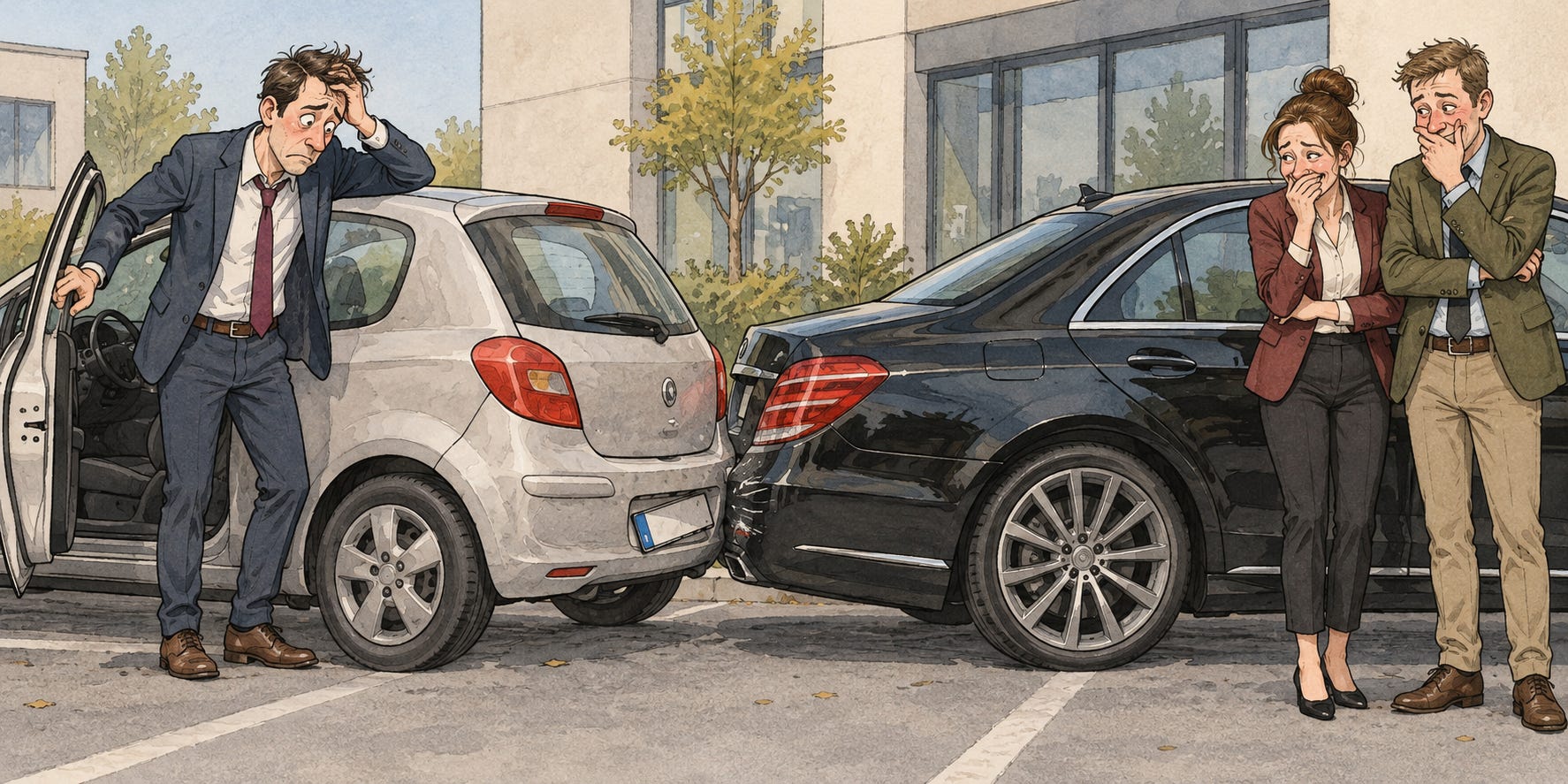
Jonas: Hast du das von Marcel gehört? Der hat gestern beim Einparken den Wagen vom Chef gerammt. Vor versammelter Mannschaft ⍟.
Lisa: Nein! Wie denn?
Jonas: Er wollte angeben und hat extra rückwärts eingeparkt, mit einer Hand am Lenkrad. Und dann – krach ⍟. Direkt in den Mercedes vom Chef.
Lisa: Oh nein. Okay, das ist gemein, aber ich muss lachen.
Jonas: Ich auch. Ich schäm mich ein bisschen.
Lisa: Moment. Ist das jetzt Schadenfreude? Darf man das überhaupt ⍟?
Jonas: Kommt drauf an. Wenn jemand verletzt wird, nein. Aber ein Kratzer am Mercedes – da find ich’s okay.
Lisa: Marcel gibt eh immer so an. Der erzählt jedem, dass er der beste Fahrer im ganzen Büro ist.
Jonas: Genau das ist ja der Punkt. Wer so auftritt, muss damit rechnen ⍟, dass man sich ein bisschen freut, wenn’s schiefgeht.
Lisa: Stimmt schon. Aber trotzdem – armer Kerl ⍟.
You just saw what conversational German looks like. The next parts are where passive understanding turns into real training reps: 2. listen → 3. understand → 4. write → 5. speak. That’s what makes conversational German start feeling more natural!

Part 2 - Listen 👂
Hear the Dialogue (switch to slow version if the original is too quick.)
Audio 🎧
Slow Audio ⏳

Part 3 - Understand 💡
Read the explanations & translation (Go through the explanations and translation. Take your time, this is where things click.)
A) Explanations 💬
⍟ vor versammelter Mannschaft – A fixed spoken idiom used to say that something happened in front of everyone present, typically an embarrassing or public moment, common in storytelling about workplace or team situations and slightly humorous in tone. (English: “in front of everyone” or “in front of the whole crew”, literal: “in front of the assembled team”)
⍟ krach – A short, onomatopoeic spoken interjection used to mimic the sound of a sudden crash or impact, dropped into a story at the decisive moment to add drama and comic timing, very common in informal storytelling. (English: “crash” or “bang”, literal: “crash”)
⍟ überhaupt – A very versatile spoken particle used to question whether something is allowed or possible at all, adding a note of doubt or a step back to the basic premise, widely usable in questions like “Darf man das überhaupt?”. (English: “even” or “at all”, literal: “overall”)
⍟ muss damit rechnen – A spoken construction used to say that someone has to expect a particular consequence of their behaviour, often delivered as a mildly moralising observation, widely reusable whenever actions bring predictable reactions. (English: “has to expect that” or “can’t be surprised if”, literal: “must reckon with it”)
⍟ armer Kerl – A warm, informal spoken phrase used to express sympathy for a man who has had bad luck or embarrassment, often said with a hint of amusement or affection rather than real pity. (English: “poor guy” or “poor bloke”, literal: “poor fellow”)
B) Translation 🔄
Jonas: Have you heard about Marcel? Yesterday he smashed into the boss’s car while parking. In front of everyone.
Lisa: No! How?
Jonas: He wanted to show off and deliberately reversed in, one hand on the wheel. And then – crash. Straight into the boss’s Mercedes.
Lisa: Oh no. Okay, that’s mean, but I can’t help laughing.
Jonas: Me neither. I feel a bit bad about it.
Lisa: Hang on. Is that schadenfreude now? Are we even allowed to?
Jonas: Depends. If someone gets hurt, no. But a scratch on a Mercedes – I think that’s fine.
Lisa: Marcel’s always showing off anyway. He tells everyone he’s the best driver in the whole office.
Jonas: That’s exactly the point. If you come across like that, you’ve got to expect people to enjoy it a little when it goes wrong.
Lisa: Fair enough. But still – poor guy.

Part 4 - Write ✍️
Writing Practice (this step is easy to skip, but it’s where real progress happens)
Answer ONE of these:
Wann hast du zuletzt Schadenfreude empfunden?
Warum freuen sich Menschen manchmal über das Pech anderer?
Wo liegt für dich die Grenze zwischen harmloser Schadenfreude und Gemeinheit?
👉 Reply to this email or comment below.
Part 5 - Speak 🗣️
Spoken Conversation Practice (This is the part that gets you speaking more naturally, faster.)
Have a short 3–5 minute conversation with your favorite AI (ChatGPT, Claude, Gemini, etc.).
Follow today’s topic
Or choose your own
Ask the AI for corrections and feedback afterwards
AI isn't a substitute for real conversations with people, but it's a great way to practise when no conversation partner is available.
Ist Schadenfreude wirklich so schlimm oder manchmal einfach nur menschlich? 😈
Tell me what you think in the comments, and leave a like if you enjoyed today’s training!
And send this dialogue to someone who says they never feel Schadenfreude...
If you’d like to join my A1, A2, B1 or B2 group classes starting 2 November, comment “GWM” or reply to this email and I’ll send you the details. 🇩🇪

LG
Marwan