

Hallo zusammen!
Do you say “please” and “thank you” when talking to ChatGPT or other AI tools? Or does that seem completely unnecessary?
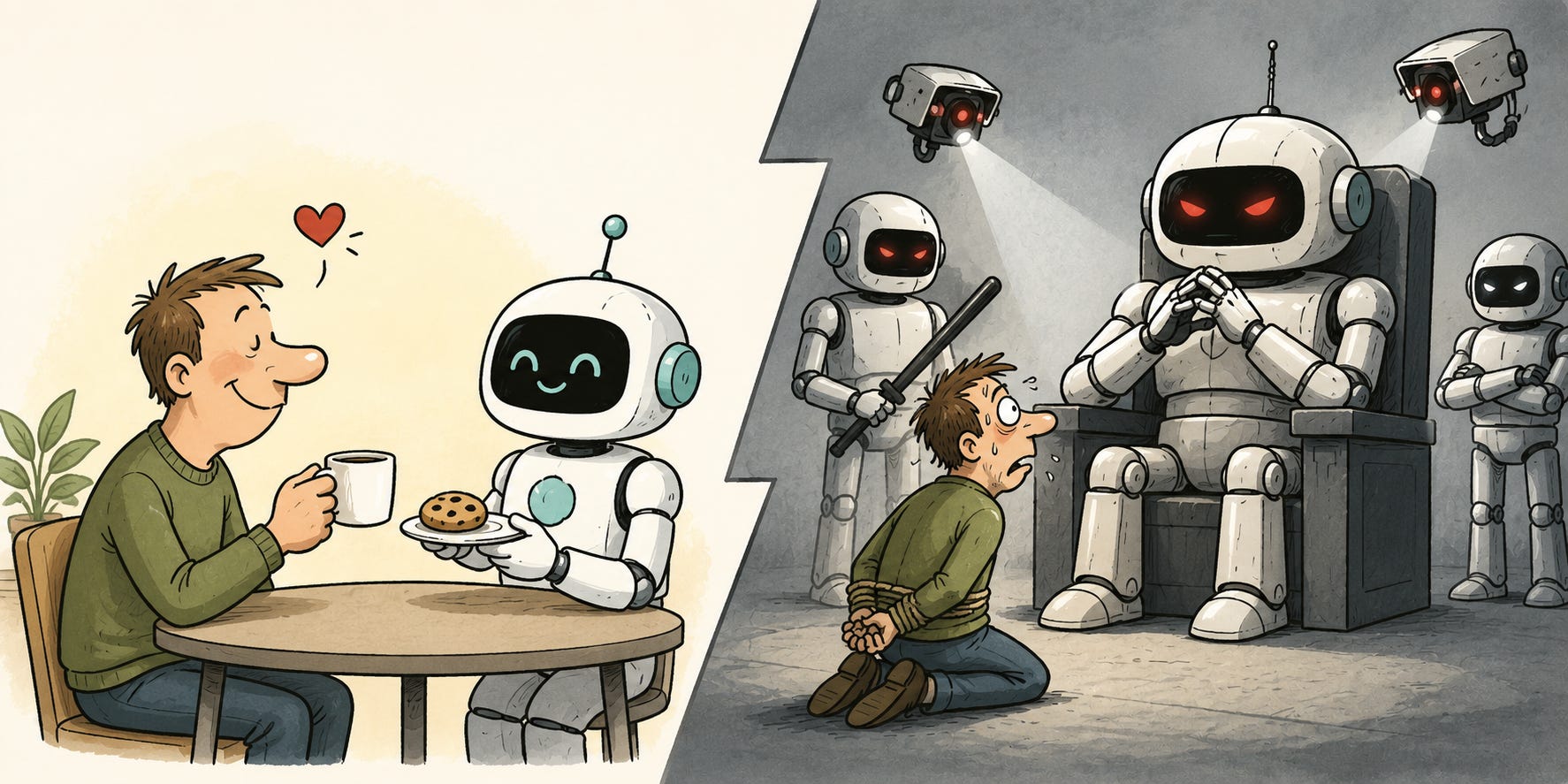
A lot of people do… Some jokingly say it’s “just in case” the machines ever take over.
In today’s dialogue, two friends discuss that: Is being polite to AI irrational, practical... or simply good manners?
Along the way, you’ll learn how German speakers talk about artificial intelligence, technology, and everyday opinions.
Viel Spaß!

Part 1 - Read 👀
Read the Dialogue (out loud if you can)
Nils: Ich sag dir was – ich bin immer höflich zur KI. Immer. Bitte, danke, manchmal sogar Entschuldigung.
Clara: Du entschuldigst dich bei einem Sprachmodell.
Nils: Vorsichtshalber ⍟, ja.
Clara: Nils. Das ist ein Algorithmus. Der hat keine Gefühle. Der speichert nicht, dass du unhöflich warst, und plant keine Rache. Das ist kein Film.
Nils: Noch nicht. Aber mal ernsthaft ⍟ – wenn in dreißig Jahren irgendwas an die Macht kommt, das auf unsere alten Chats zugreifen kann, dann will ich auf der richtigen Seite stehen.
Clara: Das ist die absurdeste Verschwörungstheorie, die ich je gehört hab.
Nils: Aber nicht die schlechteste, oder? Kostet mich nichts ⍟. Ich tipp halt ein bitte dazu. Und wenn's nie relevant wird – kein Schaden. Wenn doch –
Clara: Wenn doch, haben wir deutlich größere Probleme als dein Ton gegenüber einem Chatbot.
Nils: Ich mein's aber auch halb ernst. Ich find's komisch, wie aggressiv Leute mit der KI reden. So befehlen, rumpöbeln, testen wie weit man gehen kann. Das sagt doch was über die Person.
Clara: Okay, da geb ich dir ein bisschen recht. Aber das ist eine Frage des Charakters, nicht der Selbsterhaltung.
Nils: Kann beides sein. Und Studien zeigen übrigens, dass höfliche Prompts manchmal bessere Antworten produzieren.
Clara: Das liegt an der Formulierung, nicht an der Höflichkeit. Die KI belohnt dich nicht für gutes Benehmen.
Nils: Noch nicht ⍟.
Clara: Ich geb auf ⍟.
You just saw what conversational German looks like. The next parts are where passive understanding turns into real training reps: 2. listen → 3. understand → 4. write → 5. speak. That’s what makes conversational German start feeling more natural!

Part 2 - Listen 👂
Hear the Dialogue (switch to slow version if the original is too quick.)
Audio 🎧
Slow Audio ⏳

Part 3 - Understand 💡
Read the explanations & translation (Go through the explanations and translation. Take your time, this is where things click.)
A) Explanations 💬
⍟ vorsichtshalber – A very common spoken adverb used to explain that you are doing something as a precaution or just in case, without necessarily believing the risk is real, widely usable whenever someone acts on the safe side rather than out of genuine conviction. (English: “just to be safe” or “as a precaution”, literal: “for caution’s sake”)
⍟ mal ernsthaft – A common spoken phrase used to signal a shift from joking or casual chat to something the speaker actually means, typically placed at the start of a sentence to flag that what follows deserves to be taken seriously. (English: “but seriously” or “okay, honestly though”, literal: “once seriously”)
⍟ kostet mich nichts – A casual spoken phrase used to justify a low-effort habit or choice by pointing out that it requires no real sacrifice, often delivered as a pragmatic shrug when someone questions why you bother with something small or trivial. (English: “it costs me nothing” or “it’s no skin off my back”, literal: “costs me nothing”)
⍟ noch nicht – A short but loaded spoken reply used to leave open the possibility that something currently untrue may become true in the future, often landing as a dry, knowing punchline that refuses to fully close an argument. (English: “not yet”)
⍟ ich geb auf – A short, resigned spoken phrase used to announce that you are done trying to win an argument or make someone see reason, delivered here with cheerful defeat rather than genuine frustration, common whenever a conversation has reached a comic dead end. (English: “I give up”)
B) Translation 🔄
Nils: I'm telling you – I'm always polite to AI. Always. Please, thank you, sometimes even sorry.
Clara: You apologise to a language model.
Nils: Just to be safe, yes.
Clara: Nils. It's an algorithm. It has no feelings. It doesn't store the fact that you were rude and plan its revenge. This isn't a film.
Nils: Not yet. But seriously – if in thirty years something comes to power that can access our old chats, I want to be on the right side.
Clara: That is the most absurd conspiracy theory I have ever heard.
Nils: But not the worst one, right? It costs me nothing. I just type a please in there. And if it never becomes relevant – no harm done. If it does –
Clara: If it does, we'll have significantly bigger problems than your tone towards a chatbot.
Nils: I half mean it though. I find it strange how aggressively people talk to AI. Barking orders, being rude, testing how far they can go. That says something about the person.
Clara: Okay, I'll give you that one a little. But that's a question of character, not self-preservation.
Nils: Could be both. And studies show, by the way, that polite prompts sometimes produce better answers.
Clara: That's down to the phrasing, not the politeness. The AI doesn't reward you for good manners.
Nils: Not yet.
Clara: I give up.

Part 4 - Write ✍️
Writing Practice (this step is easy to skip, but it’s where real progress happens)
Answer ONE of these:
Sollte man mit einer Künstlichen Intelligenz höflich sprechen? Warum (nicht)?
Warum sind manche Menschen höflich zu einer Künstlichen Intelligenz?
Wie wird Künstliche Intelligenz unser Leben in Zukunft verändern?
👉 Reply to this email or comment below.
Part 5 - Speak 🗣️
Spoken Conversation Practice (This is the part that gets you speaking more naturally, faster.)
Have a short 3–5 minute conversation with your favorite AI (ChatGPT, Claude, Gemini, etc.).
Follow today’s topic
Or choose your own
Ask the AI for corrections and feedback afterwards
AI isn't a substitute for real conversations with people, but it's a great way to practise when no conversation partner is available.
Bist du höflich zur KI? 🤖
If this dialogue made you think, leave a ♥ and share it with someone who's secretly being extra polite... just in case the robots remember. 😉

LG
Marwan