

Hallo zusammen!
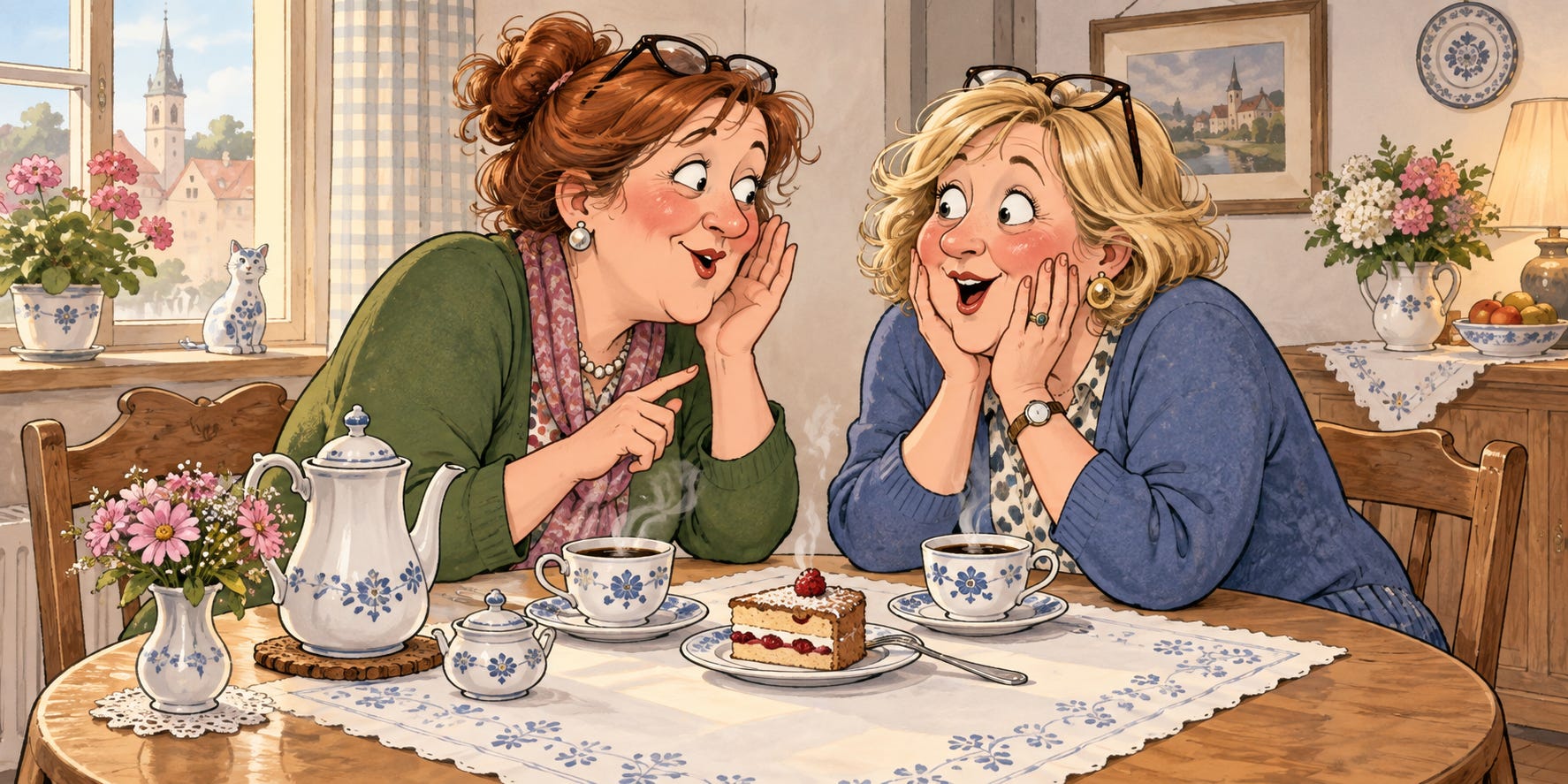
Today we are talking about Kaffeeklatsch, literally “coffee gossip.” Klatsch means gossip, so Kaffeeklatsch describes a chat over coffee, often with cake, where people talk about everyday life.
Also: my new A1, A2, B1 & B2 group classes start on 2 November. If you want to join, reply to this email or comment “GWM” and I’ll send you the details.

Part 1 - Read 👀
Read the Dialogue (out loud if you can)
Hanna: So, ich mach noch eine Kanne. Du hast Zeit, ja?
Brigitte: Ich hab eigentlich um drei einen Termin. Aber eine Tasse geht noch ⍟, ja.
Hanna: Hast du gehört, dass Sabine und ihr Mann sich getrennt haben?
Brigitte: Nein! Wirklich? Die haben doch gerade erst geheiratet ⍟.
Hanna: Ich weiß. Jetzt ist er wohl ausgezogen.
Brigitte: Woher weißt du das?
Hanna: Ihre Schwester hat's meiner Nachbarin erzählt. Also, ich weiß eigentlich gar nichts ⍟.
Brigitte: Aber irgendwas ist bestimmt dran. Man hat's ja irgendwie gemerkt: Beim letzten Grillabend war die Stimmung so komisch.
Hanna: Ja, eben. Er hat kaum geredet.
Brigitte: Er redet nie viel.
Hanna: Stimmt auch wieder ⍟. Milch in deinen Kaffee?
Brigitte: Bitte. Ich ruf kurz an und sag, dass ich erst um halb vier komme.
Hanna: Ich mach auch noch eine Packung Kekse auf.
Brigitte: Ja, gut. Und was ist mit Monikas neuem Job?
Hanna: Oh, da gibt's einiges ⍟.
You just saw what conversational German looks like. The next parts are where passive understanding turns into real training reps: 2. listen → 3. understand → 4. write → 5. speak. That’s what makes conversational German start feeling more natural!

Part 2 - Listen 👂
Hear the Dialogue (switch to slow version if the original is too quick.)
Audio 🎧
Slow Audio ⏳

Part 3 - Understand 💡
Read the explanations & translation (Go through the explanations and translation. Take your time, this is where things click.)
A) Explanations 💬
⍟ eine Tasse geht noch – A natural spoken phrase used to accept a small offer while signalling that you are limited on time, the word “noch” doing the work of suggesting this is the last one rather than the start of a longer stay. (English: “there’s time for one cup” or “one cup I can still manage”, literal: “one cup still goes”)
⍟ gerade erst geheiratet – A spoken construction used to emphasise how recently something happened, with “gerade erst” conveying that almost no time has passed, often said with surprise or disbelief when a new development seems to contradict something that only just took place. (English: “just got married” or “barely just got married”, literal: “just only now married”)
⍟ ich weiß eigentlich gar nichts – A common spoken disclaimer used to walk back a piece of gossip or hearsay immediately after sharing it, distancing yourself from the information while making clear you’ve already passed it on, a classic move in informal conversation. (English: “I don’t actually know anything” or “I really have no idea”, literal: “I actually know nothing at all”)
⍟ stimmt auch wieder – A relaxed spoken phrase used to concede that a counter-point is valid, acknowledging that the other person has a fair argument without making a big deal of changing your position, common in casual back-and-forth conversation. (English: “that’s also true” or “fair point actually” or “you’re right about that”, literal: “that’s also right again”)
⍟ da gibt’s einiges – A teasing spoken phrase used to signal that there is more to tell about a topic than the speaker is letting on right now, building anticipation while keeping the listener hooked, widely usable whenever someone wants to hint at a longer story to come. (English: “there’s quite a bit to tell” or “oh, there’s a lot there”, literal: “there’s quite something there”)
B) Translation 🔄
Hanna: Right, I'll make another pot. You've got time, yeah?
Brigitte: I've actually got an appointment at three. But there's time for one cup, yeah.
Hanna: Did you hear that Sabine and her husband have split up?
Brigitte: No! Really? They barely just got married.
Hanna: I know. Apparently he's moved out.
Brigitte: How do you know that?
Hanna: Her sister told my neighbour. So, I don't actually know anything.
Brigitte: But something's definitely going on. You could sort of tell: the atmosphere at the last barbecue was so strange.
Hanna: Yeah, exactly. He hardly said a word.
Brigitte: He never talks much.
Hanna: Fair point actually. Milk in your coffee?
Brigitte: Please. I'll just call and say I won't be there until half three.
Hanna: I'll open another packet of biscuits too.
Brigitte: Yeah, go on then. And what about Monika's new job?
Hanna: Oh, there's quite a bit to tell there.

Part 4 - Write ✍️
Writing Practice (this step is easy to skip, but it’s where real progress happens)
Answer ONE of these:
Mit wem machst du am liebsten einen Kaffeeklatsch?
Warum reden Menschen so gerne über das Leben anderer?
Wo liegt für dich die Grenze zwischen harmlosem Klatsch und Lästern?
👉 Reply to this email or comment below.
Part 5 - Speak 🗣️
Spoken Conversation Practice (This is the part that gets you speaking more naturally, faster.)
Have a short 3–5 minute conversation with your favorite AI (ChatGPT, Claude, Gemini, etc.).
Follow today’s topic
Or choose your own
Ask the AI for corrections and feedback afterwards
AI isn't a substitute for real conversations with people, but it's a great way to practise when no conversation partner is available.
Mit wem machst du am liebsten Kaffeeklatsch? ☕👀
If you enjoyed today's lesson… send this dialogue to someone who always says “Ich lästere nicht” 🤔
If you’d like to join my A1, A2, B1 or B2 group classes starting 2 November, comment “GWM” or reply to this email and I’ll send you the details.
LG
Marwan