

Hallo zusammen!
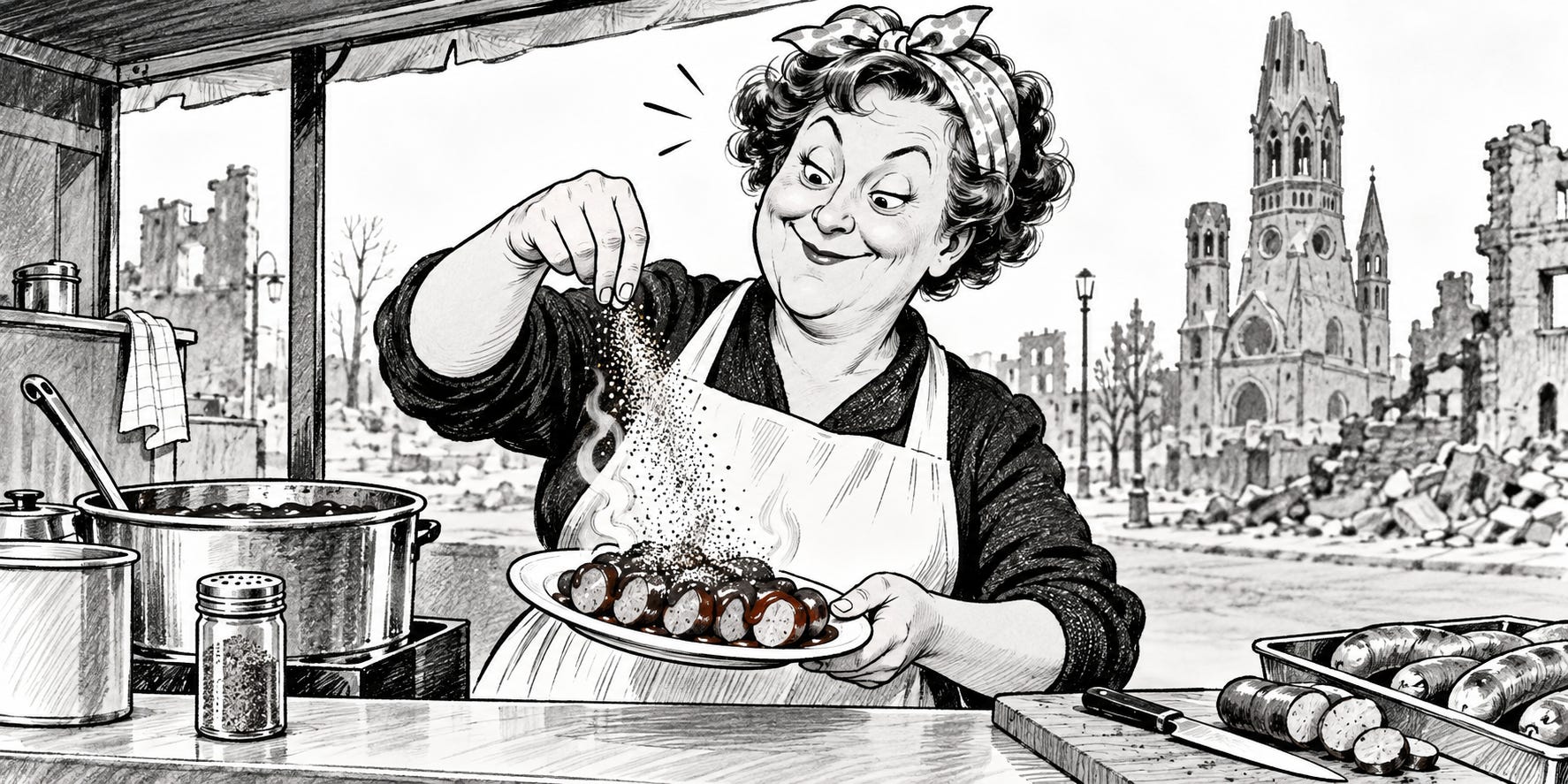
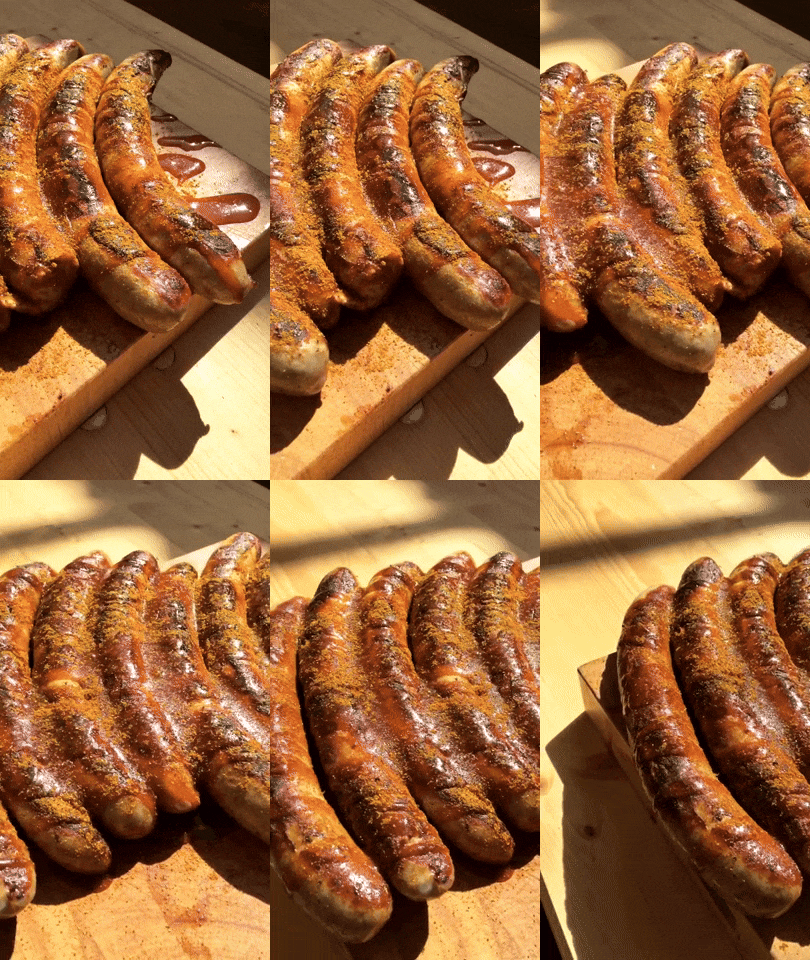
Today’s topic is Currywurst, one of Germany’s most iconic fast foods and a small piece of German cultural history. Today’s dialogue explores its history.
Viel Spaß beim Lesen und Trainieren!
New A1, A2, B1 & B2 group classes start on 2 November. If you want to join, reply to this email or comment “GWM” and I’ll send you the details.

Part 1 - Read 👀
Read the Dialogue (out loud if you can)
Lars: Weißt du eigentlich, wer die Currywurst erfunden hat?
Mira: Irgendwer in Berlin, oder?
Lars: Ja, Herta Heuwer. Sie hat sie 1949 in Charlottenburg erfunden. Sie hat an einem Imbissstand Ketchup und Currypulver gemischt – angeblich hatte sie die Zutaten von britischen Soldaten gegen Schnaps eingetauscht – und die Soße dann über die Wurst gekippt.
Mira: Ach echt, das war's? ⍟
Lars: Ja, genau. Und sie hat sich den Namen der Soße sogar als Marke schützen lassen. „Chillup" hat sie sie genannt. Den Markenschutz hatte sie wirklich – schwarz auf weiß ⍟.
Mira: Aber es wird auch behauptet, dass die Currywurst in Hamburg erfunden wurde.
Lars: Ja, das ist der ewige Streit ⍟. In Hamburg besteht man darauf, aber die meisten Historiker sagen, dass es Herta war. Es gibt sogar eine Gedenktafel dort, wo ihr Imbiss stand.
Mira: Ah, cool.
Lars: Völlig zu Recht, finde ich. Das ist Kulturgeschichte. Helmut Schmidt hat sie übrigens geliebt. Er hat gesagt, ohne Currywurst wäre er kein guter Politiker geworden.
Mira: Das glaube ich dir nicht.
Lars: Okay, das habe ich dazuerfunden ⍟. Aber klingt plausibel, oder?
Mira: Nicht wirklich… ⍟
You just saw what conversational German looks like. The next parts are where passive understanding turns into real training reps: 2. listen → 3. understand → 4. write → 5. speak. That’s what makes conversational German start feeling more natural!

Part 2 - Listen 👂
Hear the Dialogue (switch to slow version if the original is too quick.)
Audio 🎧
Slow Audio ⏳

Part 3 - Understand 💡
Read the explanations & translation (Go through the explanations and translation. Take your time, this is where things click.)
A) Explanations 💬
⍟ das war’s? – A spoken phrase used to express mild disbelief or surprise that something was simpler or more anticlimactic than expected, widely usable whenever a big story turns out to have a very unspectacular explanation. (English: “that’s all it was?” or “that was it?”, literal: “that was it?”)
⍟ schwarz auf weiß – A common spoken idiom used to emphasise that something is officially documented or proven in writing, often deployed to shut down doubt by pointing to a concrete, verifiable record. (English: “in black and white” or “officially documented”, literal: “black on white”)
⍟ das ist der ewige Streit – A natural spoken phrase used to describe a long-running, unresolved dispute that never seems to go away, widely usable in any context where two sides have been arguing the same point for years without reaching a conclusion. (English: “that’s the age-old argument” or “that’s the eternal debate”, literal: “that is the eternal argument”)
⍟ das habe ich dazuerfunden – A candid spoken phrase used to admit that you just made something up or added a detail that wasn’t true, often delivered with cheerful self-awareness after a bluff has run its course. (English: “I made that bit up” or “I just invented that part”, literal: “I invented that additionally”)
⍟ nicht wirklich… – A dry, understated spoken response used to gently but clearly disagree with something, the trailing pause adding just enough scepticism to land as a quiet but effective dismissal. (English: “not really…” or “not quite…”)
B) Translation 🔄
Lars: Do you actually know who invented the Currywurst?
Mira: Someone in Berlin, right?
Lars: Yeah, Herta Heuwer. She invented it in 1949 in Charlottenburg. She mixed ketchup and curry powder at a street food stall – apparently she'd traded the ingredients from British soldiers in exchange for schnapps – and then poured the sauce over the sausage.
Mira: Oh really, that's all it was?
Lars: Yeah, exactly. And she even had the name of the sauce trademarked. She called it "Chillup." She really did have that trademark – in black and white.
Mira: But there are also claims that the Currywurst was invented in Hamburg.
Lars: Yeah, that's the age-old argument. Hamburg insists on it, but most historians say it was Herta. There's even a commemorative plaque where her stall used to be.
Mira: Oh, cool.
Lars: Rightly so, I think. It's cultural history. Helmut Schmidt loved it by the way. He said he never would have become a good politician without Currywurst.
Mira: I don't believe you.
Lars: Okay, I made that bit up. But it sounds plausible, right?
Mira: Not really…

Part 4 - Write ✍️
Writing Practice (this step is easy to skip, but it’s where real progress happens)
Answer ONE of these:
Warum ist die Currywurst in Deutschland so beliebt?
Welche typischen Imbissgerichte gibt es in deinem Land?
Was macht ein einfaches Gericht zu einem Kultgericht?
👉 Reply to this email or comment below.
Part 5 - Speak 🗣️
Spoken Conversation Practice (This is the part that gets you speaking more naturally, faster.)
Have a short 3–5 minute conversation with your favorite AI (ChatGPT, Claude, Gemini, etc.).
Follow today’s topic
Or choose your own
Ask the AI for corrections and feedback afterwards
AI isn't a substitute for real conversations with people, but it's a great way to practise when no conversation partner is available.
Wie isst du deine Currywurst am liebsten, mit oder ohne Pommes? 🌭🍟
Tell me in the comments, and if you enjoyed today’s training, leave a like!
If you’d like to join my A1, A2, B1 or B2 group classes starting 2 November, comment “GWM” or reply to this email and I’ll send you the details.
LG
Marwan