
Hallo Leute!
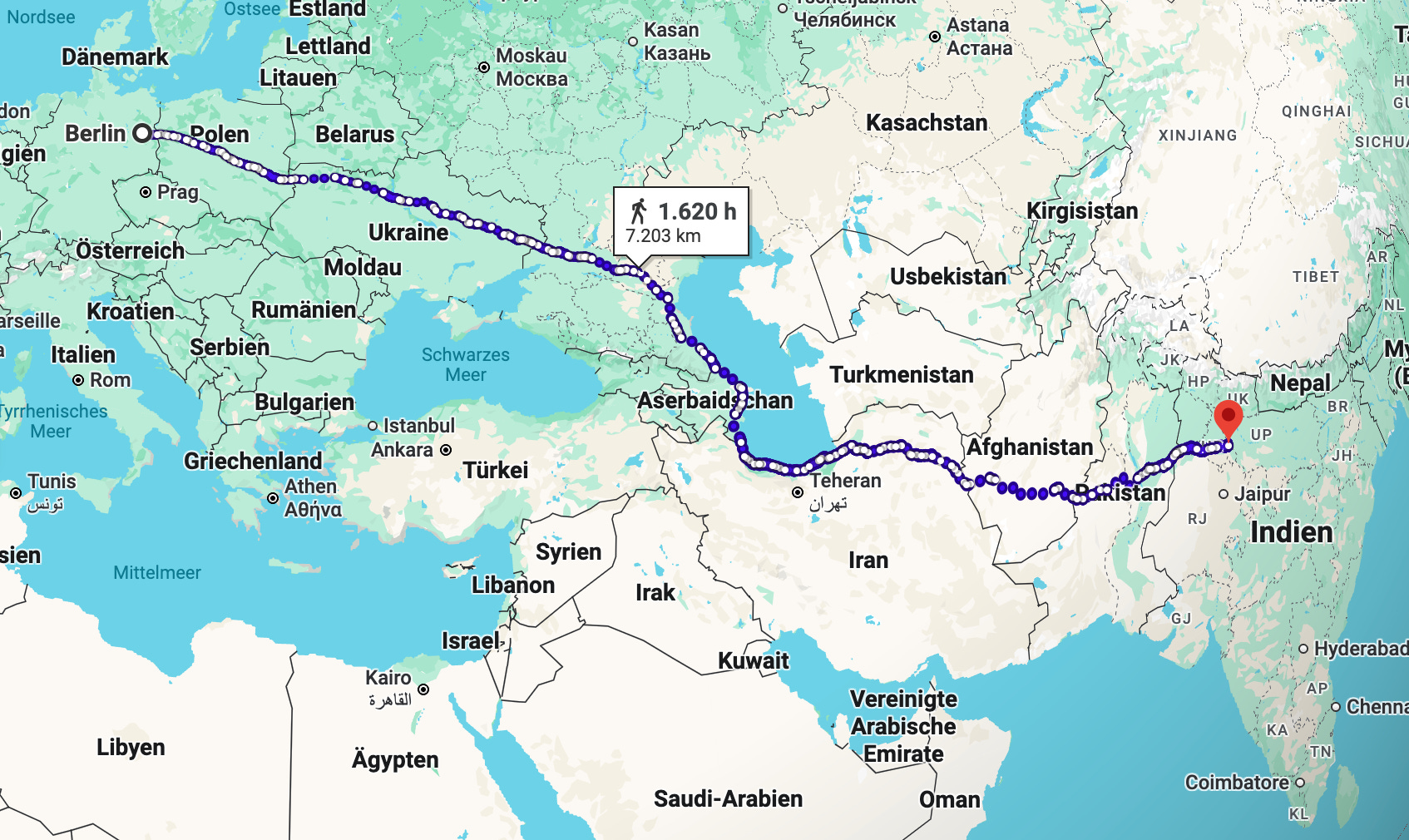
Today’s dialogue plays with a slightly crazy idea: walking from Berlin to New Delhi. Two friends explore whether something like that is even possible, talking about distance, time, borders, and what it would actually take to make it happen.

Part 1 - Read 👀
Read the Dialogue (out loud if you can)
Jann: Ich hab letzte Nacht nicht schlafen können und hab dann angefangen auszurechnen, wie lange man bräuchte, um von Berlin nach Neu-Delhi zu laufen. Zu Fuß.
Marek: Okay. Und?
Jann: So sieben bis neun Monate. Wenn man täglich dreißig Kilometer macht, ohne große Pause. Das sind ungefähr siebentausend Kilometer.
Marek: Das klingt nach einer sehr langen Wanderung durch Länder, die dich nicht unbedingt reinlassen ⍟.
Jann: Genau das ist das Problem. Du läufst durch Polen, Weißrussland - falls du da überhaupt rein kommst - Ukraine oder Russland, dann Georgien oder Iran, dann Pakistan. Das ist nicht gerade ein entspannter Spaziergang ⍟.
Marek: Iran und Pakistan. Jann, das ist kein Abenteuer, das ist ein Visumsalptraum mit Blasen an den Füßen.
Jann: Stimmt. Aber theoretisch ist's machbar. Es gibt Leute, die sowas wirklich gemacht haben. Der Typ, der zu Fuß um die Welt gegangen ist - Tom Turcich, über acht Jahre.
Marek: Acht Jahre. Und was hat er danach gemacht?
Jann: Ein Buch geschrieben, glaub ich. Was sonst ⍟.
Marek: Okay aber mal ernsthaft ⍟ - was reizt dich daran? Weil es nicht der Komfort ist, das ist klar.
Jann: Das Gefühl, dass du wirklich begreifst, wie groß die Welt ist. Nicht aus dem Flugzeug, nicht aus dem Zug - sondern Schritt für Schritt. Du siehst, wie sich Landschaften ändern, Sprachen, Gesichter, Essen. Das kannst du nicht googeln.
Marek: Das klingt gut, wenn ich's so höre. Aber ich weiß auch, dass ich nach zwei Wochen irgendwo in Polen steh und ein Bett will.
Jann: Ich wahrscheinlich auch. Aber das ist ja das Schöne an der Idee - solange man's nicht macht, bleibt's perfekt ⍟.
Marek: Der tiefste Satz, den du je auf einem Parkplatz gesagt hast.
You just read how people actually talk about this topic. Now comes the part that makes it stick: hearing it, understanding the expressions, and using them yourself.

Part 2 - Listen 👂
Hear the Dialogue (switch to slow version if the original is too quick)
Audio 🎧
Slow Audio ⏳

Part 3 - Understand 💡
Read the explanations & translation (take your time, ask questions in the comments if something is unclear)
A) Explanations 💬
⍟ nicht unbedingt reinlassen – A casual spoken construction used to describe a country, person, or institution that may well refuse you entry or access without stating it as a certainty, typical of understated informal speech. (English: “not necessarily let you in”)
⍟ das ist nicht gerade ein entspannter Spaziergang – An ironic spoken understatement used to describe something as significantly more difficult or dangerous than it might sound, widely applicable whenever someone wants to flag a challenge without being overly dramatic. (English: “that’s not exactly a relaxing walk in the park”, literal: “that’s not exactly a relaxed walk”)
⍟ was sonst – A dry, throwaway spoken phrase used to suggest that a particular outcome was completely predictable or inevitable, often delivered with mild irony or resignation. (English: “what else” or “what else would you expect”)
⍟ mal ernsthaft – A very common spoken phrase used to signal a shift in tone from small talk or joking to a more genuine or serious question, typically placed at the start of a sentence to flag that something real is about to be asked. (English: “but seriously” or “okay, honestly though”, literal: “once seriously”)
⍟ solange man’s nicht macht, bleibt’s perfekt – A reflective spoken observation about how unrealised ideas stay flawless precisely because they are never tested against reality, used informally when someone acknowledges the gap between dream and execution. (English: “as long as you don’t actually do it, it stays perfect”)
B) Translation 🔄
Jann: I couldn't sleep last night so I started working out how long it would take to walk from Berlin to New Delhi. On foot.
Marek: Okay. And?
Jann: Something like seven to nine months. If you do thirty kilometres a day without any major breaks. That's roughly seven thousand kilometres.
Marek: That sounds like a very long hike through countries that won't necessarily let you in.
Jann: That's exactly the problem. You'd be walking through Poland, Belarus - if you can even get in there - Ukraine or Russia, then Georgia or Iran, then Pakistan. That's not exactly a relaxing stroll.
Marek: Iran and Pakistan. Jann, that's not an adventure, that's a visa nightmare with blisters.
Jann: True. But theoretically it's doable. There are people who've actually done things like that. That guy who walked around the world - Tom Turcich, over eight years.
Marek: Eight years. And what did he do afterwards?
Jann: Wrote a book, I think. What else.
Marek: Okay but seriously - what appeals to you about it? Because it's not the comfort, that much is clear.
Jann: The feeling that you really grasp how big the world is. Not from a plane, not from a train - but step by step. You watch landscapes change, languages, faces, food. You can't Google that.
Marek: That does sound good when you put it like that. But I also know that after two weeks I'd be standing somewhere in Poland desperately wanting a bed.
Jann: Me too, probably. But that's the beauty of the idea - as long as you never actually do it, it stays perfect.
Marek: That's the most profound thing you've ever said in a car park.

Part 4 - Write ✍️
Writing Practice (don’t skip, writing trains your brain to actively form sentences, and this carries over into speaking)
Answer ONE of these:
Würdest du zu Fuß von Deutschland nach Indien reisen? Warum (nicht)?
Welche Herausforderungen und Vorteile hätte so eine Reise?
Was müsste man deiner Meinung nach dafür gut vorbereiten?
Send me your text by replying to this email, and I will answer + give feedback to the first 20 replies!
(check your spam folder just in case)
💬 Alternatively:
Post your answer in the comments.
(you are more likely to get feedback)
Part 5 - Speak 🗣️
Spoken Conversation Practice (This is the part that gets you speaking more naturally, faster.)
Have a short 3–5 minute conversation with your favorite AI (ChatGPT, Claude, Gemini, etc.).
Follow today’s topic
Or choose your own
Ask the AI for corrections and feedback afterwards
AI isn’t a substitute for real conversations with people, but it’s a great way to practise when no conversation partner is available.
Würdest du das durchziehen?
If this idea made you think “that’s insane”… send it to someone who would actually consider it 😄
And if you enjoyed this little thought experiment, tap ♡ and share it, let’s see how far this one travels.
LG
Marwan