
Hallo zusammen!
Today’s topic is Weltschmerz. The word combines Welt (world) and Schmerz (pain). Literally, it means “world pain.” It describes a deep sense of melancholy, disappointment, or helplessness when the world doesn’t live up to our ideals.
The term was coined by the German Romantic writer Jean Paul in the early 19th century. It became associated with Romantic literature, particularly the tension between an ideal world and an imperfect reality…

Part 1 - Read 👀
Read the Dialogue (out loud if you can)
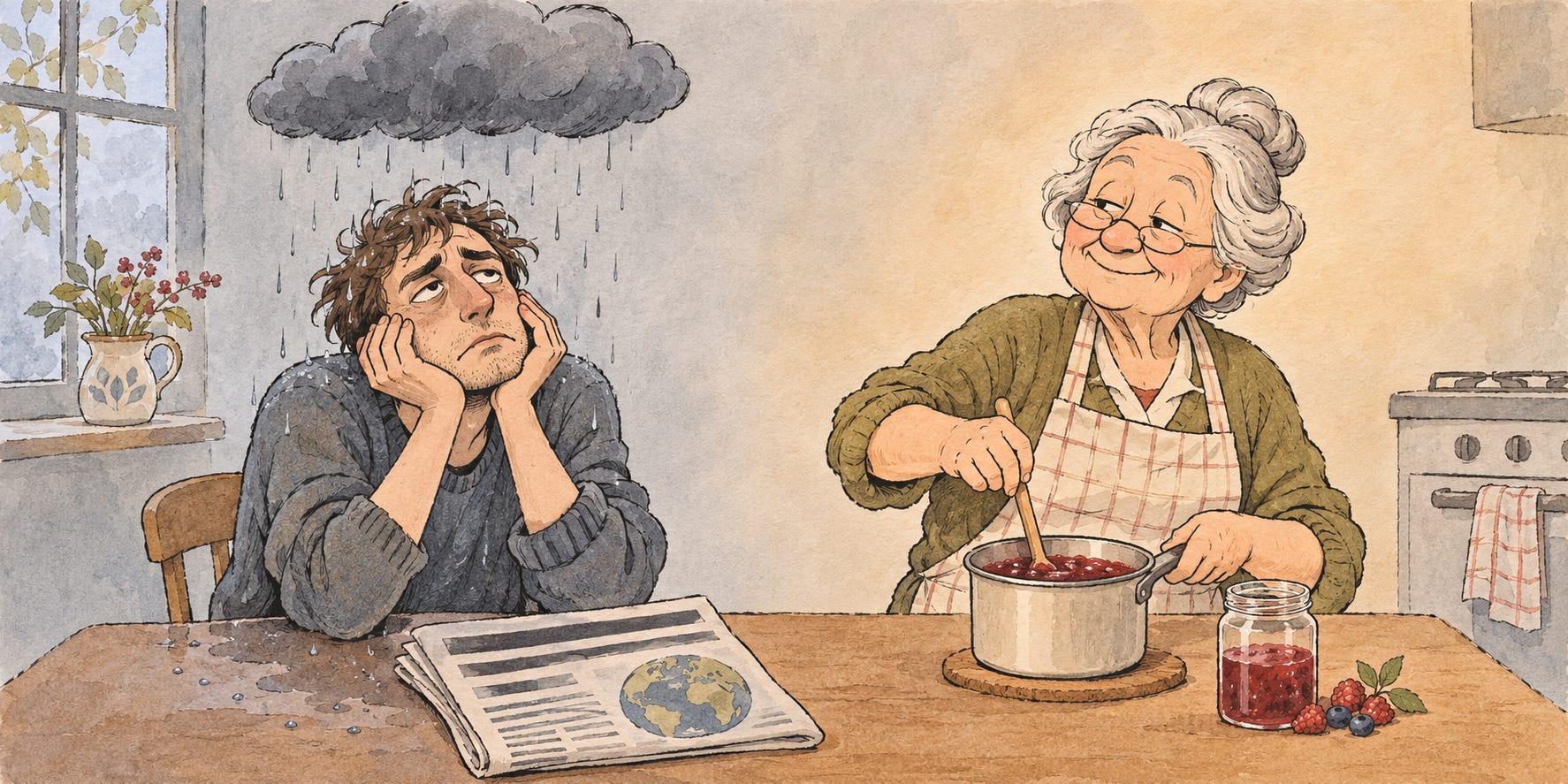
Paul: Oma, hast du auch manchmal das Gefühl, dass die Welt einfach zu viel ist? Ich meine diese ganzen Schlagzeilen und Nachrichten über Krieg, Klima und weiß der Teufel was noch ⍟. Ich bin morgens irgendwie schon durch ⍟ für den Tag.
Oma Ingrid: Das nennt man Weltschmerz, mein Junge ⍟.
Paul: Das klingt fast schön für etwas, das sich so mies anfühlt.
Oma Ingrid: Das Wort stammt ja auch von einem Dichter. Aber das Gefühl ist älter als jeder Dichter. Das hatte ich auch, als ich in deinem Alter war.
Paul: Echt? Du? Du wirkst immer so entspannt.
Oma Ingrid: Heute ja. Damals nicht. Wir hatten ja auch unsere Phasen: den Kalten Krieg, die Atomangst oder Tschernobyl. Ich erinnere mich zum Beispiel daran, dass ich nach Tschernobyl keinen Salat mehr aus dem Garten gegessen habe, weil ich Angst vor dem radioaktiven Regen hatte.
Paul: Und wie bist du damit umgegangen?
Oma Ingrid: Ich hab Marmelade gekocht. Im Ernst ⍟. Wenn alles zu groß wird, mach ich was Kleines, das ich selbst in der Hand hab ⍟.
Paul: Marmelade gegen die Weltlage.
Oma Ingrid: Nicht dagegen. Daneben. Das Große kannst du nicht allein kontrollieren, und die Probleme kannst du nicht allein lösen. Aber du kannst deinen Teil beitragen und trotzdem abends gut schlafen.
Paul: Das klingt ziemlich vernünftig.
Oma Ingrid: Ich bin ja auch alt. Ich hab schon so meine Erfahrungen gesammelt.
You just saw what conversational German looks like. The next parts are where passive understanding turns into real training reps: 2. listen → 3. understand → 4. write → 5. speak. That’s what makes conversational German start feeling more natural!

Part 2 - Listen 👂
Hear the Dialogue (Repeat if the audio is too quick.)
Audio 🎧

Part 3 - Understand 💡
Read the explanations & translation (Go through the explanations and translation. Take your time, this is where things click.)
A) Explanations 💬
⍟ weiß der Teufel was noch – A colourful spoken filler used to end a list with exasperated vagueness, implying there is far more of the same than you care to name, informal and widely understood across all ages. (English: “and God knows what else”, literal: “the devil knows what else”)
⍟ durch – A short, informal spoken adjective used to say that you are completely drained or finished, here meaning that your energy is already used up before the day has properly begun, common whenever someone feels worn out by stress or bad news. (English: “done in” or “wiped out”, literal: “through”)
⍟ mein Junge – A warm, slightly old-fashioned spoken form of address used mainly by older relatives or mentors to speak affectionately and gently to a younger man or boy, often introducing a piece of advice or wisdom. (English: “my boy” or “my dear”, literal: “my boy”)
⍟ in der Hand hab – A natural spoken expression used to describe having something under your own control or within your own power to influence, widely usable whenever someone contrasts what they can manage with what they cannot. (English: “have a handle on” or “have in my own hands”, literal: “have in the hand”)
⍟ im Ernst – A very common spoken phrase used to stress that what you just said was not a joke, placed on its own to make a surprising statement land with credibility. (English: “seriously” or “no joke”, literal: “in earnest”)
B) Translation 🔄
Paul: Gran, do you sometimes feel like the world is just too much? I mean all these headlines and news about war, climate and God knows what else. By the morning I’m somehow already done in for the day.
Oma Ingrid: That’s called Weltschmerz, my boy.
Paul: That sounds almost beautiful for something that feels so awful.
Oma Ingrid: The word comes from a poet, after all. But the feeling is older than any poet. I had it too when I was your age.
Paul: Really? You? You always seem so relaxed.
Oma Ingrid: Now, yes. Not back then. We had our phases too: the Cold War, the fear of nuclear war, or Chernobyl. I remember, for example, that after Chernobyl I stopped eating lettuce from the garden because I was afraid of the radioactive rain.
Paul: And how did you cope with it?
Oma Ingrid: I made jam. Seriously. When everything gets too big, I do something small that I have in my own hands.
Paul: Jam against the state of the world.
Oma Ingrid: Not against it. Alongside it. You can’t control the big things on your own, and you can’t solve the problems on your own. But you can do your bit and still sleep well at night.
Paul: That sounds pretty sensible.
Oma Ingrid: Well, I’m old too. I’ve picked up a bit of experience along the way.

Part 4 - Write ✍️
Writing Practice (this step is easy to skip, but it’s where real progress happens)
Answer ONE of these:
Wann hast du zuletzt Weltschmerz empfunden?
Warum fühlen sich viele Menschen von den Problemen der Welt überfordert?
Wie gehst du mit negativen Nachrichten und Weltschmerz um?
👉 Reply to this email or comment below.
Part 5 - Speak 🗣️
Spoken Conversation Practice (This is the part that gets you speaking more naturally, faster.)
Have a short 3–5 minute conversation with your favorite AI (ChatGPT, Claude, Gemini, etc.).
Follow today’s topic
Or choose your own
Ask the AI for corrections and feedback afterwards
AI isn't a substitute for real conversations with people, but it's a great way to practise when no conversation partner is available.
Hast du manchmal auch Weltschmerz oder schaltest du einfach die Nachrichten aus? 🌍
Tell me what you think in the comments, and leave a like if you enjoyed today’s training!
And send this dialogue to someone who desperately needs a break from the news, social media, and humanity in general… 😅

LG
Marwan