
Tach Leute.
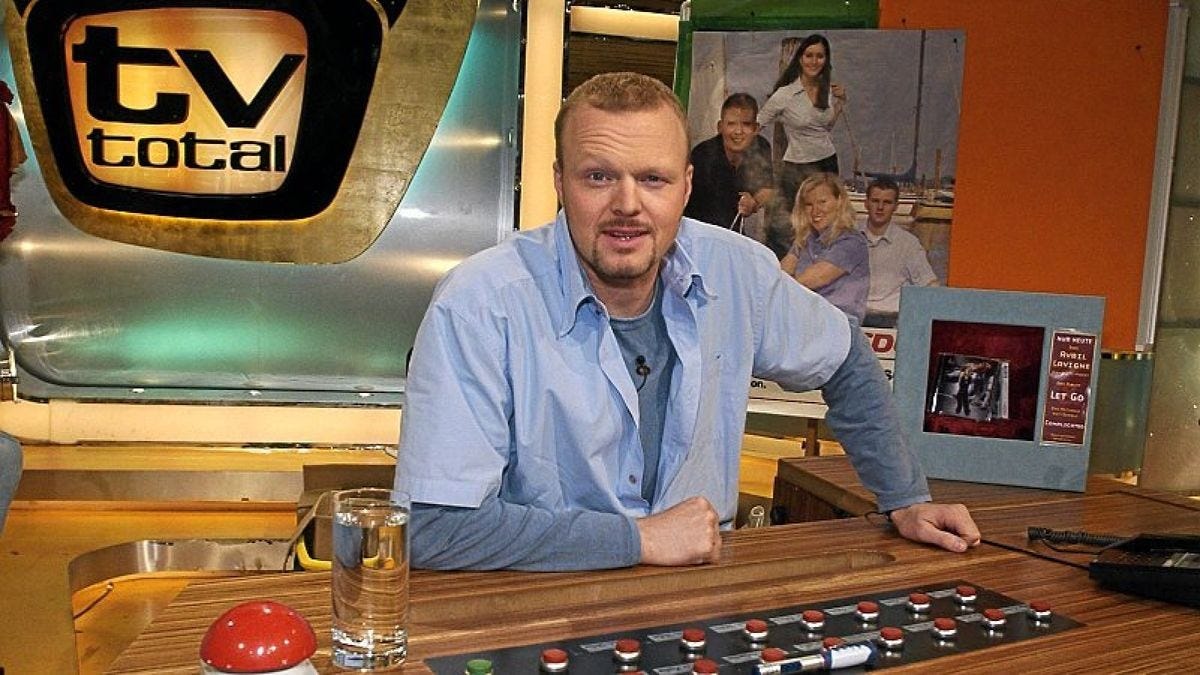
Today, we’re in Cologne and diving into why the show TV total became so popular. It created moments everyone instantly recognized: Maschendrahtzaun, Raab der Woche, Elton as the eternal intern, the Nippelboard, the Wok-WM. None of it was polished - that was the point. It felt spontaneous, chaotic, and perfectly in tune with what people were already talking about.
If you’re curious, I’d actually suggest looking up a few old clips and seeing for yourself whether it still feels entertaining today.

Part 1 - Read 👀
Read the Dialogue (out loud if you can)
Kai: Weißt du noch, wie wir früher jeden Mittwoch TV Total geschaut haben? Das war irgendwie Pflichtprogramm ⍟. Wenn man’s verpasst hat, war man am nächsten Tag im Büro komplett raus ⍟.
Noah: Absolut. Und egal, wie der Tag war, nach der Sendung war man besser drauf. Diese Mischung aus Schadenfreude, Musik und total absurden Einspielern gab’s so einfach nirgendwo sonst.
Kai: Und Stefan Raab war halt auch eine Ausnahmeerscheinung ⍟. Der hat nicht nur moderiert, der hat einfach gemacht, worauf er Lust hatte. Mal Leute interviewt, mal Spiele erfunden, mal Songs produziert – und das alles mit dieser trockenen Art.
Noah: Ja, und dabei hat er ständig Leute vorgeführt, ohne richtig gemein zu sein. Manchmal war’s grenzwertig, aber meistens einfach unfassbar lustig. Diese Interviews mit irgendwelchen Promis oder komplett unbekannten Leuten – legendär.
Kai: Ganz ehrlich, der Mann hat deutsches Fernsehen geprägt. Nicht viele schaffen das. Und dann diese Nummer, dass er einfach beim Eurovision mitmacht – und gewinnt. Das musst du dich mal trauen ⍟.
Noah: Total. Heute wäre sowas undenkbar. Da ist alles durchgeplant, glattgebügelt, bloß nichts riskieren. Damals hattest du das Gefühl: Wenn’s schiefgeht, ist’s halt schiefgegangen.
Kai: Ich glaub, genau das fehlt heute. Dieses Unberechenbare. Man wusste nie, was kommt, aber es war fast immer sehenswert.
Noah: Stimmt. Und wenn ich alte Clips sehe, merk ich erst, wie sehr das Teil vom Alltag ⍟ war.
Kai: Ja. Mittwochabend, Sofa, fertig.
Noah: Mehr brauchte man eigentlich nicht.

Part 2 - Listen 👂
Hear the Dialogue (switch to slow version if the original is too quick)
Audio 🎧
Slow Audio ⏳

Part 3 - Understand 💡
Read the explanations & translation (take your time, ask questions in the comments if something is unclear)
A) Explanations 💬
⍟ Pflichtprogramm means something that feels socially mandatory to watch or do, typically used for shared routines, and it is spoken and neutral.
⍟ komplett raus means being totally out of the loop after missing something everyone else knows, and it is spoken and informal.
⍟ eine Ausnahmeerscheinung refers to someone who clearly stands out as exceptional compared to others, and it is spoken and neutral.
⍟ das musst du dich mal trauen expresses admiration for someone daring to do something bold or risky, and it is spoken and informal.
⍟ Teil vom Alltag means something that regularly belonged to everyday life and routines, and it is spoken and neutral.
B) Translation 🔄
Kai: Do you remember how we used to watch TV total every Wednesday? It was basically must see viewing. If you missed it, you were completely out of the loop at the office the next day.
Noah: Absolutely. And no matter how the day had been, you always felt better afterward. That mix of schadenfreude, music, and totally absurd clips just didn’t exist anywhere else.
Kai: And Stefan Raab really was an exceptional figure. He didn’t just host, he simply did whatever he felt like. Sometimes interviewing people, sometimes inventing games, sometimes producing songs – all with that dry style.
Noah: Yeah, and he constantly put people on display without really being mean. Sometimes it was right on the edge, but most of the time just incredibly funny. Those interviews with random celebrities or complete unknowns were legendary.
Kai: Honestly, the guy shaped German television. Not many manage that. And then that move where he just entered Eurovision and won. You’ve really got to dare to do something like that.
Noah: Totally. Today that would be unthinkable. Everything’s planned out, smoothed over, no risks at all. Back then it felt like if it went wrong, well, it went wrong.
Kai: I think that’s exactly what’s missing today. That unpredictability. You never knew what was coming, but it was almost always worth watching.
Noah: True. And when I see old clips, I only then realize how much it was part of everyday life.
Kai: Yeah. Wednesday night, couch, done.
Noah: You really didn’t need more than that.

Part 4 - Write ✍️
Writing Practice (don’t skip, writing trains your brain to actively form sentences, and this carries over into speaking)
Answer ONE of these:
Kennst du Talk- oder Comedyshows aus deinem Land? Wie sind sie aufgebaut?
Was macht für dich eine gute Unterhaltungssendung im Fernsehen oder online aus?
Welche Rolle spielen solche Shows deiner Meinung nach in der Gesellschaft?
Send me your text by replying to this email, and I will answer + give feedback to the first 20 replies!
(check your spam folder just in case)
💬 Alternatively:
Post your answer in the comments.
(you are more likely to get feedback)
Part 5 - Speak 🗣️
Spoken Conversation Practice (This is the part that gets you speaking more naturally, faster.)
Have a short 3–5 minute conversation with your favorite AI (ChatGPT, Claude, Gemini, etc.).
Follow today’s topic
Or choose your own
Ask the AI for corrections and feedback afterwards
AI isn’t a substitute for real conversations with people, but it’s a great way to practise when no conversation partner is available.
What stood out to you?
Maybe it was a word, a phrase, the tone of the dialogue, or just the way people talk.
If you noticed something - or if something confused you - leave a comment or reply to this email.
And if this kind of real, cultural German is helpful for you, feel free to like it or share it with another learner who wants to understand German beyond textbooks.

LG
Marwan