
Hallo zusammen!
Today’s topic is Torschlusspanik, which literally means “gate-closing panic.”
The expression goes back to a time when medieval towns closed their gates at night. If you arrived too late, you could find yourself locked outside the city walls. Not exactly ideal, especially when the streets outside weren’t particularly safe…
Today, Torschlusspanik describes the fear of missing an opportunity before it’s too late. It’s often used when people worry about getting older, finding a partner, having children, or achieving certain life goals.
But it can also describe everyday situations where time is running out.

Part 1 - Read 👀
Read the Dialogue (out loud if you can)
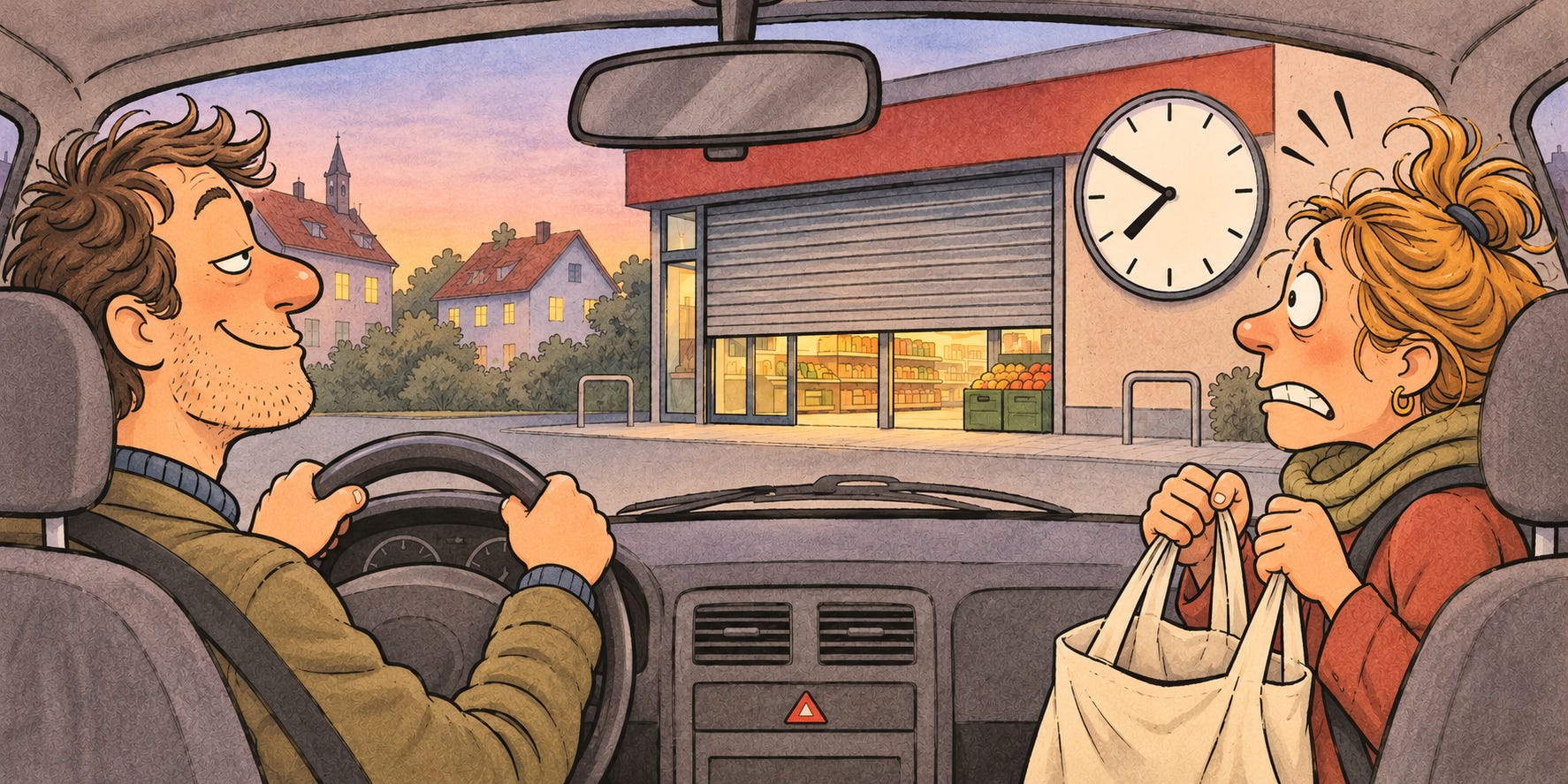
Jule: Sag mal, wie spät ist es?
Max: Zehn vor acht.
Jule: Zehn vor acht! Aldi macht um acht zu! Wir haben nur noch zehn Minuten, Max.
Wir müssen noch einkaufen ⍟.
Max: Das reicht locker ⍟. Wir sind ja in drei Minuten da.
Jule: Wenn wir keine rote Ampel erwischen. Und wenn du nicht wieder so langsam fährst.
Max: Ich fahr nicht langsam. Ich fahr entspannt.
Jule: Entspannt ist heute nicht das Wort, das ich brauche. Ich hab nichts zum Frühstück. Kein Brot, keine Milch, nichts mehr. Wenn wir das nicht schaffen, steh ich morgen früh mit einem leeren Kühlschrank da. Und morgen ist Samstag, da hat alles zu, ach nein, Aldi hat auf, aber –
Max: Jule, atmen. Wir kriegen das hin ⍟.
Jule: Du hast leicht reden ⍟. Du hast zuhause bestimmt noch was zu essen.
Max: Ja, ich mach auch nicht immer alles auf den letzten Drücker ⍟, wie du…
You just saw what conversational German looks like. The next parts are where passive understanding turns into real training reps: 2. listen → 3. understand → 4. write → 5. speak. That’s what makes conversational German start feeling more natural!

Part 2 - Listen 👂
Hear the Dialogue (Repeat if the audio is too quick.)
Audio 🎧

Part 3 - Understand 💡
Read the explanations & translation (Go through the explanations and translation. Take your time, this is where things click.)
A) Explanations 💬
⍟ wir müssen noch einkaufen – A very common spoken phrase used to say that errands still need to be done, with “noch” adding urgency by signalling that time is running out, widely used in everyday planning and in moments of mild panic. (English: “we still need to go shopping” or “we’ve still got to get groceries”, literal: “we must still shop”)
⍟ locker – A very common informal spoken adverb used to say that something is easily manageable without any stress or effort, often added to reassure someone that there is more than enough time, money, or capacity. (English: “easily” or “with room to spare” or “no problem”, literal: “loosely”)
⍟ wir kriegen das hin – A reassuring spoken phrase used to calm someone down by promising that a problem will be solved, with the colloquial verb “hinkriegen” giving it a confident, easygoing tone, very common in informal conversation. (English: “we’ll sort it out” or “we’ll manage”, literal: “we’ll get that done”)
⍟ du hast leicht reden – A common spoken phrase used to point out that the other person can afford to be relaxed or give advice because they are not in the same difficult position, delivered with mild irritation. (English: “that’s easy for you to say”, literal: “you have easy talking”)
⍟ auf den letzten Drücker – A well-known colloquial idiom used to describe doing something at the very last possible moment, often said with mild criticism or teasing, common in informal speech about deadlines and procrastination. (English: “at the last minute” or “at the eleventh hour”, literal: “on the last push”)
B) Translation 🔄
Jule: Tell me, what time is it?
Max: Ten to eight.
Jule: Ten to eight! Aldi closes at eight! We’ve only got ten minutes left, Max. We still need to go shopping.
Max: That’s plenty of time, easily. We’ll be there in three minutes.
Jule: If we don’t hit a red light. And if you don’t drive so slowly again.
Max: I’m not driving slowly. I’m driving in a relaxed way.
Jule: Relaxed is not the word I need today. I’ve got nothing for breakfast. No bread, no milk, nothing left. If we don’t make it, I’ll be standing there tomorrow morning with an empty fridge. And tomorrow is Saturday, everything’s closed, oh no, Aldi’s open, but..
Max: Jule, breathe. We’ll sort it out.
Jule: That’s easy for you to say. You’ve probably still got something to eat at home.
Max: Yeah, I don’t always leave everything until the last minute like you do…

Part 4 - Write ✍️
Writing Practice (this step is easy to skip, but it’s where real progress happens)
Answer ONE of these:
Wann hast du zuletzt Torschlusspanik verspürt?
Warum haben viele Menschen Angst, bestimmte Chancen im Leben zu verpassen?
Glaubst du, dass es für manche Lebensziele irgendwann zu spät ist?
👉 Reply to this email or comment below.
Part 5 - Speak 🗣️
Spoken Conversation Practice (This is the part that gets you speaking more naturally, faster.)
Have a short 3–5 minute conversation with your favorite AI (ChatGPT, Claude, Gemini, etc.).
Follow today’s topic
Or choose your own
Ask the AI for corrections and feedback afterwards
AI isn't a substitute for real conversations with people, but it's a great way to practise when no conversation partner is available.
Hast du manchmal Torschlusspanik oder denkst du, dass für alles noch genug Zeit ist? ⏳
Tell me what you think in the comments, and leave a like if you enjoyed today’s training!
And send this dialogue to someone who’s obviously always in Torschlusspanik mode…

LG
Marwan