
Hallo zusammen!
Have you ever forgotten a word in your native language but remembered it instantly in another one? Or started a sentence in German and finished it in English without meaning to? 😄
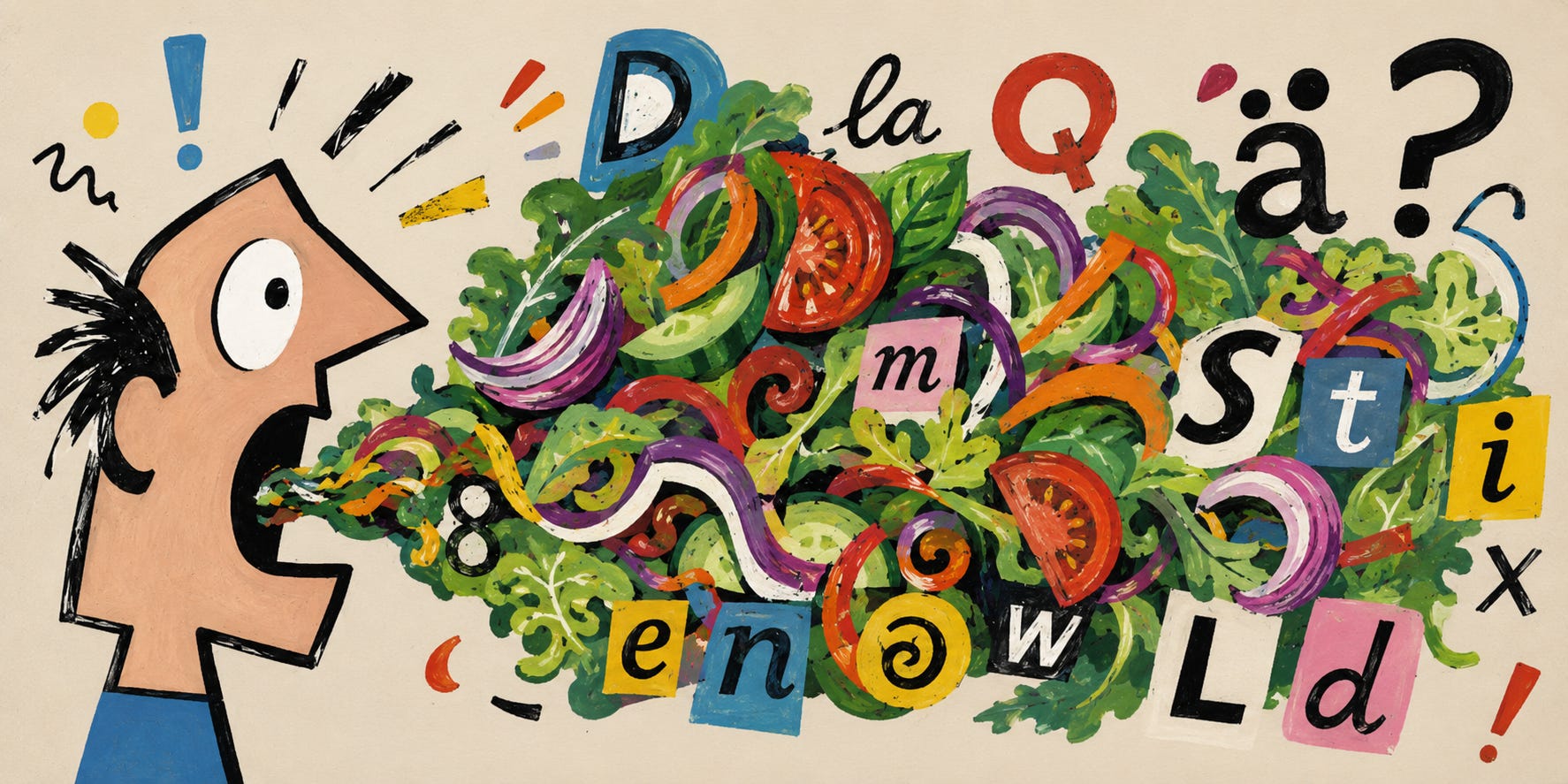
Of course, German has a word for this situation: Sprachsalat, literally “language salad.”
In this dialogue, you’ll learn how German speakers talk about multilingualism, language mixing, and those funny moments when your brain can’t decide which language it’s using, along with useful words, phrases, and natural ways of expressing these experiences in everyday conversation. Let’s explore!

Part 1 - Read 👀
Read the Dialogue (out loud if you can)
Sofia: Ich hab gestern mit meiner Mama telefoniert und ihr mitten im Satz ein deutsches Wort hingeworfen. Einfach so ⍟. Sie hat gefragt, was das heißt. Ich hab's ihr erklärt – auf Deutsch.
Lena: Kennst du das auch, wenn das Wort einfach nur in einer Sprache kommt und in keiner anderen? Mir passiert das ständig mit Englisch. „Das war so awkward" – und ich steh da und weiß nicht, wie ich's auf Deutsch sagen soll.
Sofia: Peinlich? Unangenehm? Beides trifft's irgendwie nicht ganz. Awkward ist einfach awkward.
Lena: Genau. Manche Wörter haben in der anderen Sprache kein richtiges Äquivalent. Das Konzept existiert, aber das Wort passt nicht so ganz rein ⍟.
Sofia: Bei mir ist es mittlerweile ein kompletter Sprachsalat. Spanisch mit meiner Familie, Deutsch auf der Arbeit, Englisch mit Freunden – und manchmal fließt alles zusammen ⍟ und ich weiß selbst nicht mehr, was ich gerade spreche.
Lena: Passiert dir das auch, dass du mitten in einem deutschen Satz abbrichst, weil dir das Wort gerade einfach nur auf Englisch einfällt?
Sofia: Täglich. Heute hab ich zu meinem Kollegen gesagt: „Kannst du das kurz – äh – reviewen?" Ich mein: prüfen. Überprüfen. Das Wort war weg.
Lena: Das kenn ich so gut. Und das Schlimme ist ja – je mehr Sprachen man spricht, desto öfter passiert's. Das Gehirn sucht einfach das nächste verfügbare Wort, egal in welcher Sprache.
Sofia: Meine Mutter sagt, mein Spanisch hat einen Akzent jetzt. Ich spreche meine eigene Muttersprache mit Akzent.
Lena: Das tut weh, oder?
Sofia: Ein bisschen schon. Aber dann denk ich – ich spreche halt drei Sprachen gleichzeitig, einigermaßen ⍟. Das ist doch was ⍟.
Lena: Absolut. Auch wenn der Output manchmal klingt wie Google Translate nach drei Gläsern Wein.
Sofia: Ziemlich genaue Beschreibung, ja.
You just saw what conversational German looks like. The next parts are where passive understanding turns into real training reps: 2. listen → 3. understand → 4. write → 5. speak. That’s what makes conversational German start feeling more natural!

Part 2 - Listen 👂
Hear the Dialogue (switch to slow version if the original is too quick.)
Audio 🎧
Slow Audio ⏳

Part 3 - Understand 💡
Read the explanations & translation (Go through the explanations and translation. Take your time, this is where things click.)
A) Explanations 💬
⍟ einfach so – A very common spoken phrase used to describe something that happened spontaneously and without any particular trigger or reason, often carrying a tone of mild surprise or casual matter-of-factness. (English: “just like that” or “out of nowhere”, literal: “simply so”)
⍟ passt nicht so ganz rein – A natural spoken phrase used to describe something that almost fits a category or context but not quite, with “so ganz” softening the verdict to make it feel considered rather than dismissive, widely usable whenever something is close but not quite right. (English: “doesn’t quite fit” or “doesn’t slot in all that neatly”, literal: “doesn’t fit so completely in”)
⍟ fließt alles zusammen – A natural spoken expression used to describe the moment when separate things blur into each other and lose their distinct boundaries, widely usable in any context involving things merging or becoming hard to tell apart. (English: “everything blends together” or “it all flows into one”, literal: “everything flows together”)
⍟ einigermaßen – A useful spoken adverb used to qualify a claim by softening it to mean “reasonably well” or “more or less,” common whenever someone wants to acknowledge a level of competence or success without overstating it. (English: “more or less” or “reasonably well” or “after a fashion”, literal: “to some measure”)
⍟ das ist doch was – A warm, understated spoken phrase used to remind yourself or someone else that something is worth acknowledging even if it falls short of perfect, with “doch” adding a note of mild insistence that the achievement genuinely counts. (English: “that’s still something” or “that counts for something”, literal: “that is indeed something”)
B) Translation 🔄
Sofia: I was on the phone with my mum yesterday and just dropped a German word into the middle of a sentence. Just like that. She asked what it meant. I explained it to her – in German.
Lena: Do you know that feeling too, when a word only comes to you in one language and not in any other? It happens to me all the time with English. "That was so awkward" – and I just stand there with no idea how to say it in German.
Sofia: Peinlich? Unangenehm? Neither of them quite captures it. Awkward is just awkward.
Lena: Exactly. Some words just don't have a proper equivalent in the other language. The concept exists, but the word doesn't quite fit.
Sofia: For me it's become a complete language salad at this point. Spanish with my family, German at work, English with friends – and sometimes it all blends together and I genuinely don't know what I'm speaking anymore.
Lena: Does it happen to you too that you stop mid-sentence in German because the word only comes to you in English?
Sofia: Every day. Today I said to my colleague: "Can you quickly – uh – review that?" I mean: prüfen. Überprüfen. The word was just gone.
Lena: I know that so well. And the bad part is – the more languages you speak, the more often it happens. The brain just goes for the next available word, whatever language it's in.
Sofia: My mum says my Spanish has an accent now. I speak my own mother tongue with an accent.
Lena: That hurts, doesn't it?
Sofia: A little, yeah. But then I think – I speak three languages at once, more or less. That still counts for something.
Lena: Absolutely. Even if the output sometimes sounds like Google Translate after three glasses of wine.
Sofia: Pretty accurate description, yes.

Part 4 - Write ✍️
Writing Practice (this step is easy to skip, but it’s where real progress happens)
Answer ONE of these:
Warum entsteht oft ein „Sprachsalat“, wenn man mehrere Sprachen spricht?
Welche Vor- und Nachteile hat es, mehrere Sprachen gleichzeitig zu benutzen?
In welchen Situationen vermischst du verschiedene Sprachen? Warum?
👉 Reply to this email or comment below.
Part 5 - Speak 🗣️
Spoken Conversation Practice (This is the part that gets you speaking more naturally, faster.)
Have a short 3–5 minute conversation with your favorite AI (ChatGPT, Claude, Gemini, etc.).
Follow today’s topic
Or choose your own
Ask the AI for corrections and feedback afterwards
AI isn’t a substitute for real conversations with people, but it’s a great way to practise when no conversation partner is available.
In welcher Sprache denkst du gerade? 🥗🗣️
Send this dialogue to someone who starts a sentence in one language and finishes it in another 😄

LG
Marwan