
Hallo zusammen!
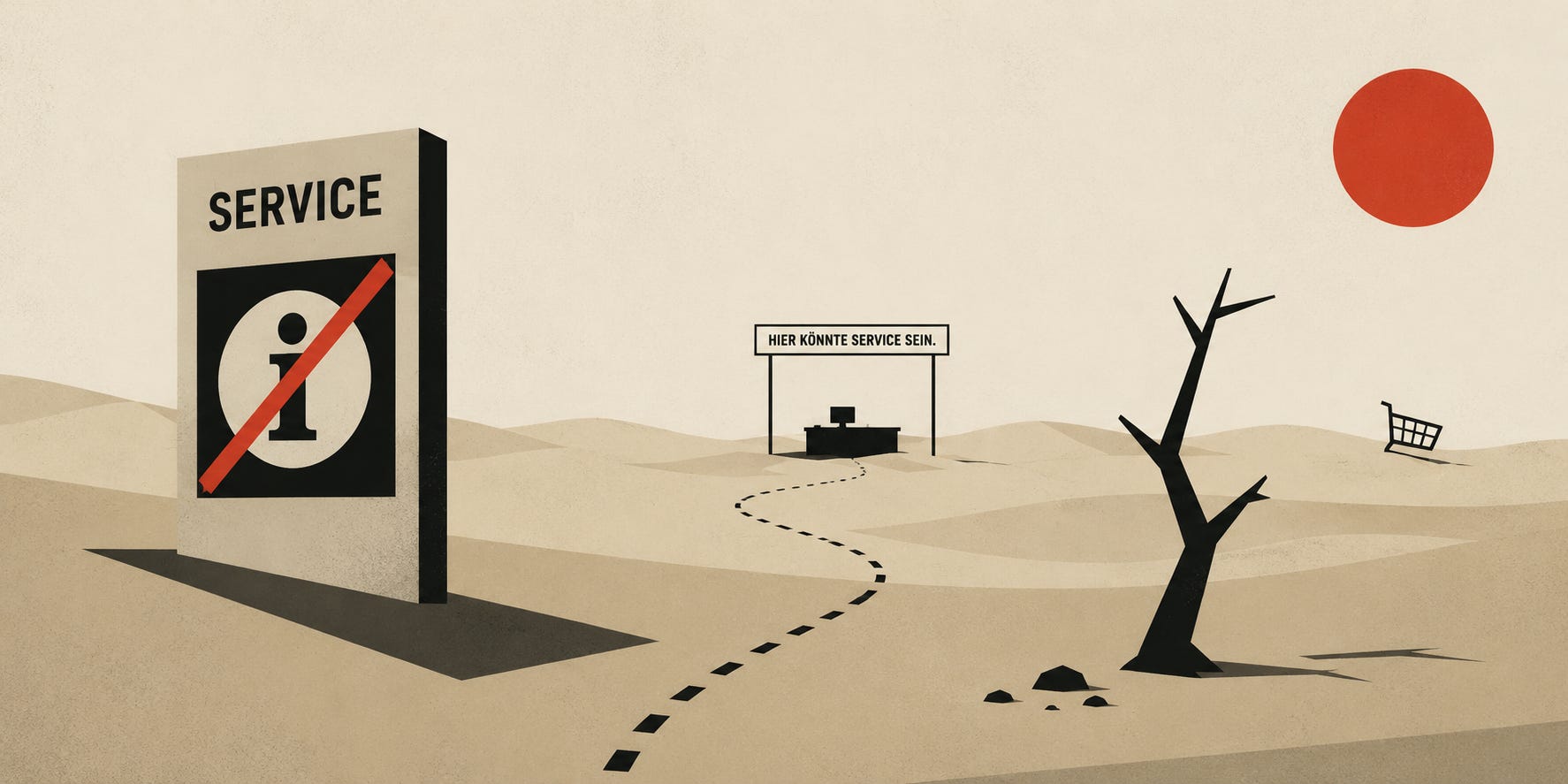
Today’s topic is Servicewüste Deutschland, literally “service desert Germany.” The expression gained popularity in the 1990s and is used to describe the feeling (fact) that customer service in Germany can sometimes seem cold, rigid, and/or strangely unhelpful.
The phrase was originally popularized by the German writer and journalist Wolf Schneider.
Viel Spaß!

Part 1 - Read 👀
Read the Dialogue (out loud if you can)
Rina: Oh Mann ⍟. Ich steh gerade noch unter Schock ⍟.
Lars: Was ist passiert?
Rina: Ich war beim Amt. Ich hatte alle Unterlagen dabei, alles ausgedruckt, alles sortiert – und die Frau am Schalter schaut mich an und sagt: „Haben Sie einen Termin?" Ich sag nein. Sie sagt: „Dann kann ich Ihnen nicht helfen." Und das war's. Gespräch beendet ⍟.
Lars: Klassisch. Ohne Termin existierst du in Deutschland nicht.
Rina: Ich hab versucht zu erklären, dass ich extra Urlaub genommen hab, dass ich extra früh da war – sie hat mich nicht mal ausreden lassen ⍟. Einfach nächster Bitte und weggeschaut.
Lars: Die haben halt keine Kapazität für Ausnahmen. Oder keinen Willen. Ich weiß manchmal nicht, was von beidem schlimmer ist.
Rina: Wo ich herkomme, erklärt man's dir zumindest. Die sagen: tut mir leid, das geht heute nicht, aber versuch's so oder so. Hier kriegst du einen Blick, der sagt: dein Problem, nicht meins.
Lars: Das ist die berühmte Servicewüste. Die Direktheit in Deutschland ist ja eigentlich keine Unfreundlichkeit – die meinen das nicht böse. Aber wenn du's nicht gewohnt bist, fühlt's sich an wie eine Ohrfeige ⍟.
Rina: Ich bin seit zwei Jahren hier. Ich bin's immer noch nicht gewohnt.
Lars: Ich bin seit dreißig Jahren hier und manchmal auch nicht. Letzte Woche beim Supermarkt hat mich die Kassiererin angeschaut, als ob ich sie persönlich beleidigt hätte – dabei hab ich nur mit Karte gezahlt.
Rina: Und jetzt?
Lars: Nächsten Termin in drei Wochen. Nimm dir wieder Urlaub.
Rina: Super. Danke.
You just saw what conversational German looks like. The next parts are where passive understanding turns into real training reps: 2. listen → 3. understand → 4. write → 5. speak. That’s what makes conversational German start feeling more natural!

Part 2 - Listen 👂
Hear the Dialogue (switch to slow version if the original is too quick.)
Audio 🎧
Slow Audio ⏳

Part 3 - Understand 💡
Read the explanations & translation (Go through the explanations and translation. Take your time, this is where things click.)
A) Explanations 💬
⍟ Oh Mann – A very common spoken exclamation used to express frustration, disbelief, or exasperation at the start of a story or reaction, neutral in register and usable across almost any situation where something has gone wrong or turned out badly. (English: “oh man” or “oh come on”)
⍟ unter Schock – A casual spoken phrase used to describe the stunned, disoriented feeling after something unexpected or unpleasant, not necessarily medical shock but the everyday sense of not quite having processed what just happened. (English: “in shock” or “still reeling”, literal: “under shock”)
⍟ das war’s. Gespräch beendet – A blunt, punchy spoken construction used to convey that something ended abruptly and without further discussion, often delivered with exasperation or disbelief when recounting a situation where no room was left for response. (English: “and that was that. Conversation over”, literal: “that was it. Conversation ended”)
⍟ sie hat mich nicht mal ausreden lassen – A common spoken phrase used to express frustration that someone cut you off before you could finish what you were saying, widely used whenever a lack of basic courtesy or attention is the point. (English: “she didn’t even let me finish” or “she cut me off before I could say my piece”, literal: “she didn’t even let me talk to the end”)
⍟ fühlt’s sich an wie eine Ohrfeige – A informal expression used to describe a remark, situation, or attitude that hits you like a slap in the face, common in spoken German when someone wants to convey sharp, unexpected emotional impact. (English: “it feels like a slap in the face”, literal: “it feels like a box on the ear”)
B) Translation 🔄
Rina: Oh man. I'm still in shock right now.
Lars: What happened?
Rina: I went to the government office. I had all my documents with me, everything printed out, everything sorted – and the woman at the counter looks at me and says: "Do you have an appointment?" I say no. She says: "Then I can't help you." And that was that. Conversation over.
Lars: Classic. Without an appointment you don't exist in Germany.
Rina: I tried to explain that I'd taken a day off especially, that I'd come in early specially – she didn't even let me finish. Just "next please" and looked away.
Lars: They don't have the capacity for exceptions. Or the will. I sometimes don't know which of the two is worse.
Rina: Where I come from they at least explain it to you. They say: sorry, that's not possible today, but try this or that. Here you get a look that says: your problem, not mine.
Lars: That's the famous service desert. German directness isn't actually unfriendliness – they don't mean it badly. But if you're not used to it, it feels like a slap in the face.
Rina: I've been here two years. I'm still not used to it.
Lars: I've been here thirty years and sometimes I'm not either. Last week at the supermarket the cashier looked at me as if I'd personally offended her – and all I'd done was pay by card.
Rina: So what now?
Lars: Next appointment in three weeks. Book another day off.
Rina: Great. Thanks.

Part 4 - Write ✍️
Writing Practice (this step is easy to skip, but it’s where real progress happens)
Answer ONE of these:
Warum gilt Deutschland für manche als „Servicewüste“?
Welche Erfahrungen hast du mit gutem oder schlechtem Service gemacht?
Wie wichtig ist guter Kundenservice für dich?
👉 Reply to this email or comment below.
Part 5 - Speak 🗣️
Spoken Conversation Practice (This is the part that gets you speaking more naturally, faster.)
Have a short 3–5 minute conversation with your favorite AI (ChatGPT, Claude, Gemini, etc.).
Follow today’s topic
Or choose your own
Ask the AI for corrections and feedback afterwards
AI isn’t a substitute for real conversations with people, but it’s a great way to practise when no conversation partner is available.
Schon mal Bekanntschaft mit der „Servicewüste“ gemacht? 😅
Well done, you made it to the end!
If this dialogue felt painfully realistic, send it to someone who has survived German bureaucracy, supermarkets, and/or customer service.

LG
Marwan