

Hallo zusammen!
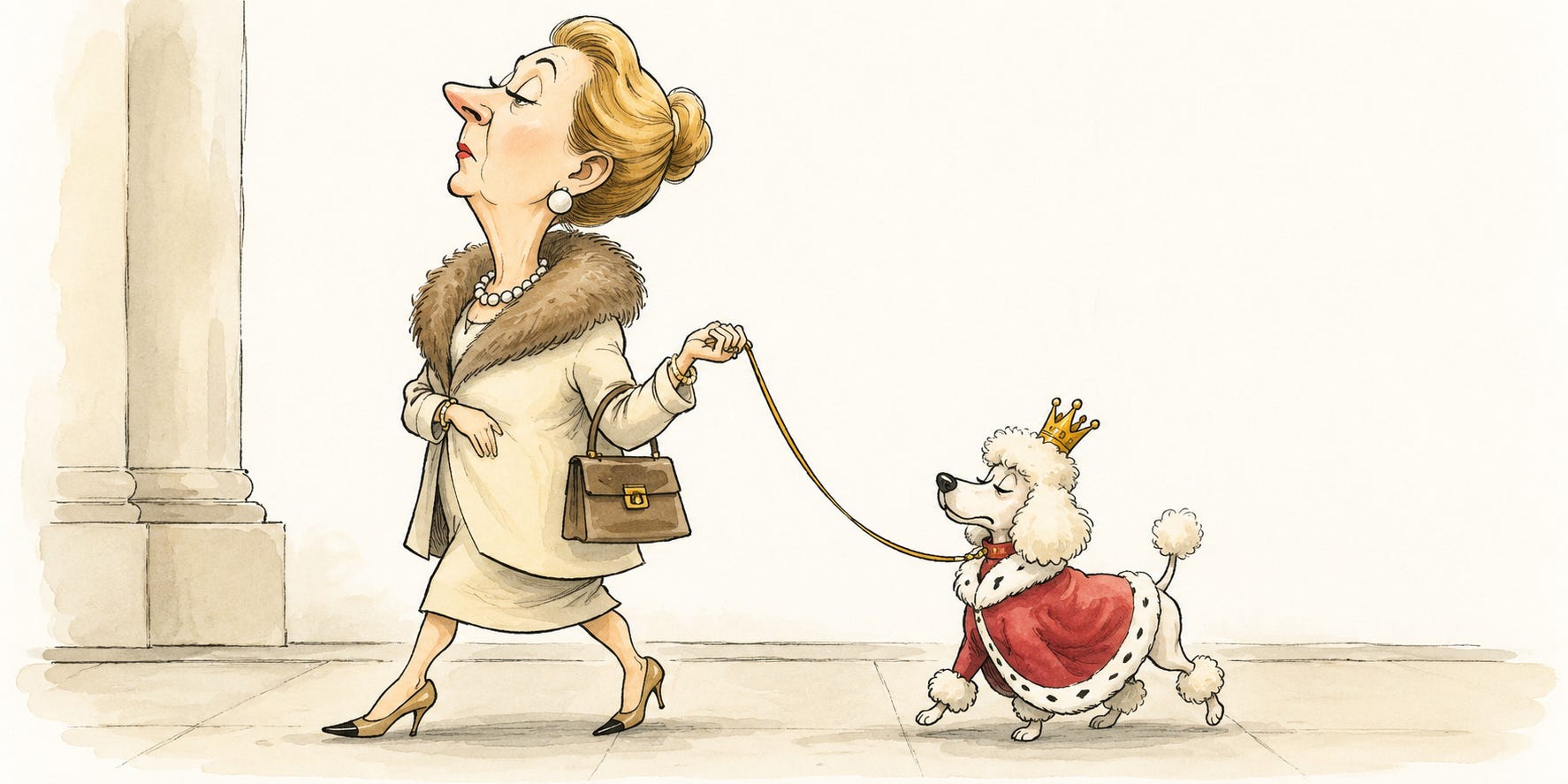
Schickimicki is a playful German word for people who seem overly concerned with appearances, luxury, designer brands, and / or status. No one knows its exact origin, but it likely developed as a rhyming expression in the 1960s and 70s, combining schick (”stylish” or “elegant”) with the nonsense ending -micki to make it sound a little silly and superficial.
Of course, dressing well doesn’t make someone schickimicki. The word is usually used when style starts to feel like showing off.
Part 1 - Read 👀
Read the Dialogue (out loud if you can)
Markus: Schau mal kurz rüber. Da, an dem Tisch rechts. Die Frau mit der riesigen Sonnenbrille.
Tanja: Oh. Oh ja. Die kenn ich vom Yoga. Die hat sich gestern voll danebenbenommen ⍟ und die Lehrerin angemacht ⍟.
Markus: Echt jetzt?
Tanja: Ja. Sie hat gesagt, dass man das bei ihr in Zürich ganz anders macht.
Markus: Okay, sie ist also Schweizer Yoga gewohnt, und hier passt ihr das nicht?
Tanja: Anscheinend. Wer weiß ⍟.
Markus: Schau mal, wie sie die Speisekarte hält. Als würde sie ein Kunstwerk bewerten.
Tanja: Und die Tasche. Ich schätze, die kostet mehr als meine Miete.
Markus: Vielleicht ist sie wirklich reich.
Tanja: Vielleicht tut sie aber auch nur so ⍟.
Markus: Achtung, sie schaut rüber.
Tanja: Immer cool bleiben ⍟.
Markus: Schickimicki.
You just saw what conversational German looks like. The next parts are where passive understanding turns into real training reps: 2. listen → 3. understand → 4. write → 5. speak. That’s what makes conversational German start feeling more natural!

Part 2 - Listen 👂
Hear the Dialogue (switch to slow version if the original is too quick.)
Audio 🎧
Slow Audio ⏳

Part 3 - Understand 💡
Read the explanations & translation (Go through the explanations and translation. Take your time, this is where things click.)
A) Explanations 💬
⍟ voll danebenbenommen – A direct spoken phrase used to describe behaviour that completely crossed the line of what is socially acceptable, with “voll” intensifying the judgment and “danebenbenommen” capturing the sense of acting in a way that misses basic norms entirely. (English: “totally out of order” or “completely out of line”, literal: “fully misbehaved next to it”)
⍟ angemacht – A colloquial spoken verb used to describe verbally attacking or aggressively confronting someone, stronger than simply criticising and carrying a sense of unnecessary hostility, common whenever someone picks a fight they didn’t need to start. (English: “had a go at” or “laid into” or “got in someone’s face”, literal: “switched on”)
⍟ Wer weiß – A short, casual spoken phrase used to shrug off a question or situation without offering an answer, implying that the truth is unclear or not worth speculating about, one of the most natural ways in German to leave something open without committing to a view. (English: “who knows” or “your guess is as good as mine”, literal: “who knows”)
⍟ tut sie aber auch nur so – A natural spoken construction used to suggest that someone is performing wealth, confidence, or status rather than genuinely having it, common whenever someone suspects a person is not quite what they appear. (English: “maybe she’s just putting it on” or “maybe she’s only pretending”, literal: “but maybe she only acts that way”)
⍟ immer cool bleiben – A short, breezy spoken phrase used to remind yourself or someone else not to give anything away in a potentially awkward moment, delivered here as a quiet instruction to act natural and avoid being caught staring or gossiping. (English: “just stay cool” or “keep it cool”, literal: “always stay cool”)
B) Translation 🔄
Markus: Have a quick look over there. That table on the right. The woman with the massive sunglasses.
Tanja: Oh. Oh yeah. I know her from yoga. She was totally out of order yesterday and had a go at the teacher.
Markus: Seriously?
Tanja: Yeah. She said they do it completely differently where she's from in Zurich.
Markus: Okay, so she's used to Swiss yoga and this doesn't quite meet her standards?
Tanja: Apparently. Who knows.
Markus: Look at how she's holding the menu. Like she's appraising a work of art.
Tanja: And that bag. I'd guess it costs more than my rent.
Markus: Maybe she actually is rich.
Tanja: Or maybe she's just putting it on.
Markus: Careful, she's looking over.
Tanja: Just stay cool.
Markus: Fancy pants.

Part 4 - Write ✍️
Writing Practice (this step is easy to skip, but it’s where real progress happens)
Answer ONE of these:
Was bedeutet „Schickimicki“ für dich?
Warum legen manche Menschen so viel Wert auf Luxus und Status?
Welche Rolle spielen Marken und Statussymbole in unserer Gesellschaft?
👉 Reply to this email or comment below.
Part 5 - Speak 🗣️
Spoken Conversation Practice (This is the part that gets you speaking more naturally, faster.)
Have a short 3–5 minute conversation with your favorite AI (ChatGPT, Claude, Gemini, etc.).
Follow today’s topic
Or choose your own
Ask the AI for corrections and feedback afterwards
AI isn't a substitute for real conversations with people, but it's a great way to practise when no conversation partner is available.
Kennst du jemanden, der ein bisschen schickimicki ist? 💎😄
If today's lesson taught you a new German word, send it to that friend who somehow manages to overdress for absolutely every occasion. 😂

LG
Marwan