

Hallo zusammen!
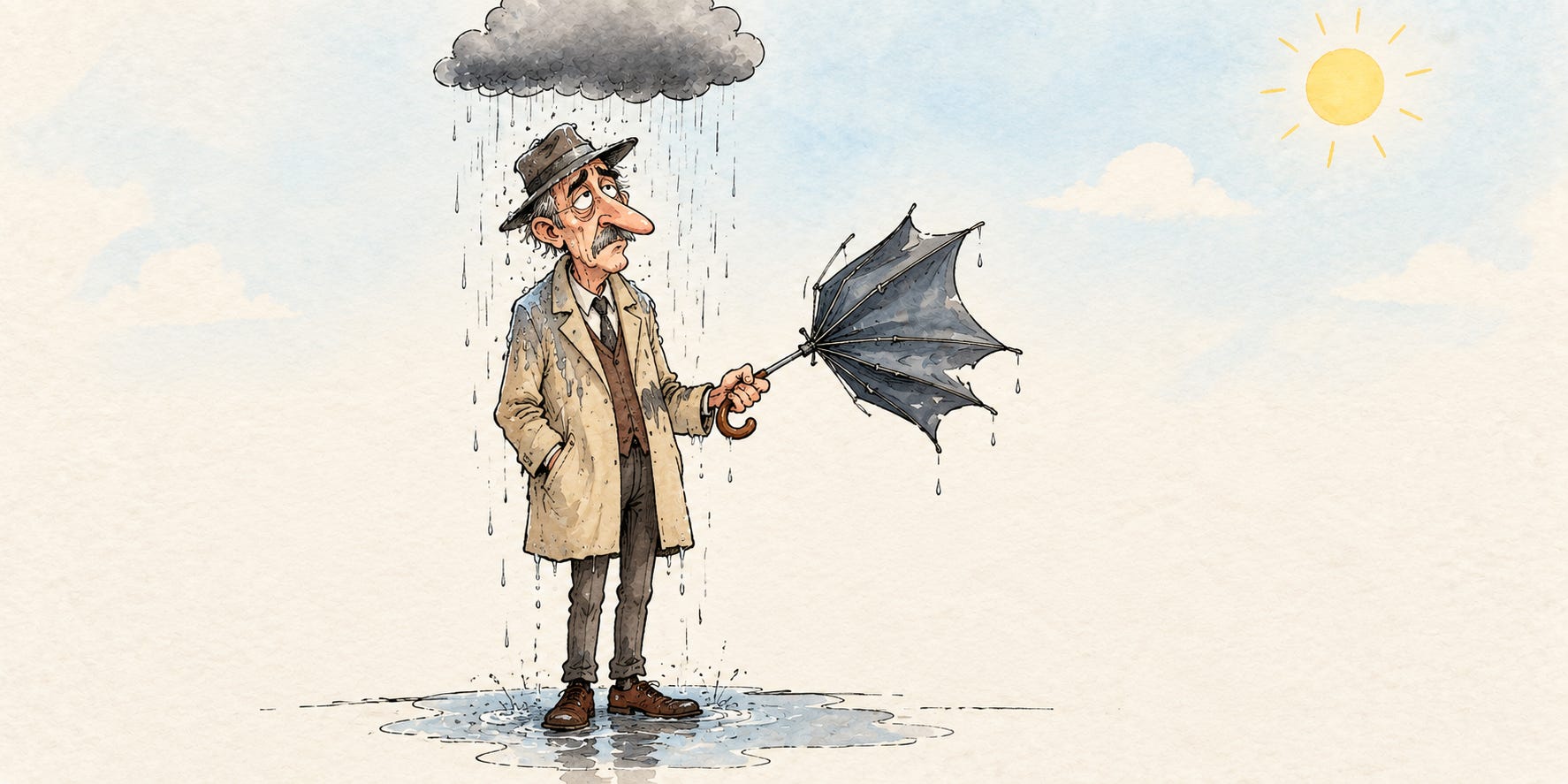
A Pechvogel is someone who seems to have bad luck all the time. In English, you might call them an unlucky person or a poor unlucky soul.
Literally, Pechvogel means “bad-luck bird” and the origin is very interesting. Pech originally meant pitch/tar, which is a very sticky substance. A bird unfortunate enough to get caught in it was literally a Pechvogel. Over time, the word became a metaphor for a person who is particularly unlucky.

Part 1 - Read 👀
Read the Dialogue (out loud if you can)
Mia: Hast du gehört, was dem Florian wieder passiert ist? Beim Einkaufen letzte Woche?
Jonas: Nö ⍟. Was denn?
Mia: Der hat eine Delle ins Auto gekriegt. Und das auf einem leeren Parkplatz.
Jonas: Wie soll das denn bitte gehen? ⍟
Mia: Durch einen Einkaufswagen. Der ist einfach von allein auf sein Auto zugerollt. Sehr mysteriös.
Jonas: Das ist so typisch Florian ⍟. Erinnerst du dich an seinen Urlaub letztes Jahr?
Mia: Am Bodensee?
Jonas: Ja, genau. Schönster Sommer seit zwanzig Jahren, überall Sonne, und an den sieben Tagen, an denen er da war, hat's geregnet.
Mia: Und erinnerst du dich an seinen Heiratsantrag?
Jonas: Oh Gott. Das war auch eine Vollkatastrophe ⍟.
Mia: Die Sara hat ja den Ring verschluckt. Dann kam der Krankenwagen, sie mussten eine Magenspiegelung machen, und der romantische Abend war vorbei.
Jonas: Sie hat trotzdem Ja gesagt.
Mia: Natürlich. Der ist ja auch so ein netter Kerl. Nur halt manchmal ⍟ ein Pechvogel.
You just saw what conversational German looks like. The next parts are where passive understanding turns into real training reps: 2. listen → 3. understand → 4. write → 5. speak. That’s what makes conversational German start feeling more natural!

Part 2 - Listen 👂
Hear the Dialogue (switch to slow version if the original is too quick.)
Audio 🎧
Slow Audio ⏳

Part 3 - Understand 💡
Read the explanations & translation (Go through the explanations and translation. Take your time, this is where things click.)
A) Explanations 💬
⍟ Nö – A casual spoken reduction of “nein” that sounds softer and more relaxed than the full form, widely used in informal conversation to give a quick, unstressed negative without any edge or formality. (English: “nope” or “nah”, literal: a relaxed shortening of “nein”)
⍟ wie soll das denn bitte gehen? – A spoken phrase used to express genuine bewilderment at how something could possibly have happened, with “denn” adding curiosity and “bitte” a hint of exasperated disbelief, common whenever a situation seems physically or logically impossible. (English: “how on earth is that supposed to happen?” or “how is that even possible?”, literal: “how should that please work?”)
⍟ so typisch Florian – A spoken construction used to say that some misfortune or blunder is completely characteristic of a particular person, the pattern “so typisch + name” being one of the most natural ways in everyday German to connect someone’s behaviour to their established reputation. (English: “so typical of Florian” or “that’s so Florian”, literal: “so typical Florian”)
⍟ Vollkatastrophe – A vivid spoken compound used to describe something that went completely and spectacularly wrong, with “Voll-” functioning as an intensifying prefix that pushes “Katastrophe” into the realm of the absurd, common in informal storytelling whenever a disaster deserves full emphasis. (English: “complete disaster” or “total catastrophe”, literal: “full catastrophe”)
⍟ nur halt manchmal – A spoken construction used to soften a characterisation by adding “nur” and “halt,” turning what could be a harsh judgment into something more affectionate and resigned, common whenever someone wants to acknowledge a pattern without being too hard on the person. (English: “just sometimes” or “only now and then”, literal: “only just sometimes”)
B) Translation 🔄
Mia: Did you hear what happened to Florian again? At the supermarket last week?
Jonas: Nope. What?
Mia: He got a dent in his car. In an empty car park.
Jonas: How is that even possible?
Mia: A shopping trolley. It just rolled straight into his car on its own. Very mysterious.
Jonas: That's so typical Florian. Do you remember his holiday last year?
Mia: At Lake Constance?
Jonas: Yeah, exactly. Best summer in twenty years, sun everywhere, and for the seven days he was there it rained.
Mia: And do you remember his marriage proposal?
Jonas: Oh God. That was also a complete disaster.
Mia: Sara swallowed the ring. Then the ambulance came, they had to do an endoscopy, and the romantic evening was over.
Jonas: She still said yes though.
Mia: Of course. He's such a lovely guy. Just sometimes a bit of an unlucky soul.

Part 4 - Write ✍️
Writing Practice (this step is easy to skip, but it’s where real progress happens)
Answer ONE of these:
Kennst du jemanden, der ein echter Pechvogel ist?
Warum haben manche Menschen scheinbar ständig Pech?
Was war dein größter Pechmoment?
👉 Reply to this email or comment below.
Part 5 - Speak 🗣️
Spoken Conversation Practice (This is the part that gets you speaking more naturally, faster.)
Have a short 3–5 minute conversation with your favorite AI (ChatGPT, Claude, Gemini, etc.).
Follow today’s topic
Or choose your own
Ask the AI for corrections and feedback afterwards
AI isn't a substitute for real conversations with people, but it's a great way to practise when no conversation partner is available.
Wer ist der größte Pechvogel, den du kennst? 🐦
Send this dialogue to someone who really hasn’t had luck on their side lately!
LG
Marwan