

Hallo zusammen!
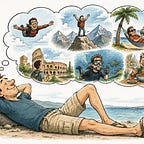
Today’s topic is the Löffelliste. Literally, Löffelliste means “spoon list.” It comes from the German expression den Löffel abgeben (”to hand over the spoon”), an old idiom meaning to die, similar to the English expression to kick the bucket. A Löffelliste is therefore a list of things someone wants to do before they die.
In today’s dialogue, two friends compare the wildest items on their bucket lists.
Los geht’s!

Part 1 - Read 👀
Read the Dialogue (out loud if you can)
Petra: Ich hab eine Löffelliste angefangen. Sachen, die ich noch machen will, bevor ich sterbe.
Klaus: Was zum Beispiel?
Petra: Einmal mit Haien tauchen. Und das ohne Käfig.
Klaus: Wie jetzt? ⍟ Du hast doch selbst Angst vor dem Hundewelpen von deiner Nachbarin.
Petra: Der ist ja aber auch unberechenbar. Haie sind da etwas berechenbarer. Außerdem will ich danach durch die Sahara. Das am besten alleine, mit einem Kamel.
Klaus: Du spinnst doch ⍟. Du bist letzten Sommer nach Mallorca geflogen und hast dich da über die Hitze beschwert. Mallorca. Im Mai.
Petra: Ich war aber auch erkältet. Das zählt doch nicht ⍟. Was steht denn auf deiner Liste?
Klaus: Ich will mal den Everest besteigen.
Petra: Ah ja, alles klar. Hast du nicht erst gestern den Aufzug in den zweiten Stock genommen?
Klaus: Komm schon, das nennt man ⍟ Energiesparen. Etwas völlig anderes. Außerdem will ich einmal komplett nackt durch Island laufen.
Petra: Ok, du machst dich über mich lustig. Die Isländer haben dir gar nichts getan… Okay, ich hab noch einen letzten Punkt auf meiner Liste.
Klaus: Was denn?
Petra: Fallschirmspringen.
Klaus: Ich bin dabei ⍟.
Petra: Wirklich?
Klaus: Nein. Absolut nicht. Niemals.
You just saw what conversational German looks like. The next parts are where passive understanding turns into real training reps: 2. listen → 3. understand → 4. write → 5. speak. That’s what makes conversational German start feeling more natural!

Part 2 - Listen 👂
Hear the Dialogue (switch to slow version if the original is too quick.)
Audio 🎧
Slow Audio ⏳

Part 3 - Understand 💡
Read the explanations & translation (Go through the explanations and translation. Take your time, this is where things click.)
A) Explanations 💬
⍟ wie jetzt? – A very common spoken interjection used to express genuine surprise or disbelief at something just said, asking for clarification while signalling that what you just heard seems hard to take seriously, natural across all informal registers. (English: “hang on?” or “wait, what?” or “how do you mean?”, literal: “how now?”)
⍟ du spinnst doch – A very common spoken expression used to tell someone their idea or plan is completely crazy, delivered with affectionate disbelief rather than genuine criticism, widely usable whenever someone says something that sounds absurd or unrealistic. (English: “you’re out of your mind” or “you must be joking”, literal: “you’re spinning”)
⍟ das zählt doch nicht – A casual spoken phrase used to dismiss a counterexample or comparison as irrelevant or invalid, common in everyday arguments when someone wants to wave away evidence that undermines their position. (English: “that doesn’t count” or “that’s not a fair comparison”, literal: “that doesn’t count”)
⍟ das nennt man – A deadpan spoken construction used to put a label on something, often to reframe questionable behaviour as something principled or intentional, the pattern widely reusable whenever someone wants to give a flattering or ironic name to what they or someone else is doing. (English: “that’s called” or “that’s what you call”, literal: “that is called”)
⍟ ich bin dabei – A very common spoken phrase used to enthusiastically sign up for something or declare you are in, widely usable in any context where someone agrees to join a plan, activity, or challenge. (English: “I’m in” or “count me in”, literal: “I am there”)
B) Translation 🔄
Petra: I've started a bucket list. Things I still want to do before I die.
Klaus: Like what?
Petra: Dive with sharks. Without a cage.
Klaus: Hang on – you're scared of your neighbour's puppy.
Petra: That dog is unpredictable. Sharks are actually a bit more predictable. Besides, I want to cross the Sahara afterwards. Ideally alone, with a camel.
Klaus: You're out of your mind. You flew to Mallorca last summer and complained about the heat. Mallorca. In May.
Petra: I had a cold though. That doesn't count. What's on your list?
Klaus: I want to climb Everest.
Petra: Oh right, sure. Didn't you take the lift to the second floor just yesterday?
Klaus: Come on, that's called saving energy. Completely different thing. And I also want to run through Iceland completely naked.
Petra: Okay, you're making fun of me. The Icelanders never did anything to you… Okay, I've got one last thing on my list.
Klaus: What?
Petra: Skydiving.
Klaus: I'm in.
Petra: Really?
Klaus: No. Absolutely not. Never.

Part 4 - Write ✍️
Writing Practice (this step is easy to skip, but it’s where real progress happens)
Answer ONE of these:
Was steht ganz oben auf deiner Löffelliste? Warum?
Welche Erfahrungen möchtest du unbedingt einmal im Leben machen?
Warum haben viele Menschen eine Löffelliste?
👉 Reply to this email or comment below.
Part 5 - Speak 🗣️
Spoken Conversation Practice (This is the part that gets you speaking more naturally, faster.)
Have a short 3–5 minute conversation with your favorite AI (ChatGPT, Claude, Gemini, etc.).
Follow today’s topic
Or choose your own
Ask the AI for corrections and feedback afterwards
AI isn't a substitute for real conversations with people, but it's a great way to practise when no conversation partner is available.
Was steht auf deiner Löffelliste? 😄
Share, reply and let me know. Maybe you'll inspire someone else to add it to theirs!

LG
Marwan