


Hallo zusammen!
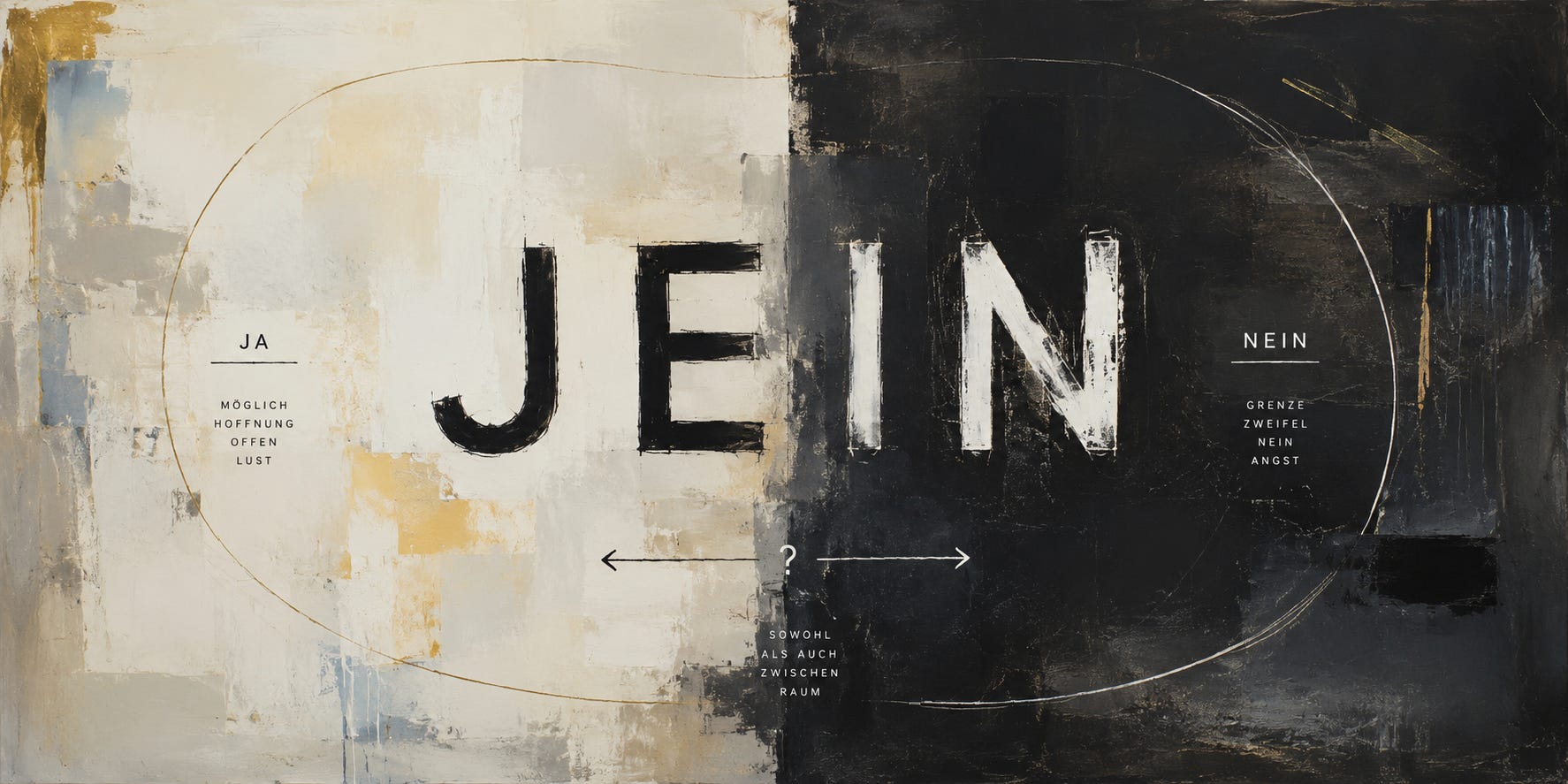
Today’s topic is „Jein“. In my opinion, a quite useful word to know in German. It’s a combination of ja (yes) and nein (no) and is used when the honest answer is somewhere in between.
This dialogue explores one of those situations where „Jein“ could be the best answer. 👀

Part 1 - Read 👀
Read the Dialogue (out loud if you can)
Finn: Darf ich dich was fragen? Und du darfst nicht einfach Ja oder Nein sagen.
Clara: Das ist eine verdächtige Einleitung. Aber okay.
Finn: Würdest du nochmal auswandern, wenn du könntest?
Clara: Jein.
Finn: Ah, erklär mal mehr.
Clara: Ja, natürlich. Ich war vier Jahre in Kanada – beste Erfahrung meines Lebens, ich hab mich entwickelt, hab Selbstständigkeit gelernt, hab Leute getroffen, die ich nie vergesse. Aber ich hab auch gemerkt, was ich vermisse. Familie, Sprache, das Vertraute. Beides war gleichzeitig wahr. Also – jein.
Finn: Das kenn ich. Ich bin gerade hin- und hergerissen ⍟ mit dem Jobangebot in München. Mehr Geld, bessere Position, spannenderes Unternehmen. Aber ich müsste hier alles hinter mir lassen – Wohnung, Freunde, meine ganzen Strukturen.
Clara: Und was sagt dein Bauch?
Finn: Mein Bauch sagt auch jein ⍟. Morgens will ich hin, abends will ich bleiben. Es hängt davon ab, wie ich geschlafen hab.
Clara: Das Schwierige bei solchen Entscheidungen ist – man kann's vorher nicht wissen. Man wägt ab ⍟, macht Listen, redet mit Leuten. Und am Ende fehlt trotzdem die Information, die man eigentlich bräuchte: wie fühlt es sich danach an.
Finn: Genau. Und beide Optionen haben echte Nachteile. Das ist das Lähmende ⍟. Wenn eine Seite klar schlechter wäre, wär's leicht.
Clara: Ich glaub, Jein bedeutet meistens: beide Wege sind möglich, aber keiner ist kostenlos. Und man muss entscheiden, welchen Preis man bereit ist zu zahlen ⍟.
Finn: Das klingt klüger als meine Excel-Tabelle mit Vor- und Nachteilen.
Clara: Hast du wirklich eine Excel-Tabelle?
Finn: Drei. Mit verschiedenen Gewichtungen.
Clara: Finn. Die Antwort steht nicht in der Tabelle.
Finn: Ich weiß. Aber die Tabellen beruhigen mich.
You just saw what conversational German looks like. The next parts are where passive understanding turns into real training reps: 2. listen → 3. understand → 4. write → 5. speak. That’s what makes conversational German start feeling more natural!

Part 2 - Listen 👂
Hear the Dialogue (switch to slow version if the original is too quick.)
Audio 🎧
Slow Audio ⏳

Part 3 - Understand 💡
Read the explanations & translation (Go through the explanations and translation. Take your time, this is where things click.)
A) Explanations 💬
⍟ hin- und hergerissen – A very common spoken expression used to describe being genuinely torn between two options or feelings, with no clear winner, widely usable in any situation involving real inner conflict or difficult decisions. (English: “torn” or “pulled in two directions”, literal: “ripped back and forth”)
⍟ mein Bauch sagt auch jein – A natural spoken construction combining “Bauchgefühl” (gut feeling) with the distinctly German word “jein,” used to express that even your instincts are giving you a mixed signal rather than a clear answer. (English: “my gut is saying the same – yes and no”, literal: “my stomach says also yes-no”)
⍟ wägt ab – The spoken form of “abwägen,” used to describe the process of carefully weighing up options or considerations before making a decision, common in everyday conversation about dilemmas, choices, or judgment calls. (English: “weighs things up” or “considers the pros and cons”, literal: “weighs off”)
⍟ das ist das Lähmende – A spoken construction used to name the specific thing that makes a situation feel paralysing or impossible to move forward from, the pattern “das ist das + adjective-as-noun” being widely reusable to pinpoint what exactly is difficult about something. (English: “that’s what makes it so paralysing” or “that’s the crippling part”, literal: “that is the paralysing thing”)
⍟ welchen Preis man bereit ist zu zahlen – A reflective spoken phrase used to reframe a difficult decision as a question of what cost or sacrifice you are willing to accept, common when someone wants to cut through pros-and-cons thinking and get to the real question. (English: “what price you’re willing to pay”, literal: “which price one is prepared to pay”)
B) Translation 🔄
Finn: Can I ask you something? And you're not allowed to just say yes or no.
Clara: That's a suspicious way to start. But okay.
Finn: Would you emigrate again if you could?
Clara: Yes and no.
Finn: Ah, say more.
Clara: Yes, of course. I spent four years in Canada – best experience of my life, I grew as a person, learned to be independent, met people I'll never forget. But I also noticed what I was missing. Family, language, the familiar. Both were true at the same time. So – yes and no.
Finn: I know that feeling. I'm completely torn right now about the job offer in Munich. More money, better position, more interesting company. But I'd have to leave everything behind here – my flat, my friends, all my routines.
Clara: And what does your gut say?
Finn: My gut says yes and no too. In the morning I want to go, in the evening I want to stay. It depends on how well I slept.
Clara: The hard thing with decisions like this is – you can't know beforehand. You weigh things up, make lists, talk to people. And in the end you're still missing the one piece of information you actually need: how it'll feel afterwards.
Finn: Exactly. And both options have real downsides. That's what makes it so paralysing. If one side were clearly worse, it would be easy.
Clara: I think yes-and-no usually means: both paths are possible, but neither one is free. And you have to decide which price you're willing to pay.
Finn: That sounds smarter than my Excel spreadsheet with pros and cons.
Clara: Do you actually have an Excel spreadsheet?
Finn: Three. With different weightings.
Clara: Finn. The answer isn't in the spreadsheet.
Finn: I know. But the spreadsheets calm me down.

Part 4 - Write ✍️
Writing Practice (this step is easy to skip, but it’s where real progress happens)
Answer ONE of these:
Wann antwortest du eher mit „jein“ statt mit „ja“ oder „nein“?
Warum sind manche Fragen schwer mit einem klaren Ja oder Nein zu beantworten?
In welchen Situationen ist „jein“ die ehrlichste Antwort?
👉 Reply to this email or comment below.
Part 5 - Speak 🗣️
Spoken Conversation Practice (This is the part that gets you speaking more naturally, faster.)
Have a short 3–5 minute conversation with your favorite AI (ChatGPT, Claude, Gemini, etc.).
Follow today’s topic
Or choose your own
Ask the AI for corrections and feedback afterwards
AI isn’t a substitute for real conversations with people, but it’s a great way to practise when no conversation partner is available.
Gibt es bei dir ein „Jein“? 🤔
Send this dialogue to someone who never gives a simple yes-or-no answer 😄

LG
Marwan