

Hallo zusammen!
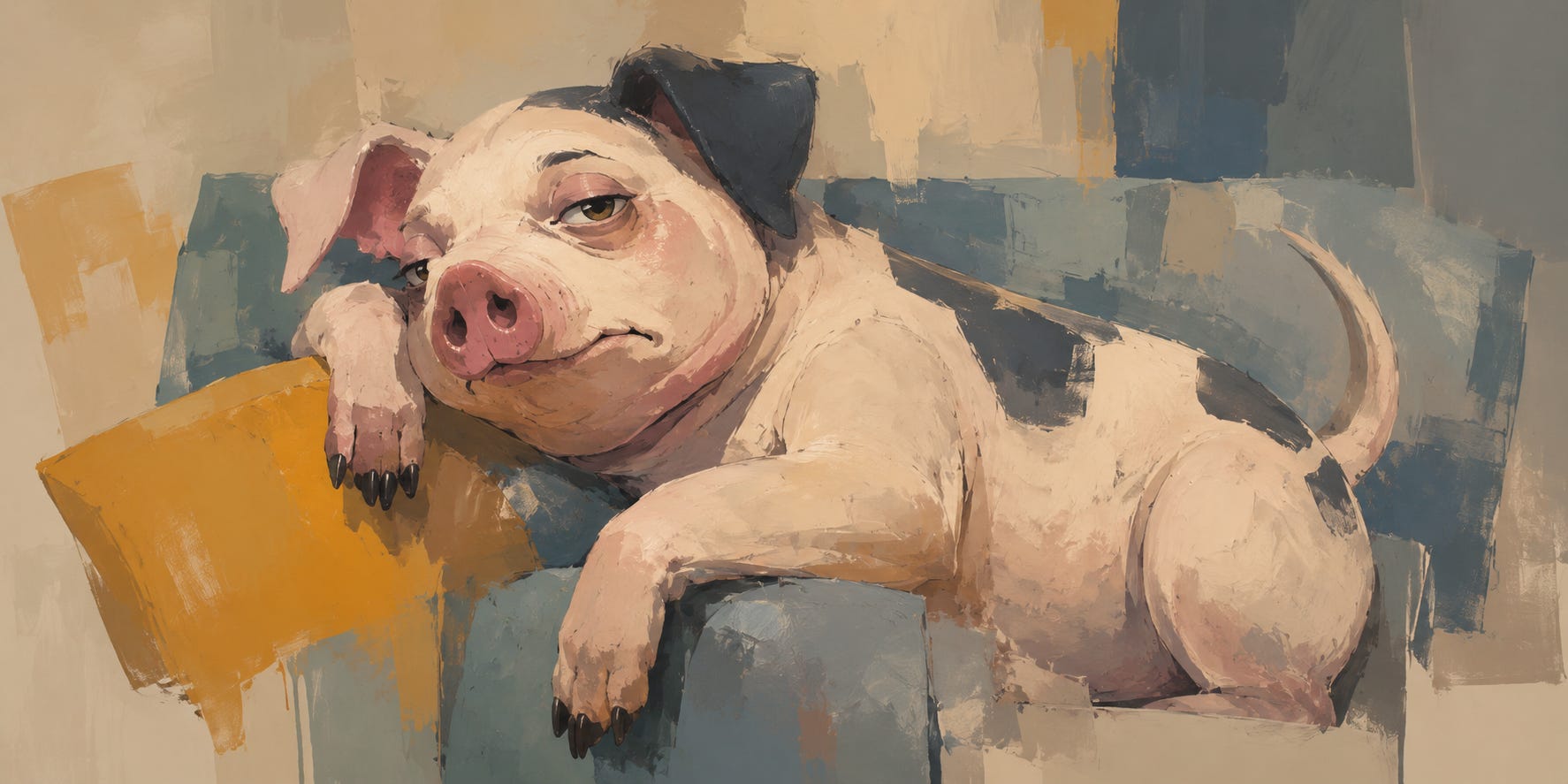
Today’s topic is one of my favorite weird German expressions: „der innere Schweinehund.“ Literally, it means something like “the inner pig-dog.”
The expression has existed for over a hundred years and was originally used for something unpleasant or hard to control. Over time, it became a very common way in German to describe a certain inner struggle that probably all of us know.
What exactly it means… you’ll quickly understand once you read the dialogue 👀

Part 1 - Read 👀
Read the Dialogue (out loud if you can)
Tom: Ich war heute im Fitnessstudio.
Lisa: Wirklich? Ich dachte, du hast seit drei Wochen nicht mehr trainiert.
Tom: Ja, stimmt. Deswegen war's heute auch so eine Überwindung ⍟. Ich hab eine Stunde auf der Couch gesessen, Schuhe an, Schuhe aus, Schuhe wieder an – und dann bin ich irgendwie doch noch gegangen.
Lisa: Das kenn ich so gut. Mein innerer Schweinehund ⍟ ist manchmal unschlagbar. Der redet mir ein, dass ich müde bin, dass ich morgen anfange, dass einmal aussetzen ja nicht schlimm ist.
Tom: Und dann wird aus einmal drei Wochen.
Lisa: Genau. Das Gemeine ist – sobald man drin ist, ist es ja gar nicht so schlimm. Ich hab noch nie ein Training bereut, das ich gemacht hab. Nur die, die ich nicht gemacht hab.
Tom: Irgendwo hab ich mal gelesen, dass man sich nur zu den ersten zehn Minuten verpflichten soll. Einfach anfangen, und dann schaut man weiter ⍟. Klingt simpel, aber es funktioniert eigentlich.
Lisa: Das Problem ist die Zeit davor. Dieser Moment, wo man auf dem Sofa sitzt und weiß, dass man eigentlich sollte ⍟ – das ist der schwerste Teil. Das Training selbst ist easy dagegen.
Tom: Ich hab mir jetzt fest vorgenommen ⍟, dreimal die Woche. Keine Diskussion mit mir selbst, einfach gehen.
Lisa: Das sagst du jetzt. Frag mich in zwei Wochen nochmal.
Tom: Ich frag dich in zwei Wochen, und du fragst mich. Deal?
Lisa: Deal. Wobei ich mir nicht sicher bin, ob das motivierend ist oder einfach gegenseitiger Druck.
Tom: Gegenseitiger Druck funktioniert. Frag jeden, der mal einen Laufpartner hatte.
Lisa: Mein letzter Laufpartner hat nach einer Woche aufgehört.
Tom: Und du?
Lisa: Nach zwei Wochen.
You just saw what conversational German looks like. The next parts are where passive understanding turns into real training reps: 2. listen → 3. understand → 4. write → 5. speak. That’s what makes conversational German start feeling more natural!

Part 2 - Listen 👂
Hear the Dialogue (switch to slow version if the original is too quick.)
Audio 🎧
Slow Audio ⏳

Part 3 - Understand 💡
Read the explanations & translation (Go through the explanations and translation. Take your time, this is where things click.)
A) Explanations 💬
⍟ so eine Überwindung – A spoken expression used to describe the effort it takes to push yourself to do something you’ve been avoiding, capturing the internal resistance before an action rather than the action itself, common in casual conversation about motivation and habits. (English: “such a struggle to get going” or “such a hurdle to overcome”, literal: “such an overcoming”)
⍟ mein innerer Schweinehund – One of the most beloved and untranslatable expressions in everyday German, used to personify the lazy, comfort-seeking inner voice that talks you out of doing what you know you should, used affectionately and without shame across all registers. (English: “my inner laziness” or “the voice in my head telling me not to bother”, literal: “my inner pig-dog”)
⍟ schaut man weiter – A relaxed spoken phrase used to describe a wait-and-see approach where you commit to a small first step and then reassess rather than planning everything in advance, widely usable in any context involving gradual progress or open-ended situations. (English: “you take it from there” or “then you see how it goes”, literal: “then one looks further”)
⍟ eigentlich sollte – A small but loaded spoken construction used to describe the nagging awareness that you know you should be doing something but are not, capturing the gap between intention and action with a hint of guilt or self-awareness. (English: “you know you really should” or “you technically ought to”)
⍟ fest vorgenommen – A common spoken phrase used to describe a firm personal resolution, stronger than a vague intention and carrying the sense that this time the decision is serious and not up for negotiation, often used when someone wants to signal real commitment. (English: “made a firm decision” or “resolved to”, literal: “firmly taken on”)
B) Translation 🔄
Tom: I went to the gym today.
Lisa: Really? I thought you hadn't trained in three weeks.
Tom: Yeah, that's true. Which is why it was such a struggle to get going today. I sat on the couch for an hour, shoes on, shoes off, shoes back on – and then somehow I went anyway.
Lisa: I know that feeling so well. My inner laziness is sometimes unbeatable. It convinces me I'm tired, that I'll start tomorrow, that skipping once isn't a big deal.
Tom: And then once turns into three weeks.
Lisa: Exactly. The annoying thing is – once you're actually there, it's not that bad at all. I've never regretted a workout I actually did. Only the ones I didn't do.
Tom: I read somewhere that you should only commit to the first ten minutes. Just start, and then take it from there. Sounds simple, but it actually works.
Lisa: The problem is the time before. That moment when you're sitting on the sofa and you know you really should – that's the hardest part. The workout itself is easy compared to that.
Tom: I've made a firm decision now – three times a week. No negotiating with myself, just go.
Lisa: That's what you say now. Ask me again in two weeks.
Tom: I'll ask you in two weeks, and you ask me. Deal?
Lisa: Deal. Although I'm not sure if that's motivating or just mutual pressure.
Tom: Mutual pressure works. Ask anyone who's ever had a running partner.
Lisa: My last running partner quit after a week.
Tom: And you?
Lisa: After two weeks.

Part 4 - Write ✍️
Writing Practice (this step is easy to skip, but it’s where real progress happens)
Answer ONE of these:
Wann musst du gegen deinen inneren Schweinehund kämpfen?
Warum fällt es Menschen oft schwer, motiviert zu bleiben?
Welche Methoden helfen dir, disziplinierter zu sein?
👉 Reply to this email or comment below.
Part 5 - Speak 🗣️
Spoken Conversation Practice (This is the part that gets you speaking more naturally, faster.)
Have a short 3–5 minute conversation with your favorite AI (ChatGPT, Claude, Gemini, etc.).
Follow today’s topic
Or choose your own
Ask the AI for corrections and feedback afterwards
AI isn’t a substitute for real conversations with people, but it’s a great way to practise when no conversation partner is available.
Hat dein innerer Schweinehund heute gewonnen?
Send it to someone who’s currently “starting again on Monday” 😄

LG
Marwan