


Hallo zusammen!
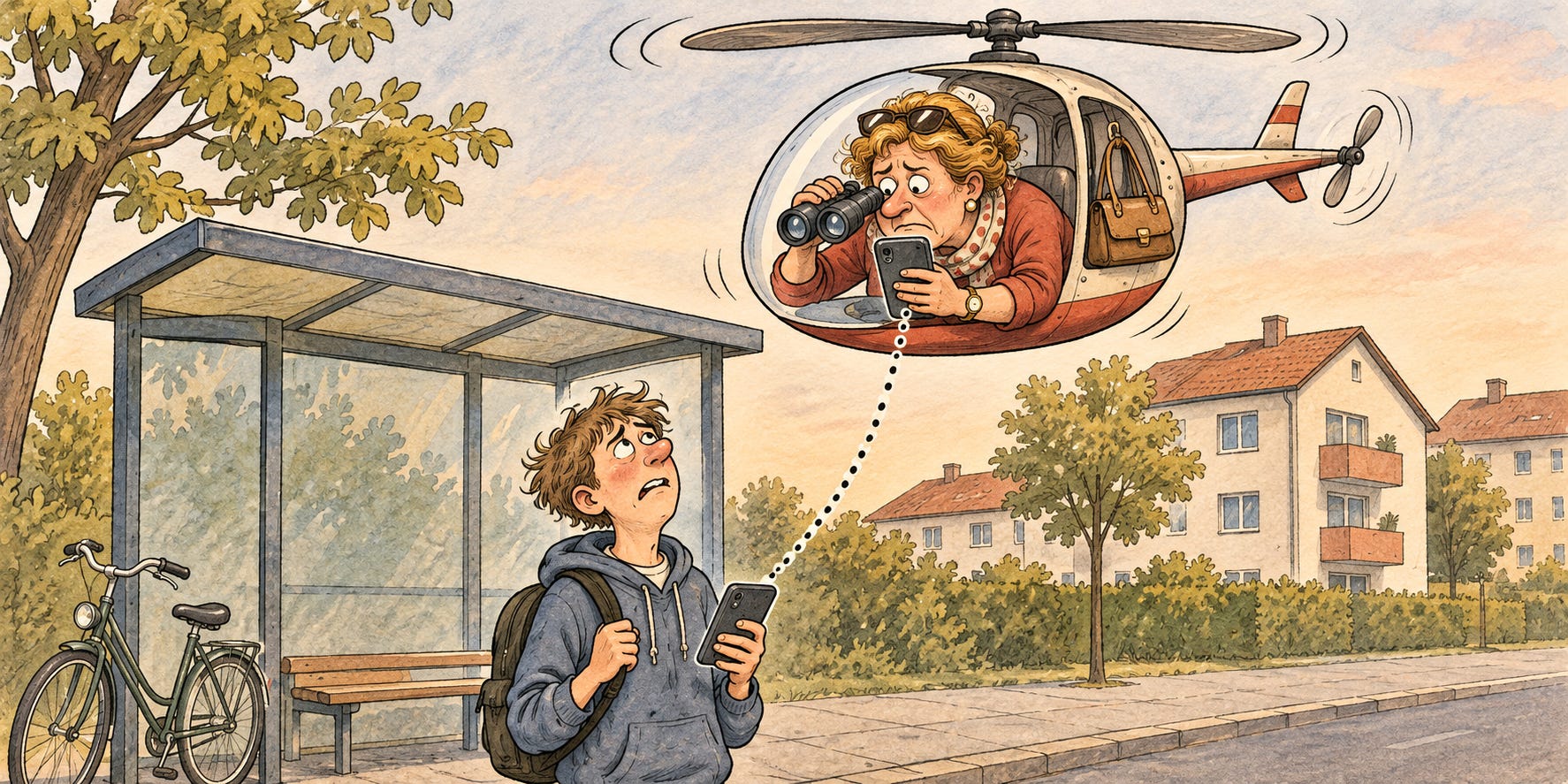
Today’s topic is Helikoptereltern, literally “helicopter parents.”
And yes, it’s the same expression as in English!
The German term comes from the English term, which describes parents who constantly hover over their children, monitoring their activities, controlling their decisions, and trying to protect them from every possible danger.
Viel Spaß!

Part 1 - Read 👀
Read the Dialogue (out loud if you can)
Daniel: Du, meine Schwester hat ihrem Sohn eine Tracking-App auf dem Handy installiert. Dabei ist der schon sechzehn. Sie sieht also immer live, wo er sich gerade herumtreibt ⍟.
Stefan: Oh Mann… und er weiß das?
Daniel: Seit letzter Woche schon, ja. Er hat’s selbst rausgefunden, weil sie ihn angerufen und gesagt hat: „Warum bist du noch im Bus? Du solltest schon zu Hause sein!“
Stefan: Das ist so ein klassischer Fall von Helikoptermama.
Daniel: Sie sagt, sie macht es wegen der Sicherheit. Heutzutage könne ja alles passieren. Aber mal ehrlich ⍟, wir sind früher stundenlang draußen rumgerannt, und unsere Eltern wussten gar nicht, wo wir waren.
Stefan: Das war aber auch eine andere Zeit. Ich versteh die Angst schon ein bisschen. Mit Handy, Social Media und Internet – da gibt’s ja auch Gefahren, die es früher nicht gab.
Daniel: Klar. Aber irgendwann muss man doch loslassen ⍟. Der Junge muss auch mal Fehler machen dürfen. Ich hab mit sechzehn ein Fahrrad in den Fluss geworfen, und aus mir ist trotzdem was geworden.
Stefan: Ich glaub, es kommt auf die Dosis an. Ein bisschen Kontrolle schadet nicht, aber wenn Eltern jede Hausaufgabe überprüfen und mit dem Lehrer um jede Note feilschen ⍟, dann lernt das Kind nie, selbst klarzukommen.
Daniel: Genau. Neulich hat eine Mutter bei uns im Büro angerufen, weil ihr Sohn – vierundzwanzig Jahre alt – sein Vorstellungsgespräch verschlafen hatte. Sie wollte einen neuen Termin ausmachen.
Stefan: Das ist nicht dein Ernst ⍟.
You just saw what conversational German looks like. The next parts are where passive understanding turns into real training reps: 2. listen → 3. understand → 4. write → 5. speak. That’s what makes conversational German start feeling more natural!

Part 2 - Listen 👂
Hear the Dialogue (Repeat if the audio is too quick.)
Audio 🎧

Part 3 - Understand 💡
Read the explanations & translation (Go through the explanations and translation. Take your time, this is where things click.)
A) Explanations 💬
⍟ mal ehrlich – A very common spoken phrase used to introduce a frank, slightly challenging point, signalling that the speaker is about to say what many people are thinking but rarely say out loud. (English: “let’s be honest” or “come on, honestly”, literal: “once honestly”)
⍟ herumtreibt – An informal spoken verb used to describe someone hanging around or roaming about with no clear purpose, often with a slightly disapproving or suspicious undertone, common when parents talk about teenagers. (English: “hanging around” or “roaming about”, literal: “drives itself around”)
⍟ loslassen – A neutral but emotionally loaded verb used in everyday speech to describe giving up control, whether over a person, a worry or a situation, very common in conversations about parenting and relationships. (English: “to let go”, literal: “to let loose”)
⍟ um jede Note feilschen – A vivid spoken phrase used to describe haggling over every small detail as if it were a market deal, here applied to parents who bargain with teachers about grades, informal and mildly mocking in tone. (English: “haggle over every single grade”, literal: “haggle about every grade”)
⍟ dein Ernst – A short spoken expression, almost always used in the question or negated form “das ist nicht dein Ernst”, to react with disbelief to something absurd, widely used among friends and family. (English: “you can’t be serious” or “you’re kidding”, literal: “your seriousness”)
B) Translation 🔄
Daniel: Hey, my sister installed a tracking app on her son’s phone. And he’s already sixteen. So she can see live where he’s off roaming at any given moment.
Stefan: Oh man… and does he know?
Daniel: Since last week, yeah. He found out himself because she called him and said: “Why are you still on the bus? You should be home by now!”
Stefan: That’s a classic case of a helicopter mum.
Daniel: She says she does it for safety. Anything could happen these days. But let’s be honest, we used to be out running around for hours and our parents had no idea where we were.
Stefan: Different times, though. I understand the fear a little. With phones, social media and the internet, there are dangers that didn’t exist back then.
Daniel: Sure. But at some point you have to let go. The boy has to be allowed to make mistakes. When I was sixteen I threw a bike into the river, and I still turned out fine.
Stefan: I think it’s all about moderation. A bit of control doesn’t hurt, but if parents check every piece of homework and haggle with the teacher over every single grade, the kid never learns to cope on their own.
Daniel: Exactly. The other day a mother called our office because her son, twenty-four years old, had overslept his job interview. She wanted to arrange a new appointment.

Part 4 - Write ✍️
Writing Practice (this step is easy to skip, but it’s where real progress happens)
Answer ONE of these:
Wann werden Eltern deiner Meinung nach zu Helikoptereltern?
Welche Auswirkungen kann übermäßige Fürsorge auf Kinder haben?
Wie viel Freiheit sollten Eltern ihren Kindern geben?
👉 Reply to this email or comment below.
Part 5 - Speak 🗣️
Spoken Conversation Practice (This is the part that gets you speaking more naturally, faster.)
Have a short 3–5 minute conversation with your favorite AI (ChatGPT, Claude, Gemini, etc.).
Follow today’s topic
Or choose your own
Ask the AI for corrections and feedback afterwards
AI isn't a substitute for real conversations with people, but it's a great way to practise when no conversation partner is available.
Hattest du als Kind Helikoptereltern oder durftest du auch mal etwas alleine machen? 🚁
Tell me in the comments, and leave a like if you enjoyed today’s training!
And send this dialogue to someone whose parents still check whether they’ve eaten, worn a jacket, and arrived home safely… even though they’re 35.

LG
Marwan