

Hallo zusammen!
Literally, Glückspilz means “lucky mushroom.” It sounds strange at first, but the word goes back to the 19th century. Certain mushrooms were considered rare and valuable finds, so anyone who discovered them was seen as especially fortunate. Over time, Glückspilz became a playful way of describing someone who always seems to have luck on their side.
Are you a Glückspilz or does luck usually seem to find everyone else?

Part 1 - Read 👀
Read the Dialogue (out loud if you can)
Lena: Krass ⍟. Ich glaub, ich bin gerade die glücklichste Person Deutschlands. Ich hab diese Woche im Supermarkt an der Kasse zwanzig Euro gefunden. Die lagen einfach da.
Mia: Okay, schön für dich.
Lena: Warte. Jetzt kommt's ⍟. Dann hab ich ein Parkticket gekriegt, aber der Automat war kaputt, und die mussten es stornieren. Danach hab ich beim Bäcker versehentlich zu wenig gezahlt, und die haben mir einfach gesagt: passt schon ⍟.
Mia: Boah. Sowas passiert mir nie.
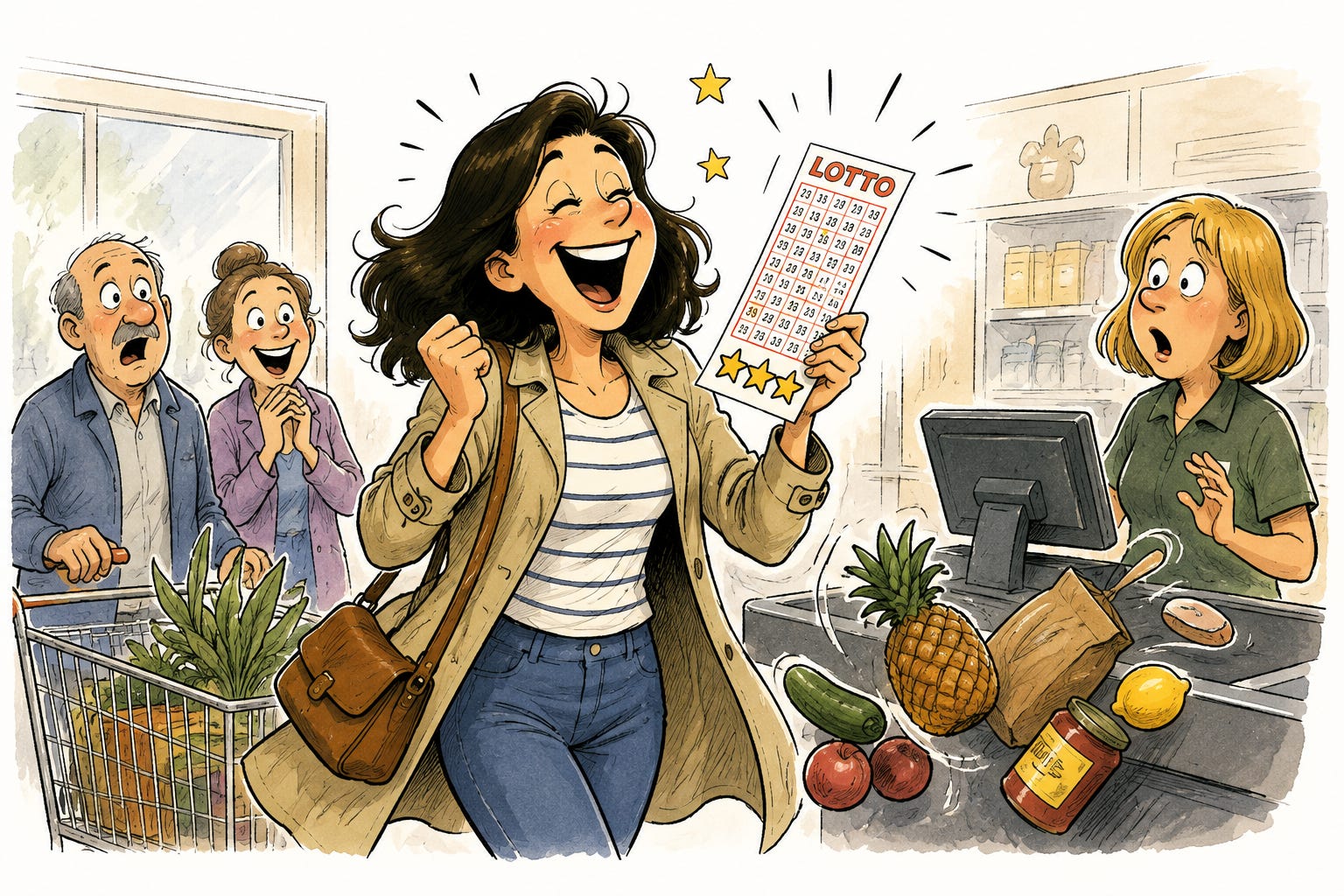
Lena: Und dann – das ist der Höhepunkt ⍟ – hab ich bei einem Gewinnspiel mitgemacht. Irgendwas auf Instagram, ich hab nicht mal richtig hingeschaut. Und ich hab natürlich gewonnen.
Mia: Was hast du gewonnen?
Lena: Ein Wochenende in einem Wellnesshotel. Für zwei Personen.
Mia: Mensch, das gibt's ja nicht ⍟.
Lena: Willst du mitkommen?
Mia: Ja klar. Sofort. Seit wann bist du eigentlich so ein Glückspilz?
Lena: Keine Ahnung. Aber ich kauf morgen auf jeden Fall einen Lottoschein.
You just saw what conversational German looks like. The next parts are where passive understanding turns into real training reps: 2. listen → 3. understand → 4. write → 5. speak. That’s what makes conversational German start feeling more natural!

Part 2 - Listen 👂
Hear the Dialogue (switch to slow version if the original is too quick.)
Audio 🎧
Slow Audio ⏳

Part 3 - Understand 💡
Read the explanations & translation (Go through the explanations and translation. Take your time, this is where things click.)
A) Explanations 💬
⍟ Krass – A very common spoken exclamation used to react to something surprising, impressive, or hard to believe, one of the most versatile informal intensifiers in everyday German, equally at home expressing amazement, disbelief, or mild shock. (English: “wow” or “unbelievable” or “insane”, literal: “extreme” or “glaring”)
⍟ jetzt kommt’s – A spoken phrase used to build anticipation before delivering the best or most surprising part of a story, functioning as a verbal drumroll that tells the listener to pay close attention to what comes next, common in informal storytelling. (English: “now here’s the thing” or “wait for it” or “but here’s the best part”, literal: “now it comes”)
⍟ passt schon – A very common spoken phrase used to wave away a problem or mistake with easy-going acceptance, signalling that something is fine as it is and no correction or apology is needed, widely used across everyday situations as a casual all-clear. (English: “that’s fine” or “don’t worry about it” or “no problem”, literal: “it fits already”)
⍟ das ist der Höhepunkt – A spoken phrase used to flag that the most impressive or surprising part of a story is about to land, often placed mid-sentence as a pause for effect before the punchline or key moment is revealed. (English: “this is the highlight” or “and here’s the best bit”, literal: “that is the high point”)
⍟ das gibt’s ja nicht – A spontaneous spoken exclamation used to express delighted disbelief when something seems almost too good or too unlikely to be real, one of the most natural reactions in German when something genuinely surprises you in a positive way. (English: “you’re kidding” or “I can’t believe it” or “no way”, literal: “that doesn’t exist”)
B) Translation 🔄
Lena: Unbelievable. I think I'm the happiest person in Germany right now. This week I found twenty euros at the checkout in the supermarket. Just sitting there.
Mia: Okay, good for you.
Lena: Wait. Here's the best part. Then I got a parking ticket, but the machine was broken and they had to cancel it. After that I accidentally underpaid at the bakery and they just said: don't worry about it.
Mia: Wow. That never happens to me.
Lena: And then – and this is the highlight – I entered a competition. Something on Instagram, I didn't even look properly. And of course I won.
Mia: What did you win?
Lena: A weekend at a wellness hotel. For two people.
Mia: No way. I can't believe it.
Lena: Do you want to come?
Mia: Of course. Right now. Since when are you such a lucky devil?
Lena: No idea. But I'm definitely buying a lottery ticket tomorrow.

Part 4 - Write ✍️
Writing Practice (this step is easy to skip, but it’s where real progress happens)
Answer ONE of these:
Was macht jemanden deiner Meinung nach zu einem Glückspilz?
Glaubst du, dass Glück Zufall ist oder dass man es beeinflussen kann? Warum?
Wann hattest du zuletzt besonders viel Glück?
👉 Reply to this email or comment below.
Part 5 - Speak 🗣️
Spoken Conversation Practice (This is the part that gets you speaking more naturally, faster.)
Have a short 3–5 minute conversation with your favorite AI (ChatGPT, Claude, Gemini, etc.).
Follow today’s topic
Or choose your own
Ask the AI for corrections and feedback afterwards
AI isn't a substitute for real conversations with people, but it's a great way to practise when no conversation partner is available.
Bist du ein Glückspilz? 🍀🍄
Send this lesson to someone who's definitely not been a Glückspilz this week. 🍀😂

LG
Marwan