

Moin moin!
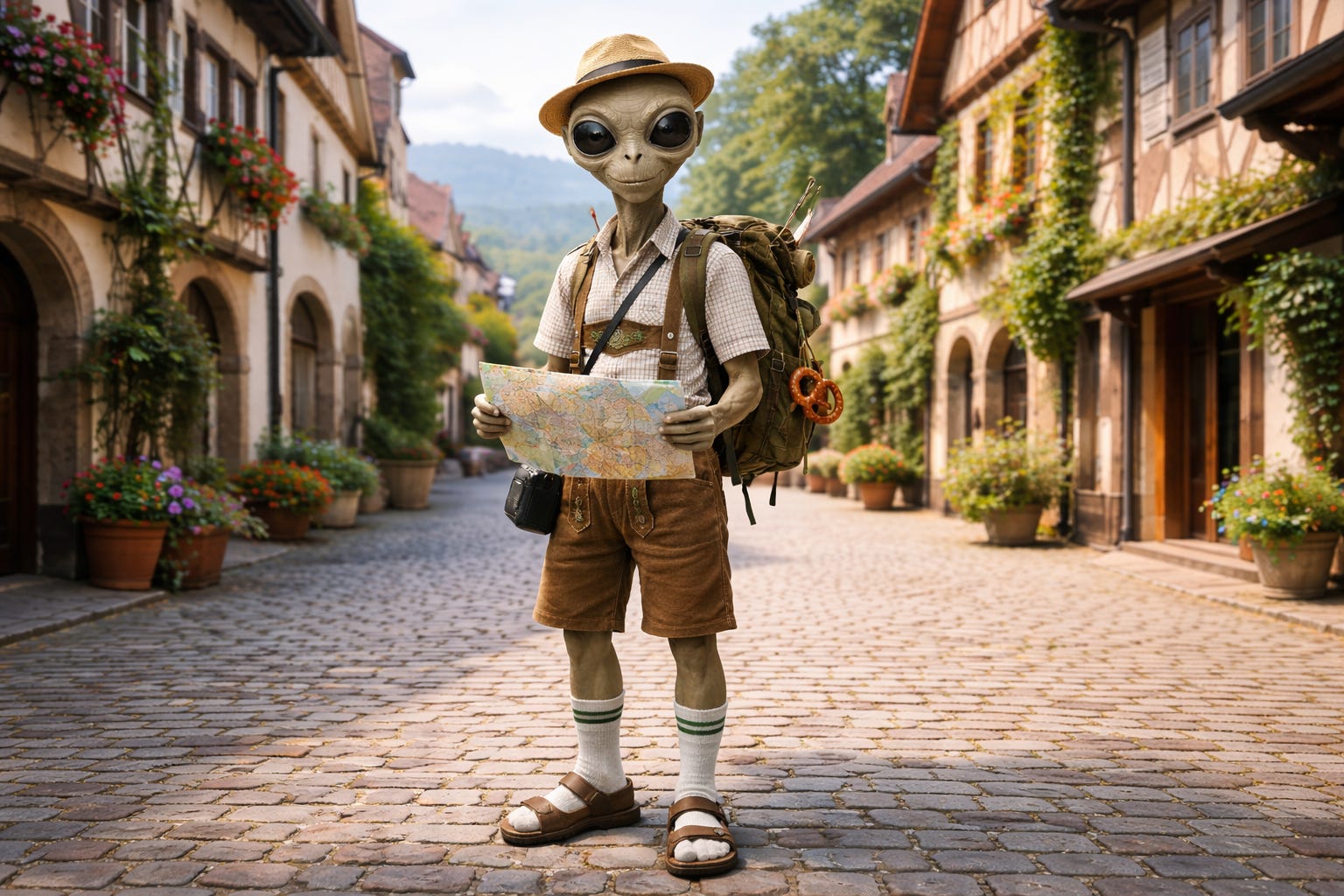
Are we alone in the universe… or just „nicht ganz von dieser Welt“? 👽 This dialogue plays with that very human mix of curiosity, logic, and slightly wild imagination.
Now I’m curious: Was meint ihr? Feel free to share your thoughts.

Part 1 - Read 👀
Read the Dialogue (out loud if you can)
Jan: Glaubst du eigentlich, dass wir wirklich allein im Universum sind? Ich mein, rein statistisch gesehen wäre das doch total unwahrscheinlich. Milliarden Galaxien, Milliarden Sterne – und nur hier soll Leben entstanden sein?
Alex: Eben! Das denk ich mir auch immer. Allein in unserer Galaxie gibt es so viele erdähnliche Planeten. Da muss doch irgendwo irgendwas sein ⍟. Vielleicht nicht unbedingt kleine grüne Männchen, aber zumindest Mikroorganismen oder irgendwas in der Art.
Jan: Ja, genau. Viele denken ja sofort an UFOs und Hollywood, aber es geht ja erstmal nur um Leben an sich. Selbst Bakterien wären schon eine Sensation. Und wenn es einfache Lebensformen gibt, warum dann nicht auch komplexe?
Alex: Stimmt. Und dann gibt’s noch dieses Fermi-Paradoxon. Wenn es so wahrscheinlich ist, warum haben wir noch nichts gehört? Keine Signale, nichts Eindeutiges. Das find ich fast noch spannender ⍟ als die Frage, ob es sie gibt.
Jan: Vielleicht sind die Entfernungen einfach zu groß. Oder die sind technisch schon viel weiter und haben kein Interesse an uns. Oder wir sind für sie wie Ameisen – interessant, aber nicht wirklich relevant.
Alex: Das wär irgendwie ernüchternd. Andererseits: Vielleicht beobachten sie uns längst und denken sich: „Nee, da warten wir noch ein paar Jahrhunderte.“
Jan: Möglich. Manchmal, wenn ich die Nachrichten sehe, denk ich mir auch ⍟: Vielleicht besser so.
Alex: Oder sie sind schon hier.
Jan: Jetzt wird’s aber wild ⍟.
Alex: Naja, wenn ich dich so anschaue… bist du dir sicher, dass du nicht von einem anderen Planeten kommst?
Jan: Sehr witzig.
Alex: War nur Spaß. Aber ausschließen kann man’s bei dir nicht ganz ⍟.

Part 2 - Listen 👂
Hear the Dialogue (switch to slow version if the original is too quick)
Audio 🎧
Slow Audio ⏳

Part 3 - Understand 💡
Read the explanations & translation (take your time, ask questions in the comments if something is unclear)
A) Explanations 💬
⍟ da muss doch irgendwo irgendwas sein expresses strong intuitive conviction that something must exist and is used in speculative discussions, literally “there has to be something somewhere,” spoken and informal.
⍟ das find ich fast noch spannender means finding one aspect even more interesting than another and is used to compare ideas in conversation, literally “I find that almost even more exciting,” spoken and neutral.
⍟ denk ich mir auch signals personal reflection or internal agreement and is commonly used when sharing thoughts, literally “I think that to myself too,” spoken and informal.
⍟ jetzt wird’s aber wild comments that a situation or idea is becoming extreme or unrealistic and is used humorously in discussions, literally “now it’s getting wild,” spoken and informal.
⍟ ausschließen kann man’s bei dir nicht ganz suggests something cannot be completely ruled out and is often used jokingly or ironically, literally “you can’t entirely rule it out with you,” spoken and informal.
B) Translation 🔄
Jan: Do you actually think we’re really alone in the universe? I mean, statistically speaking, that would be incredibly unlikely. Billions of galaxies, billions of stars and life only developed here?
Alex: Exactly! That’s what I always think. Even in our own galaxy there are so many Earth-like planets. There has to be something somewhere. Maybe not little green men, but at least microorganisms or something like that.
Jan: Right. People immediately think of UFOs and Hollywood, but first of all it’s just about life itself. Even bacteria would already be a sensation. And if simple life forms exist, why not complex ones too?
Alex: True. And then there’s the Fermi paradox. If it’s so likely, why haven’t we heard anything yet? No signals, nothing clear. I almost find that even more interesting than the question of whether they exist.
Jan: Maybe the distances are just too great. Or maybe they’re technologically far ahead and not interested in us. Or maybe we’re like ants to them, interesting but not really relevant.
Alex: That would be kind of sobering. On the other hand, maybe they’ve been observing us for ages and thinking, let’s wait a few more centuries.
Jan: Possible. Sometimes when I watch the news, I think the same. Maybe that’s for the best.
Alex: Or maybe they’re already here.
Jan: Okay, now it’s getting wild.
Alex: Well, when I look at you, are you sure you’re not from another planet?
Jan: Very funny.
Alex: Just kidding. But you can’t completely rule it out in your case.

Part 4 - Write ✍️
Writing Practice (don’t skip, writing trains your brain to actively form sentences, and this carries over into speaking)
Answer ONE of these:
Glaubst du, dass es Außerirdische gibt? Warum (nicht)?
Wie würde sich dein Leben verändern, wenn es Beweise dafür gäbe?
Warum fasziniert das Thema so viele Menschen?
Send me your text by replying to this email, and I will answer + give feedback to the first 20 replies!
(check your spam folder just in case)
💬 Alternatively:
Post your answer in the comments.
(you are more likely to get feedback)
Part 5 - Speak 🗣️
Spoken Conversation Practice (This is the part that gets you speaking more naturally, faster.)
Have a short 3–5 minute conversation with your favorite AI (ChatGPT, Claude, Gemini, etc.).
Follow today’s topic
Or choose your own
Ask the AI for corrections and feedback afterwards
AI isn’t a substitute for real conversations with people, but it’s a great way to practise when no conversation partner is available.
Your turn: What should we explore next?
If you enjoyed this little trip into space, feel free to share it with another German learner who likes thinking beyond textbooks.

And I’m curious, what topics would you like to see next?
Leave a comment or reply to this email with your idea. Even a short message helps. I read them all and often turn them directly into future dialogues.
LG
Marwan