

Hallo zusammen!
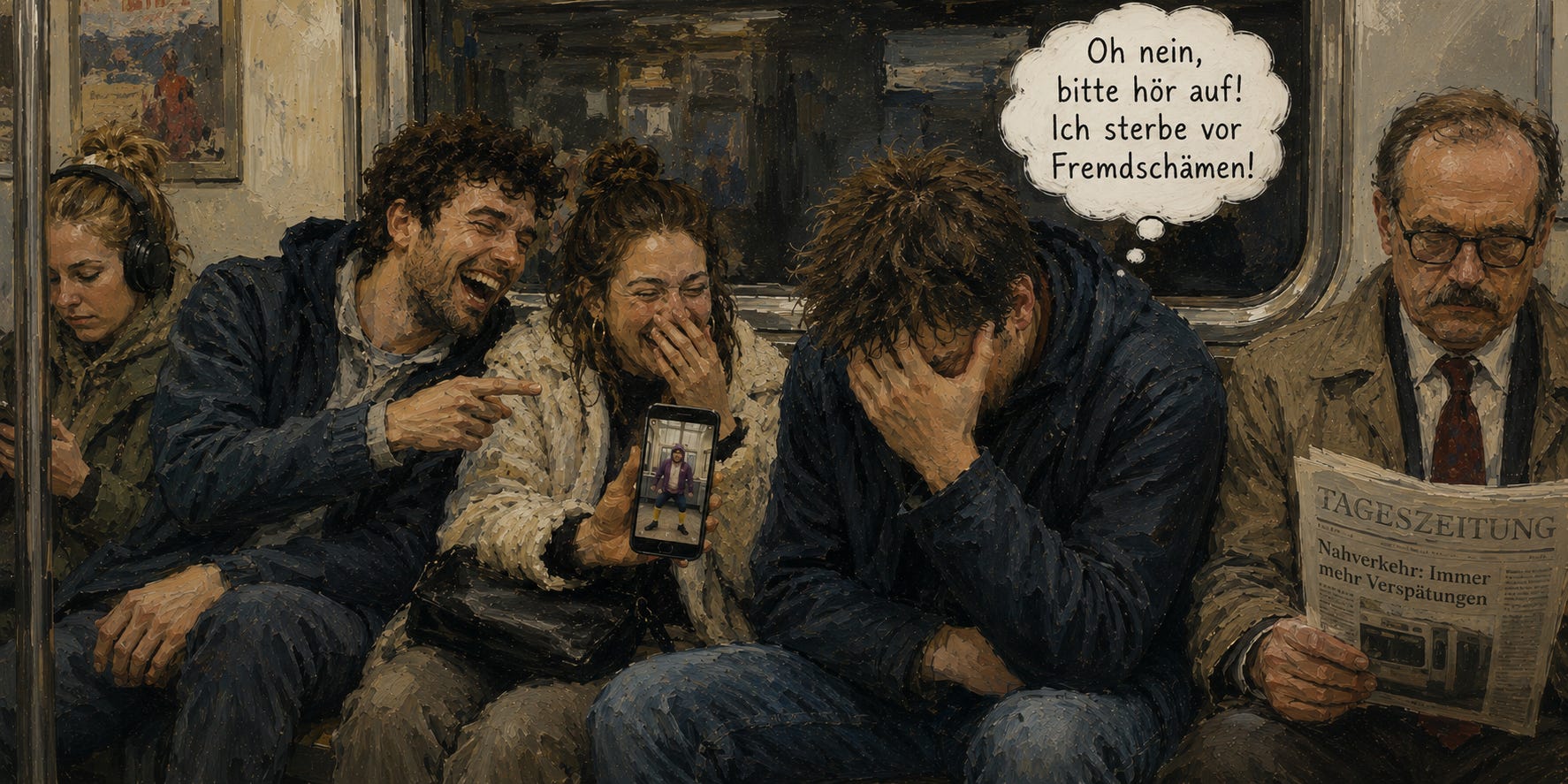
Today’s topic is Fremdschämen. One of those wonderfully specific German words. It literally means “feeling embarrassed on behalf of someone else.”
Let’s explore together a situation and how people actually talk about it…

Part 1 - Read 👀
Read the Dialogue (out loud if you can)
Mia: Ich muss dir was erzählen. Gestern im Restaurant – ich hab mich so fremdgeschämt, ich wusste nicht, wohin mit mir ⍟.
Jonas: Was ist passiert?
Mia: Am Nebentisch sitzt ein Typ, erstes Date, das war offensichtlich. Und er fängt an, seiner Begleitung zu erklären, wie ein Restaurant wirklich funktioniert. Küche, Service, Einkauf – alles. Als ob sie noch nie essen war.
Jonas: Nein.
Mia: Doch. Und sie schaut so… leer. Dieses Lächeln, das eigentlich keins ist. Und er merkt's nicht. Der redet einfach weiter.
Jonas: Das ist so ein klassischer Moment – man will eingreifen, aber man kann ja nicht. Man sitzt da und leidet mit ⍟.
Mia: Ich hab meine Karte genommen und so getan, als ob ⍟ ich die Speisekarte sehr interessant finde. Einfach wegschauen und hoffen, dass es aufhört.
Jonas: Ich kenn das. Ich hatte mal einen Kollegen bei einer Präsentation vor dem ganzen Team – der hat das falsche Dokument geöffnet, live, vor allen. Private Fotos vom letzten Urlaub. Badehose, Strandliege, der volle Urlaubsalbum.
Mia: Oh nein.
Jonas: Er hat so lange gebraucht, bis er's gemerkt hat. Gefühlt eine Ewigkeit ⍟. Und alle haben geschaut und niemand hat was gesagt – das ist ja das Schlimme beim Fremdschämen, man will helfen, aber man ist wie eingefroren.
Mia: Genau dieses Eingefrieren. Am liebsten wäre ich im Boden versunken – für ihn, nicht für mich.
Jonas: Es ist nicht mal dein Problem und trotzdem stresst es dich genauso.
Mia: Mehr, manchmal. Weil die andere Person es oft gar nicht merkt. Die ist entspannt, und du stirbst innerlich ⍟.
Jonas: Und der Restaurant-Typ – wie hat's geendet?
Mia: Sie ist früh gegangen. Kopfschmerzen, hat sie gesagt.
You just saw what conversational German looks like. The next parts are where passive understanding turns into real training reps: 2. listen → 3. understand → 4. write → 5. speak. That’s what makes conversational German start feeling more natural!

Part 2 - Listen 👂
Hear the Dialogue (switch to slow version if the original is too quick.)
Audio 🎧
Slow Audio ⏳

Part 3 - Understand 💡
Read the explanations & translation (Go through the explanations and translation. Take your time, this is where things click.)
A) Explanations 💬
⍟ ich wusste nicht, wohin mit mir – A spoken expression used to describe the physical discomfort of extreme embarrassment or awkwardness, the feeling that your own body has become a problem with nowhere to escape to, common in stories about cringe-worthy situations. (English: “I didn’t know where to put myself”, literal: “I didn’t know where to go with myself”)
⍟ man sitzt da und leidet mit – A natural spoken phrase used to describe the helpless, passive experience of watching something painful or awkward unfold while being unable to intervene, common whenever secondhand suffering is the point. (English: “you just sit there and suffer along with them”, literal: “one sits there and suffers along”)
⍟ so getan, als ob – A common useful spoken construction in everyday German, used to describe pretending or acting as if something is the case when it clearly is not, widely applicable in any situation involving a bluff, a social performance, or deliberate distraction. (English: “pretended that” or “acted as if”, literal: “done so as if”)
⍟ gefühlt eine Ewigkeit – A very common spoken phrase used to describe a stretch of time that felt far longer than it actually was, especially during uncomfortable or tense situations, widely usable whenever subjective time is the point. (English: “felt like forever” or “what felt like an eternity”, literal: “felt an eternity”)
⍟ du stirbst innerlich – A sharp, expressive spoken phrase used to describe the intense internal suffering of a bystander who is far more distressed by a situation than the person actually in it, a staple of any conversation about secondhand embarrassment. (English: “you’re dying inside”, literal: “you die inwardly”)
B) Translation 🔄
Mia: I have to tell you something. Yesterday at the restaurant – I was so embarrassed for someone else, I didn't know where to put myself.
Jonas: What happened?
Mia: There's a guy at the next table, first date, that was obvious. And he starts explaining to his date how a restaurant actually works. Kitchen, service, ordering – everything. As if she'd never eaten out before.
Jonas: No.
Mia: Yes. And she just looks so… blank. That smile that isn't really one. And he doesn't notice. He just keeps talking.
Jonas: That's such a classic moment – you want to step in but you can't. You just sit there and suffer along with them.
Mia: I picked up my menu and pretended to find it absolutely fascinating. Just look away and hope it stops.
Jonas: I know that feeling. I once had a colleague doing a presentation in front of the whole team – he opened the wrong document, live, in front of everyone. Personal photos from his last holiday. Swimming trunks, sun lounger, the full holiday album.
Mia: Oh no.
Jonas: It took him forever to notice. Felt like an eternity. And everyone was watching and nobody said anything – that's the worst part about secondhand embarrassment, you want to help but you're completely frozen.
Mia: That exact freezing. I would have gladly sunk into the floor – for him, not for me.
Jonas: It's not even your problem and it stresses you out just as much anyway.
Mia: More, sometimes. Because the other person often doesn't even notice. They're perfectly relaxed and you're dying inside.
Jonas: And the restaurant guy – how did it end?
Mia: She left early. Headache, she said.

Part 4 - Write ✍️
Writing Practice (this step is easy to skip, but it’s where real progress happens)
Answer ONE of these:
Wann hast du dich zuletzt fremdgeschämt? Was ist passiert?
Warum schämt man sich manchmal für das Verhalten anderer Menschen?
Welche Situationen führen bei dir besonders schnell zu Fremdscham?
👉 Reply to this email or comment below.
Part 5 - Speak 🗣️
Spoken Conversation Practice (This is the part that gets you speaking more naturally, faster.)
Have a short 3–5 minute conversation with your favorite AI (ChatGPT, Claude, Gemini, etc.).
Follow today’s topic
Or choose your own
Ask the AI for corrections and feedback afterwards
AI isn’t a substitute for real conversations with people, but it’s a great way to practise when no conversation partner is available.
Wann hast du dich zuletzt fremdgeschämt? 😬
Send this dialogue to someone who physically cannot watch talent shows, awkward dates, or cringeworthy LinkedIn posts without looking away 😄

LG
Marwan