

Hallo zusammen!
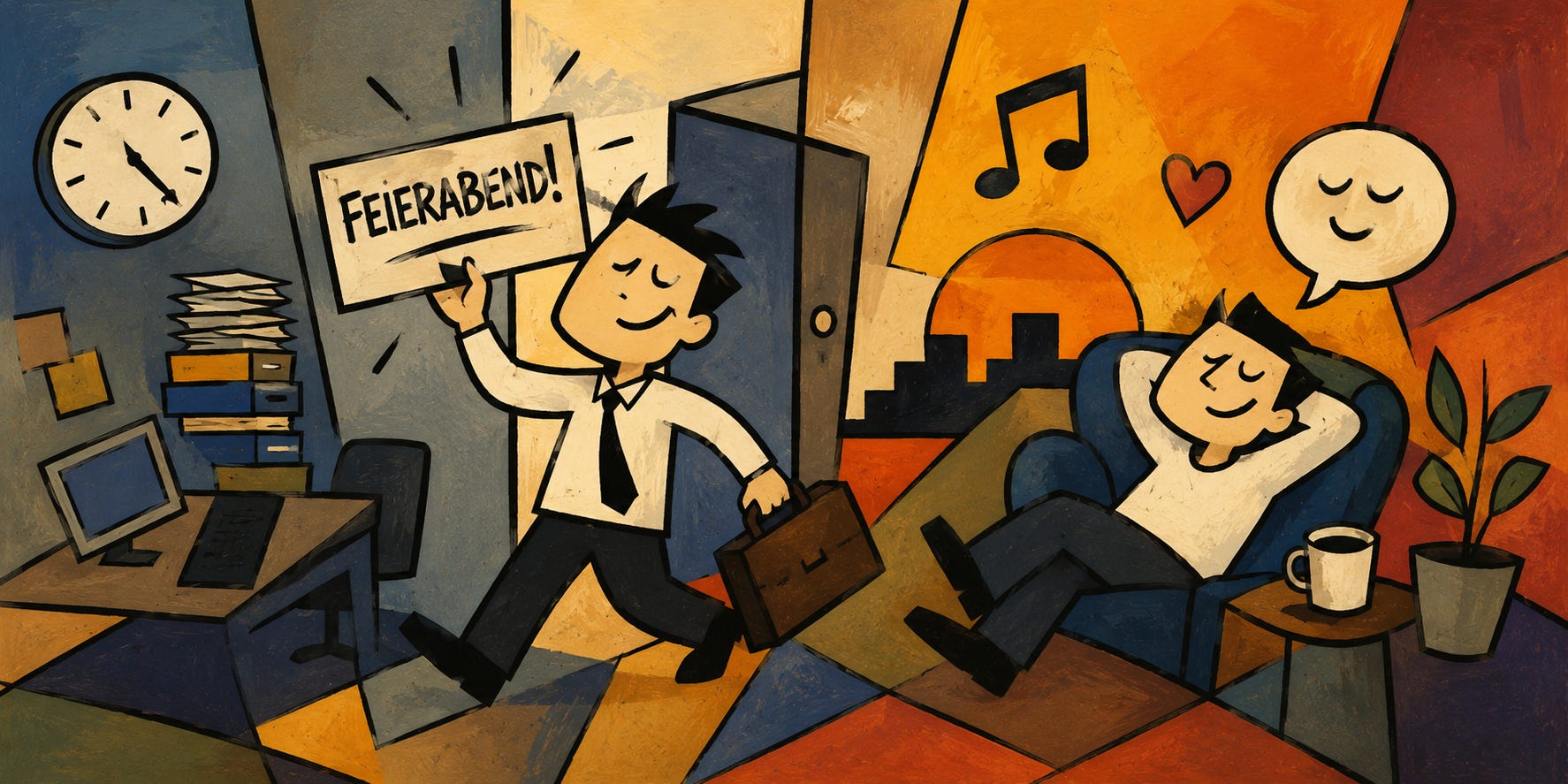
When do you truly finish work on a work day?
You may already know the word for the moment work truly ends: Feierabend. It means leaving work behind and fully switching into your personal life. It’s almost a philosophy.
In this dialogue, you’ll learn how German speakers talk about work-life balance, setting boundaries, and enjoying their free time with useful words, phrases, and natural ways of expressing these ideas in everyday conversation.

Part 1 - Read 👀
Read the Dialogue (out loud if you can)
Timo: Wie machst du das eigentlich, dass du nach der Arbeit nicht mehr auf dein Handy schaust? Mein Chef schreibt mir abends noch manchmal Sachen, und ich antworte dann immer.
Petra: Ich nicht. Sechs Uhr heißt: Laptop zu und fertig. Feierabend ist Feierabend ⍟.
Timo: Aber wenn was Wichtiges ist?
Petra: Dann ruft mich jemand an, wenn's wirklich brennt ⍟. Eine E-Mail um halb acht abends ist nie so dringend, wie sie aussieht. Das ist meistens nur, weil jemand anders sein eigenes schlechtes Zeitmanagement auf dich abwälzt.
Timo: Das klingt einfach, aber bei mir funktioniert das nicht so. Ich schau aufs Handy, lese die Nachricht, und dann denk ich den ganzen Abend drüber nach, auch wenn ich nicht antworte.
Petra: Genau deswegen schau ich gar nicht erst rein. Das Gehirn braucht ja diese klare Grenze. Wenn du ständig zwischen Arbeit und Freizeit hin- und herspringst, schaltest du nie richtig ab ⍟.
Timo: Ich glaub, bei mir ist das auch ein bisschen Ehrgeiz. Ich will halt zeigen, dass ich erreichbar bin.
Petra: Verstehe ich. Aber irgendwann zahlst du den Preis dafür ⍟. Ich hab das bei meinem letzten Job gemacht – Überstunden, Handy immer dabei, auch im Urlaub. Ich war nach zwei Jahren komplett ausgebrannt.
Timo: Und dann?
Petra: Job gewechselt. Und mir eine Regel gesetzt: nach Feierabend existiert die Arbeit nicht. Am Anfang war das schwer, ehrlich. Ich hab mich ständig schuldig gefühlt.
Timo: Und jetzt?
Petra: Jetzt mach ich Sport, koch in Ruhe, seh Freunde – ohne die ganze Zeit gedanklich noch im Büro zu sein. Das war die beste Entscheidung.
Timo: Ich glaub, ich probier das auch mal. Wenigstens versuchsweise ⍟.
Petra: Fang einfach an. Heute. Handy aus, sobald du zuhause bist.
You just saw what conversational German looks like. The next parts are where passive understanding turns into real training reps: 2. listen → 3. understand → 4. write → 5. speak. That’s what makes conversational German start feeling more natural!

Part 2 - Listen 👂
Hear the Dialogue (switch to slow version if the original is too quick.)
Audio 🎧
Slow Audio ⏳

Part 3 - Understand 💡
Read the explanations & translation (Go through the explanations and translation. Take your time, this is where things click.)
A) Explanations 💬
⍟ Feierabend ist Feierabend – A firm, repetitive spoken construction used to assert a clear boundary between work and free time, the doubling of the word for emphasis signalling that the rule is non-negotiable. (English: “off the clock is off the clock” or “when the day’s done, it’s done”, literal: “after-work is after-work”)
⍟ wenn’s wirklich brennt – A vivid spoken idiom used to describe a situation that is genuinely urgent, as opposed to something that merely feels urgent in the moment, widely usable whenever someone wants to set a high bar for what counts as an emergency. (English: “if it’s truly urgent” or “if there’s an actual fire to put out”, literal: “if it’s really burning”)
⍟ schaltest du nie richtig ab – A common spoken expression used to describe the inability to mentally disconnect from work or stress, with “abschalten” capturing the idea of switching off like a device, widely used in conversations about rest and burnout. (English: “you never really switch off” or “you can’t properly unwind”, literal: “you never properly switch off”)
⍟ zahlst du den Preis dafür – A natural spoken construction used to warn that unsustainable behaviour will eventually catch up with you, even if the cost isn’t immediately visible, widely applicable to any situation involving long-term consequences of short-term choices. (English: “you’ll pay the price for that”, literal: “you pay the price for it”)
⍟ wenigstens versuchsweise – A cautious spoken phrase used to commit to trying something new without fully promising to stick with it, common when someone wants to sound open to change while still hedging their bets. (English: “at least as a trial” or “at least give it a try”, literal: “at least on a trial basis”)
B) Translation 🔄
Timo: How do you actually manage not looking at your phone after work? My boss still messages me sometimes in the evening, and I always reply.
Petra: Not me. Six o'clock means: laptop shut, done. When the day's done, it's done.
Timo: But what if something important comes up?
Petra: Then someone calls me, if it's truly urgent. An email at half seven in the evening is never as urgent as it looks. Usually it's just someone else dumping their own bad time management onto you.
Timo: That sounds simple, but it doesn't work like that for me. I check my phone, read the message, and then I think about it all evening even if I don't reply.
Petra: That's exactly why I don't even look in the first place. The brain needs that clear boundary. If you keep jumping back and forth between work and free time, you never really switch off.
Timo: I think for me it's partly ambition too. I just want to show that I'm reachable.
Petra: I get that. But at some point you'll pay the price for it. I did that at my last job – overtime, phone always on me, even on holiday. After two years I was completely burned out.
Timo: And then?
Petra: Changed jobs. And set myself a rule: after work ends, work doesn't exist. It was hard at the start, honestly. I felt guilty constantly.
Timo: And now?
Petra: Now I do sport, cook properly, see friends – without being mentally still at the office the whole time. Best decision I ever made.
Timo: I think I'll try that too. At least give it a go.
Petra: Just start. Today. Phone off as soon as you're home.

Part 4 - Write ✍️
Writing Practice (this step is easy to skip, but it’s where real progress happens)
Answer ONE of these:
Was bedeutet Feierabend für dich?
Wie verbringst du deinen Feierabend am liebsten?
Warum ist Feierabend für viele Menschen so wichtig?
👉 Reply to this email or comment below.
Part 5 - Speak 🗣️
Spoken Conversation Practice (This is the part that gets you speaking more naturally, faster.)
Have a short 3–5 minute conversation with your favorite AI (ChatGPT, Claude, Gemini, etc.).
Follow today’s topic
Or choose your own
Ask the AI for corrections and feedback afterwards
AI isn’t a substitute for real conversations with people, but it’s a great way to practise when no conversation partner is available.
Feierabend schon erreicht? 😌
When does Feierabend actually start for you? The moment you leave work... or only when you stop thinking about it?

LG
Marwan