
Hallo zusammen!
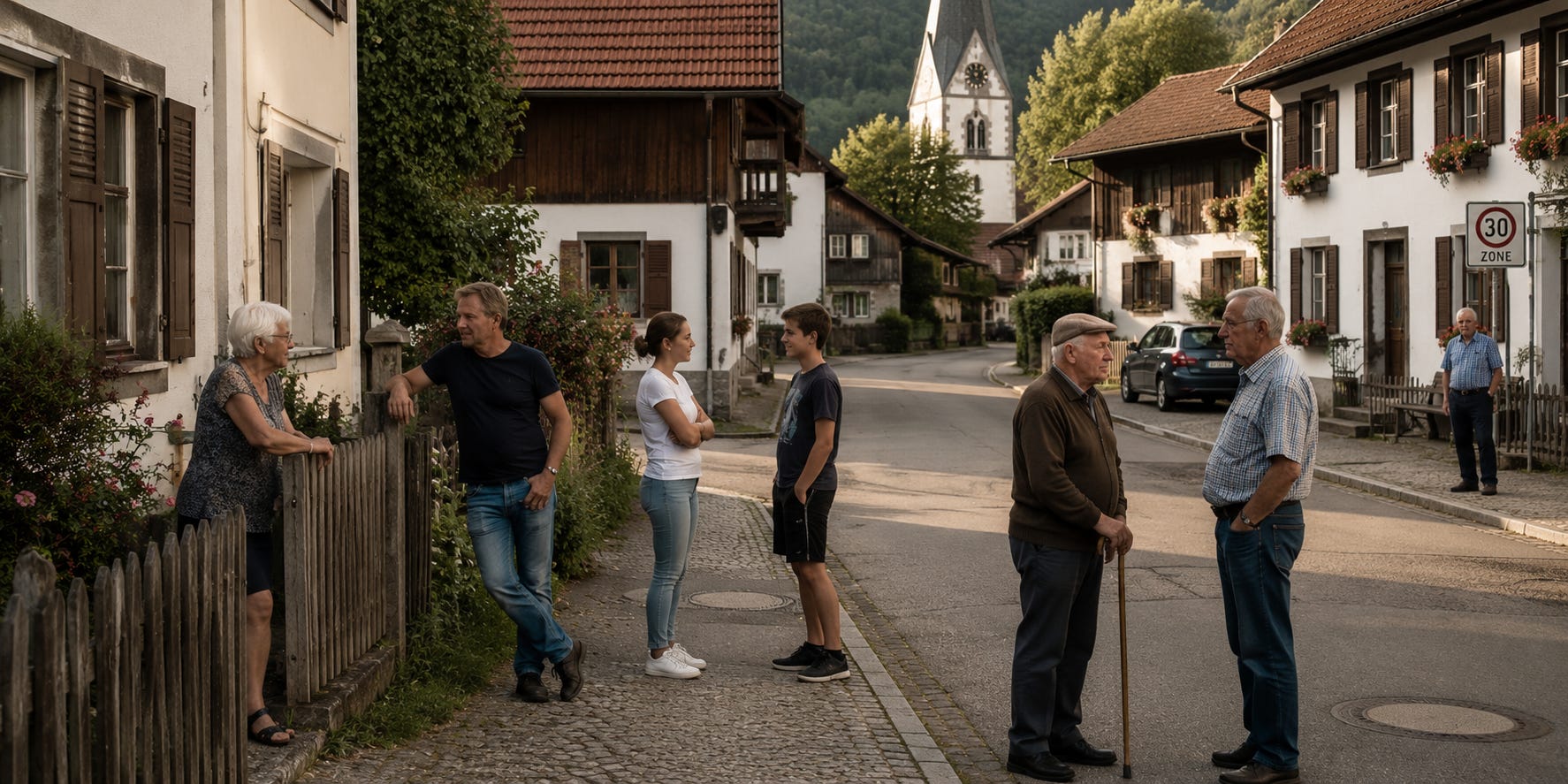
Today’s topic is Dorfmentalität, literally “village mentality.” Depending on who you ask, it’s either cozy or exhausting. This dialogue plays with that tension.
Before we start today’s training, I’d love your quick input.
I’m currently refining these sessions to help learners become more comfortable speaking real conversational German.
Your answers directly shape what you’ll get here in the future.
And as a thank you for participating, I’ll invite a few people to a complimentary 1-on-1 speaking class with me!
Here’s the survey:
Part 1 - Read 👀
Read the Dialogue (out loud if you can)
Lena: Ich erzähl dir was. Ich bin jetzt vier Monate im Dorf. Letzte Woche hat mich die Bäckersfrau gefragt, wie's meinem Rücken geht. Ich hab mit meinem Rücken noch nie ein Problem gehabt.
Jonas: Vielleicht hat sie dich mit jemand anderem verwechselt.
Lena: Nein, nein… sie hat meinen Namen gesagt. Die wissen alles. Ich glaub, die wissen Sachen über mich, die ich selbst noch nicht weiß.
Jonas: Das ist halt Dorf ⍟. Du hast eine Nachbarin, die hat eine Freundin, die hat einen Mann, der mit dem Briefträger redet und nach zwei Tagen weiß die ganze Gemeinde, dass du Dienstag um halb acht mit einem Karton aus dem Auto gestiegen bist.
Lena: Exakt. Als ich eingezogen bin, hat mir drei Tage später der Nachbar von gegenüber gesagt, ich solle die Blaue Tonne nicht so früh rausstellen. Ich hatte sie noch nicht draußen gehabt.
Jonas: Der hat auf dich gewartet.
Lena: Bestimmt. Aber das Verrückte ist - es ist nicht nur nervig. Als ich letzte Woche krank war, hat mir dieselbe Frau eine Suppe vor die Tür gestellt. Einfach so, ohne was zu sagen ⍟.
Jonas: Das ist der Deal im Dorf, oder? Du gibst Privatsphäre ab und kriegst Gemeinschaft dafür ⍟. In der Stadt ist's umgekehrt - totale Anonymität, aber wenn du umfällst, schaut keiner hin.
Lena: So hab ich's noch gar nicht gesehen ⍟. Aber stimmt schon. Ich kenn meine Berliner Nachbarn nach vier Jahren nicht mal mit Vornamen.
Jonas: Und jetzt kennt dich das halbe Dorf nach vier Monaten besser als deine Eltern.
Lena: Meine Mutter hat mich angerufen und gefragt, ob ich wirklich einen Hund anschaffe. Ich hab gar keinen Hund.
Jonas: Noch nicht ⍟.
Lena: Woher weißt du das?
You just saw how this sounds in real life. The next part is where you turn this into something you can actually say yourself. Listen → understand → write → speak. That’s how you stop going blank.

Part 2 - Listen 👂
Hear the Dialogue (switch to slow version if the original is too quick. Focus on how words connect, rhythm and flow)
Audio 🎧
Slow Audio ⏳

Part 3 - Understand 💡
Read the explanations & translation (Go through the explanations and translation. Take your time, this is where things click.)
A) Explanations 💬
⍟ das ist halt Dorf – A resigned, knowing spoken phrase used to explain away the quirks of small-town life in one sweep, with “halt” signalling that this is simply the accepted reality and no further explanation should be needed. (English: “that’s just how village life is” or “that’s small-town life for you”, literal: “that’s just village”)
⍟ einfach so, ohne was zu sagen – A natural spoken phrase used to describe a spontaneous, unprompted act done quietly and without any fuss or expectation of acknowledgement, common whenever someone wants to highlight the understated generosity of a gesture. (English: “just like that, without saying a word” or “out of nowhere, no fuss”)
⍟ du gibst Privatsphäre ab und kriegst Gemeinschaft dafür – A compact spoken formulation used to describe a social trade-off clearly and directly, the pattern “du gibst X ab und kriegst Y dafür” being widely reusable whenever someone wants to spell out what you lose and gain in a given situation. (English: “you give up privacy and get community in return”)
⍟ so hab ich’s noch gar nicht gesehen – A very common spoken phrase used to acknowledge that someone has just offered a perspective or framing you genuinely hadn’t considered before, often said with mild surprise and openness rather than full agreement. (English: “I’d never thought about it that way” or “I hadn’t looked at it like that”, literal: “I haven’t seen it that way at all yet”)
⍟ noch nicht – A short but loaded spoken reply used to imply that something hasn’t happened yet but almost certainly will, leaving the suggestion hanging without spelling it out, and landing especially well as a final line. (English: “not yet”)
B) Translation 🔄
Lena: Let me tell you something. I've been in the village four months now. Last week the baker's wife asked me how my back was doing. I've never had a problem with my back in my life.
Jonas: Maybe she mixed you up with someone else.
Lena: No, no…she used my name. They know everything. I think they know things about me that I don't even know yet.
Jonas: That's just village life. You've got a neighbour, she's got a friend, the friend's got a husband who chats to the postman - and two days later the whole community knows you got out of your car on Tuesday at half seven with a cardboard box.
Lena: Exactly. When I moved in, three days later my neighbour across the road told me not to put the blue bin out so early. I hadn't even put it out yet.
Jonas: He'd been watching for you.
Lena: Definitely. But the strange thing is - it's not just annoying. When I was ill last week, the same woman left a pot of soup outside my door. Just like that, without a word.
Jonas: That's the village deal, isn't it? You trade away your privacy and get community in return. In the city it's the opposite - total anonymity, but if you collapse in the street nobody looks up.
Lena: I'd never thought about it that way. But you're right. I've lived next to my Berlin neighbours for four years and I don't even know their first names.
Jonas: And now half the village knows you better after four months than your own parents do.
Lena: My mum called and asked if I was really getting a dog. I don't have a dog.
Jonas: Not yet.
Lena: How would you know?
Part 4 - Write ✍️
Writing Practice (this step is easy to skip, but it’s where real progress happens)
Answer ONE of these:
Was versteht man deiner Meinung nach unter „Dorfmentalität“?
Welche Vor- und Nachteile hat das Leben in einem Dorf?
Wie unterscheiden sich Menschen auf dem Dorf und in der Stadt?
👉 Reply to this email or comment below.
Part 5 - Speak 🗣️
Spoken Conversation Practice (This is the part that gets you speaking more naturally, faster.)
Have a short 3–5 minute conversation with your favorite AI (ChatGPT, Claude, Gemini, etc.).
Follow today’s topic
Or choose your own
Ask the AI for corrections and feedback afterwards
AI isn’t a substitute for real conversations with people, but it’s a great way to practise when no conversation partner is available.
Das ist halt Dorf 😄
Well done, you made it to the end!
If this dialogue reminded you of someone who grew up in a village… or escaped one, send it to them.
LG
Marwan