


Tach zusammen!
Sometimes the smartest reaction is not getting involved… Not because you don’t care, but because some things are better left where they belong. This dialogue is about that quiet decision to step back and say: „Nicht mein Bier.“
If you enjoy the edition, feel free to share it with someone who might enjoy it too.
Part 1 - Read 👀
Read the Dialogue (out loud if you can)
Judith: Hast du gehört, dass Sandra sich wohl mit ihrem Chef überworfen hat ⍟? Seit Tagen spekulieren alle ⍟, wer was gesagt haben soll und wer auf wessen Seite steht.
Mareike: Ja, das geht gerade richtig durch die Abteilung. Aber ich halte mich da bewusst raus. Das ist am Ende wirklich nicht mein Bier ⍟.
Judith: Früher hätte ich da sofort mitgeredet, einfach weil man alles wissen wollte. Heute frag ich mich eher: Was hab ich eigentlich davon? Meistens nichts außer einem vollen Kopf.
Mareike: Genau. Man kennt ja immer nur Bruchstücke ⍟. Und plötzlich bist du Teil einer Geschichte, mit der du eigentlich nichts zu tun hast.
Judith: Und im schlimmsten Fall zitiert dich jemand falsch, und du stehst da, als hättest du Partei ergriffen. Das brauch ich wirklich nicht mehr.
Mareike: Ich auch nicht. Ich hör mir sowas an, nicke höflich und wechsel das Thema. Das spart Nerven und schont die Beziehungen.
Judith: Außerdem weiß man nie, wie es hinter verschlossenen Türen wirklich läuft. Vielleicht ist nächste Woche schon alles wieder ganz anders.
Mareike: Eben. Und selbst wenn nicht: Es ist Sandras Job und ihre Entscheidung, wie sie damit umgeht.
Judith: Schon lustig, wie sich das mit den Jahren ändert. Man wird selektiver, worauf man Energie verwendet.
Mareike: Absolut. Nicht alles, was spannend klingt, verdient auch Aufmerksamkeit ⍟.
Judith: Ein guter Grundsatz.
Mareike: Finde ich auch. Nicht unser Bier, nicht unser Stress.

Part 2 - Listen 👂
Hear the Dialogue (switch to slow version if the original is too quick)
Audio 🎧
Slow Audio ⏳

Part 3 - Understand 💡
Read the explanations & translation (take your time, ask questions in the comments if something is unclear)
A) Explanations 💬
⍟ überworfen hat means “had a falling out” and is used to describe a serious disagreement, and it is spoken and neutral.
⍟ spekulieren alle means “everyone is speculating” and is used when rumors and guesses spread in a group, and it is spoken and neutral.
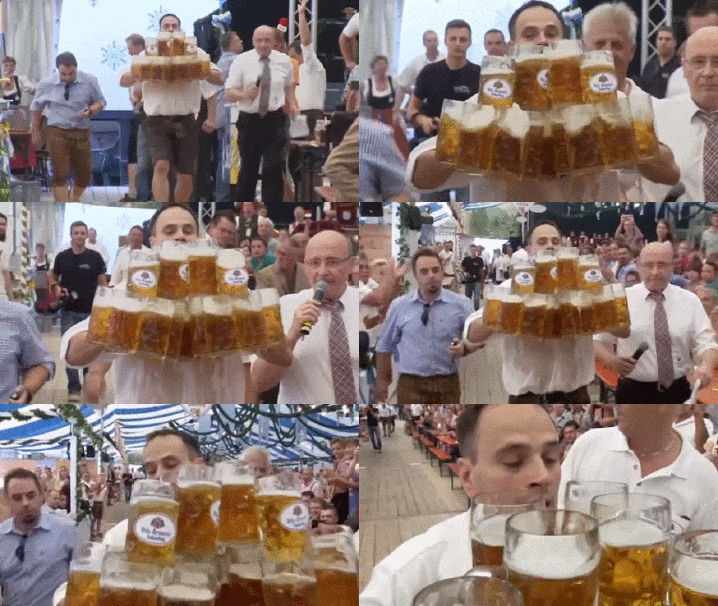
⍟ nicht mein Bier means “not my business” and is used to distance yourself from an issue, and it is spoken and informal.
⍟ Bruchstücke means “bits and pieces” and is used to describe incomplete information, and it is spoken and neutral.
⍟ nicht alles, was spannend klingt, verdient auch Aufmerksamkeit means “not everything that sounds exciting deserves attention” and is used to express conscious prioritization, and it is spoken and neutral.
B) Translation 🔄
Judith: Did you hear that Sandra apparently had a falling out with her boss? For days now everyone’s been speculating about who said what and who’s on whose side.
Mareike: Yeah, it’s really spreading through the department right now. But I’m deliberately staying out of it. In the end, it’s really none of my business.
Judith: I used to jump right into that kind of talk, just because you wanted to know everything. These days I ask myself: what do I actually get out of it? Usually nothing but a cluttered head.
Mareike: Exactly. You usually only know bits and pieces. And suddenly you’re part of a story you actually have nothing to do with.
Judith: And in the worst case, someone misquotes you and you’re standing there like you took sides. I really don’t need that anymore.
Mareike: Me neither. I listen politely, nod, and change the subject. It saves nerves and protects relationships.
Judith: Besides, you never really know what’s going on behind closed doors. Maybe next week everything will be completely different.
Mareike: Exactly. And even if not, it’s Sandra’s job and her decision how she handles it.
Judith: Funny how that changes over the years. You become more selective about where you put your energy.
Mareike: Absolutely. Not everything that sounds exciting actually deserves attention.
Judith: A good rule of thumb.
Mareike: I think so too. Not our business, not our stress.

Part 4 - Write ✍️
Writing Practice (don’t skip, writing trains your brain to actively form sentences, and this carries over into speaking)
Answer ONE of these:
Was bedeutet für dich „Das ist nicht mein Bier“?
In welchen Situationen würdest du diesen Ausdruck benutzen?
Gibt es ähnliche Ausdrücke in deiner Sprache?
Send me your text by replying to this email, and I will answer + give feedback to the first 20 replies!
(check your spam folder just in case)
💬 Alternatively:
Post your answer in the comments.
(you are more likely to get feedback)
Part 5 - Speak 🗣️
Spoken Conversation Practice (This is the part that gets you speaking more naturally, faster.)
Have a short 3–5 minute conversation with your favorite AI (ChatGPT, Claude, Gemini, etc.).
Follow today’s topic
Or choose your own
Ask the AI for corrections and feedback afterwards
AI isn’t a substitute for real conversations with people, but it’s a great way to practise when no conversation partner is available.
Did this feel familiar?
If something in this edition made you nod, smile, or think “oh wow, that’s me” - tell me 🙂 Leave a comment or reply to this email.
And if you enjoyed reading it, tap ♥ or share it with someone who’s learning German too.
LG
Marwan