


Hallo liebe Leute!
Today’s topic is a great example of Denglish: some ideas are simply expressed more precisely in English, and German doesn’t always have a clean one-to-one equivalent.
If you enjoy this newsletter, the best way to support it is to share it with someone who might benefit from it as well. It really helps more than you think.

Part 1 - Read 👀
Read the Dialogue (out loud if you can)
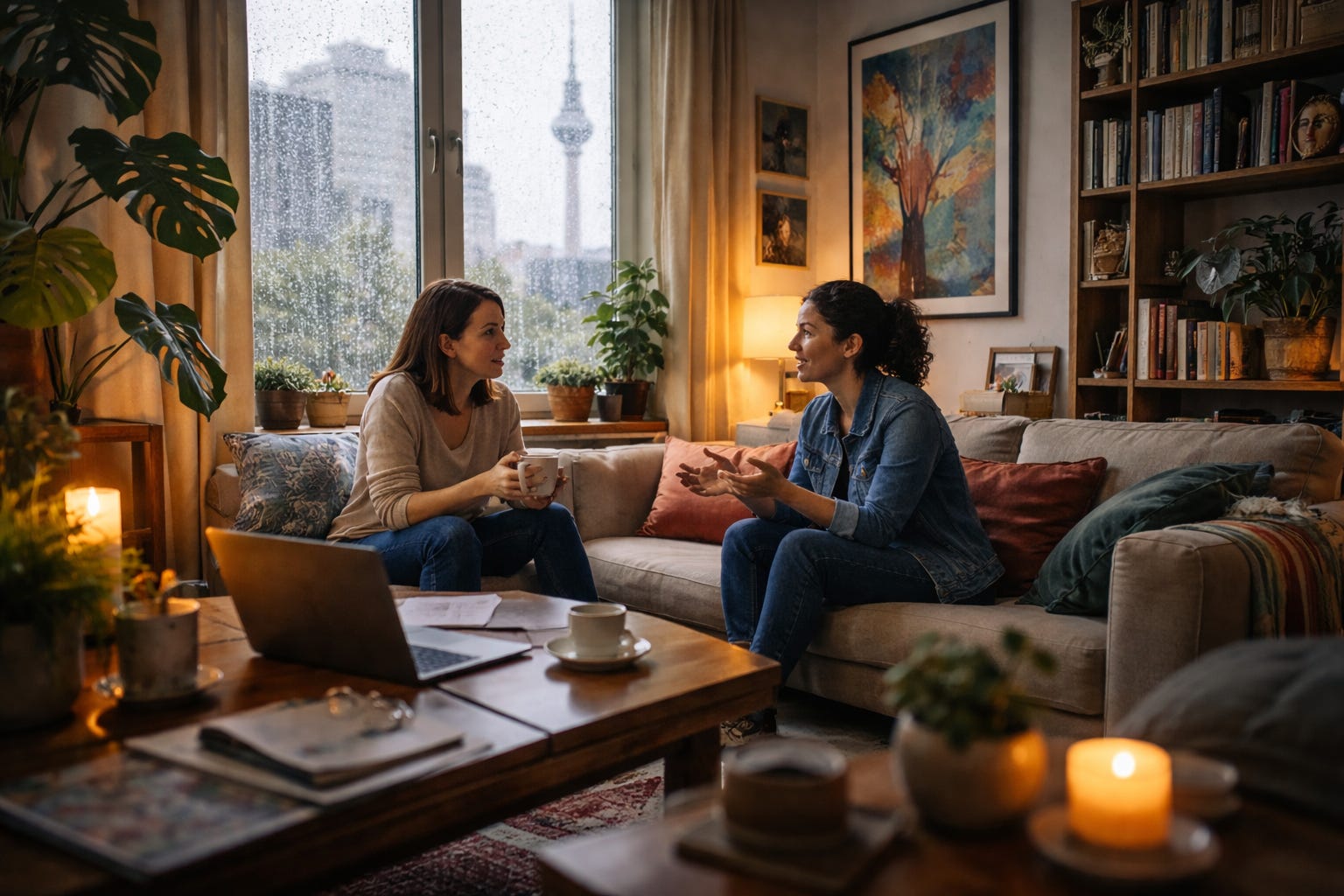
Xenia: Weißt du noch ⍟, wie wir früher jeden Morgen im Stau standen? Wenn ich heute daran denke, frage ich mich echt, wie ich das jahrelang ausgehalten habe. Seit Corona und dem Homeoffice ist mein Alltag komplett anders. Ich steh später auf, trinke in Ruhe meinen Kaffee und bin trotzdem pünktlich bei der Arbeit, das fühlt sich immer noch ein bisschen wie Schummeln an.
Lea: Total. Am Anfang fand ich’s zu gut, um wahr zu sein ⍟. Kein Pendeln, keine vollen U-Bahnen, keine Smalltalks an der Kaffeemaschine, wenn man eigentlich nur seine Ruhe will. Aber nach ein paar Monaten hab ich gemerkt, dass mir genau das irgendwie fehlt. Die Tage verschwimmen, und manchmal weiß ich abends gar nicht mehr, was eigentlich Arbeit und was Freizeit war.
Xenia: Ja, diese Grenzen sind echt das Schwierige. Ich ertappe mich oft dabei ⍟, dass ich „nur noch kurz“ was erledige und plötzlich ist es halb acht. Auf der anderen Seite hab ich so viel mehr Zeit für mich. Ich geh mittags kurz raus, mach Sport oder koche was Vernünftiges. Früher hab ich mir irgendwo schnell was geholt und weitergemacht.
Lea: Bei mir ist es eher umgekehrt. Ich muss mich richtig zwingen, Pausen zu machen. Und ehrlich gesagt: Allein in der Wohnung zu sitzen, jeden Tag, das kann schon auf die Stimmung schlagen ⍟. Meetings über Video sind okay, aber sie ersetzen kein echtes Gespräch. Man lacht weniger, irgendwie.
Xenia: Stimmt. Ich glaub, die Mischung macht’s ⍟. Ein paar Tage Homeoffice, ein paar Tage Büro. Ganz zurück will ich nicht mehr, aber komplett allein arbeiten auch nicht.
Lea: Genau. Homeoffice hat viel verändert, nicht alles schlecht, aber perfekt ist es auch nicht.

Part 2 - Listen 👂
Hear the Dialogue (switch to slow version if the original is too quick)
Audio 🎧
Slow Audio ⏳

Part 3 - Understand 💡
Read the explanations & translation (take your time, ask questions in the comments if something is unclear)
A) Explanations 💬
⍟ Weißt du noch means “do you remember” and is used to bring up a shared past experience in conversation, and it is spoken and informal.
⍟ zu gut, um wahr zu sein means “too good to be true” and is used to express pleasant disbelief about a situation, and it is spoken and neutral.
⍟ ich ertappe mich oft dabei means “I often catch myself” and is used to describe noticing one’s own habits or behavior, and it is spoken and neutral.
⍟ auf die Stimmung schlagen means “to affect one’s mood negatively” and is used to talk about emotional impact in everyday situations, and it is spoken and neutral.
⍟ die Mischung macht’s means “it’s the mix that matters” and is used to say that balance is the best solution, and it is spoken and informal.
B) Translation 🔄
Xenia: Do you remember how we used to sit in traffic every morning? When I think about it now, I honestly wonder how I put up with that for years. Since corona and working from home, my daily routine is completely different. I get up later, have my coffee in peace, and I’m still on time for work. It still feels a bit like cheating.
Lea: Totally. At the beginning it almost felt too good to be true. No commuting, no crowded subways, no small talk at the coffee machine when you actually just want some peace and quiet. But after a few months I realized that I kind of missed exactly that. The days blur together, and sometimes in the evening I don’t even know anymore what was work and what was free time.
Xenia: Yeah, those boundaries are really the hard part. I often catch myself just doing one more quick thing and suddenly it’s half past seven. On the other hand, I have so much more time for myself. I go out briefly at lunchtime, do some exercise, or cook something proper. Before, I’d just grab something somewhere and keep going.
Lea: For me it’s the other way around. I really have to force myself to take breaks. And honestly, sitting alone in the apartment every day can really get to your mood. Video meetings are fine, but they don’t replace real conversations. You laugh less, somehow.
Xenia: True. I think it’s all about the mix. A few days working from home, a few days at the office. I don’t want to go back completely, but I also don’t want to work completely alone.
Lea: Exactly. Working from home has changed a lot. Not all of it is bad, but it’s not perfect either.

Part 4 - Write ✍️
Writing Practice (don’t skip, writing trains your brain to actively form sentences, and this carries over into speaking)
Answer ONE of these:
Wie unterscheidet sich dein Homeoffice vom Arbeiten im Büro?
Was sind für dich die größten Vor- und Nachteile vom Homeoffice?
Wie hat Homeoffice deinen Alltag verändert?
Send me your text by replying to this email, and I will answer + give feedback to the first 20 replies!
(check your spam folder just in case)
💬 Alternatively:
Post your answer in the comments.
(you are more likely to get feedback)
Part 5 - Speak 🗣️
Spoken Conversation Practice (This is the part that gets you speaking more naturally, faster.)
Have a short 3–5 minute conversation with your favorite AI (ChatGPT, Claude, Gemini, etc.).
Follow today’s topic
Or choose your own
Ask the AI for corrections and feedback afterwards
AI isn’t a substitute for real conversations with people, but it’s a great way to practise when no conversation partner is available.
I’d love to hear from you!
If this edition helped you:
Tap ♡ on Substack
And share it with someone learning German, that’s the biggest support you can give

If you have any feedback, feel free to leave a comment or reply to this email, I read every message :)
LG
Marwan