

Hallo zusammen!
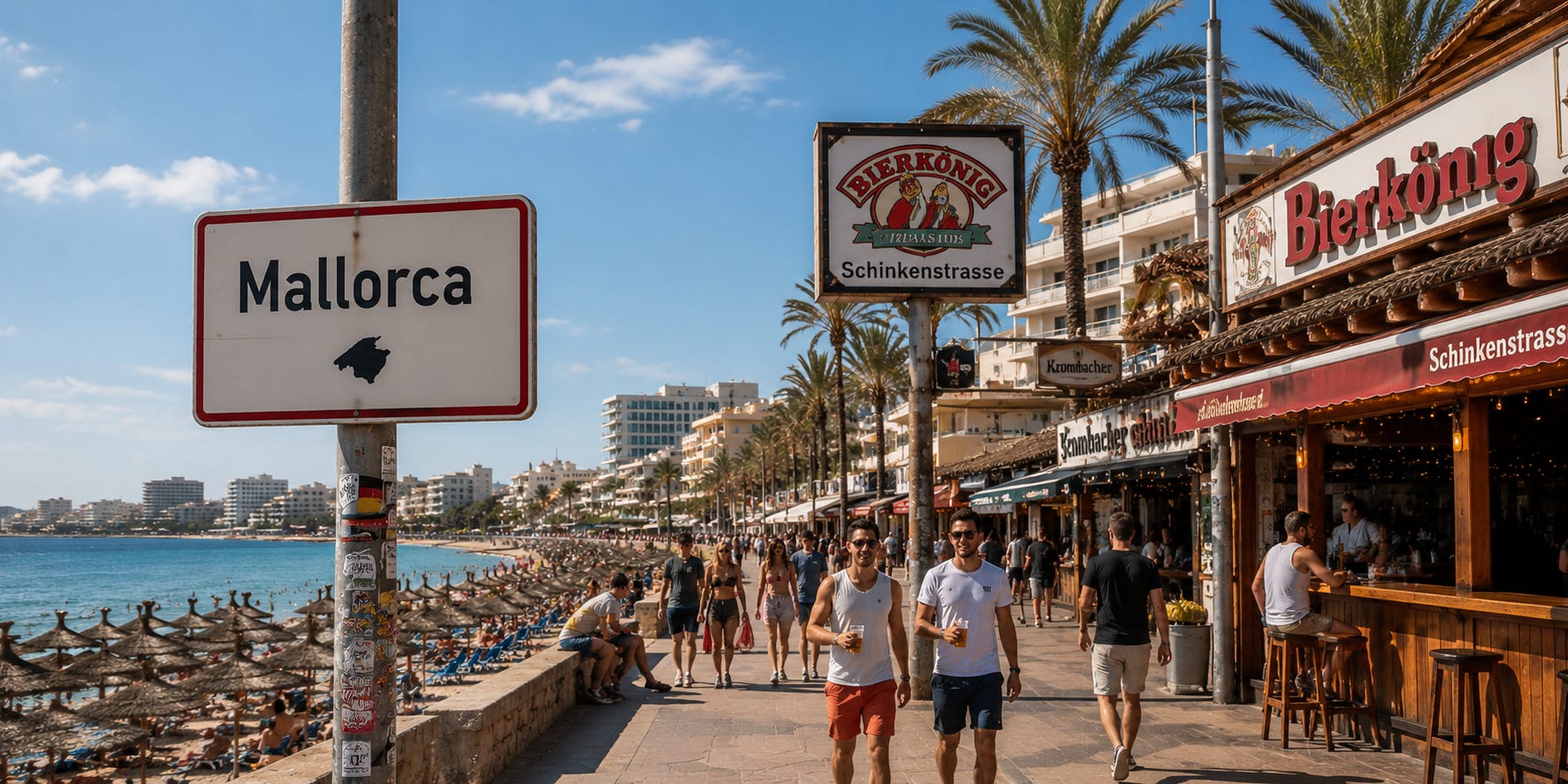
So yes, Germany actually has 16 Bundesländer (federal states), but Mallorca is jokingly often called the 17th Bundesland. Why? Because for decades, it has been probably the most popular vacation destination for Germans.
Let’s take a look at how people speak about it…

Part 1 - Read 👀
Read the Dialogue (out loud if you can)
Karin: Wir fahren im August nach Mallorca.
Stefan: Wieder?
Karin: Was heißt wieder? ⍟ Wir waren zuletzt vor drei Jahren da.
Stefan: Ihr wart 2019 da, 2017 da, und 2015 auch. Ich erinner mich, weil du jedes Mal dasselbe Foto mit demselben Cocktail postest.
Karin: Der Cocktail ist halt gut.
Stefan: Ich sag ja gar nichts ⍟. Aber das ist halt das typisch – man findet einen Ort, der funktioniert, und dann bleibt man dabei. Für immer.
Karin: Was ist daran falsch? Ich weiß, was ich krieg ⍟. Gutes Wetter, gutes Essen, nette Leute – und ich muss nicht irgendwas riskieren.
Stefan: Du könntest auch nach Portugal, Griechenland, Kroatien – aber nein, es muss Mallorca sein. Wo du am Pool Deutsche triffst, in deutschen Restaurants isst und am Ballermann ⍟ Leute siehst, die du auch in Dortmund sehen könntest.
Karin: Wir gehen nicht an den Ballermann.
Stefan: Ich weiß. Ihr geht in die ruhige Ecke. Trotzdem – da hört man mehr Deutsch als Spanisch. Das ist doch kein Urlaub, das ist wie das Leben in Deutschland mit Sonnenschein.
Karin: Und? Was ist das Problem? Im Urlaub will ich mich entspannen, nicht an mir arbeiten ⍟.
Stefan: Das sagen alle. Und dann reservieren sie um sieben Uhr morgens die Liege mit dem Handtuch und wundern sich, warum Mallorca als das 17. Bundesland gilt.
Karin: Das mit den Liegen machen wir nicht.
Stefan: Natürlich nicht.
Karin: Meistens nicht.
Stefan: Bucht ihr wieder dasselbe Hotel?
Karin: Es ist ein gutes Hotel, Stefan.
Stefan: Ich weiß. Ich fahr übrigens auch mit – hab gestern gebucht. Zimmer 14, zweiter Stock, Poolblick.
Karin: Das ist doch unser Zimmer.
Stefan: Ich weiß. Es ist halt ein gutes Zimmer.
You just saw what conversational German looks like. The next parts are where passive understanding turns into real training reps: 2. listen → 3. understand → 4. write → 5. speak. That’s what makes conversational German start feeling more natural!

Part 2 - Listen 👂
Hear the Dialogue (switch to slow version if the original is too quick.)
Audio 🎧
Slow Audio ⏳

Part 3 - Understand 💡
Read the explanations & translation (Go through the explanations and translation. Take your time, this is where things click.)
A) Explanations 💬
⍟ Was heißt wieder? – A punchy spoken phrase used to push back against a word or framing you find unfair or inaccurate, essentially asking “what do you mean by that?” with a defensive edge, very common in casual conversation when someone objects to how something has been framed. (English: “what do you mean, again?” or “what’s that supposed to mean, again?”, literal: “what does ‘again’ mean?”)
⍟ ich sag ja gar nichts – A classic spoken move used to signal that you are deliberately holding back a criticism while making it absolutely clear that you have one, often delivered with a knowing tone that says the opposite of its literal meaning. (English: “I’m not saying anything” or “I didn’t say a word”, literal: “I’m not saying anything at all”)
⍟ ich weiß, was ich krieg – A short, direct spoken phrase used to justify a familiar or repeat choice by pointing to the comfort of predictability, common whenever someone defends a safe option against the suggestion they should try something new. (English: “I know what I’m getting” or “I know what to expect”, literal: “I know what I get”)
⍟ Ballermann – A well-known cultural reference used in everyday German conversation as shorthand for loud, alcohol-fuelled mass tourism, specifically tied to a strip on Mallorca but used more broadly to evoke a certain type of holiday behaviour that many Germans simultaneously mock and secretly recognise. (English: “the Ballermann” – no direct translation, roughly “the party strip” or “that scene”)
⍟ nicht an mir arbeiten – A spoken phrase used to describe the deliberate choice not to improve, grow, or challenge yourself in a given context, often said in mild self-defence when someone implies you should be doing something more demanding or enriching. (English: “not work on myself” or “not treat it as some kind of self-improvement exercise”, literal: “not work on myself”)
B) Translation 🔄
Karin: We're going to Mallorca in August.
Stefan: Again?
Karin: What do you mean, again? We haven't been for three years.
Stefan: You were there in 2019, 2017, and 2015. I remember because you post the same photo with the same cocktail every time.
Karin: The cocktail is good.
Stefan: I'm not saying anything. But that's just typical – you find a place that works and you stick with it. Forever.
Karin: What's wrong with that? I know what I'm getting. Good weather, good food, nice people – and I don't have to risk anything.
Stefan: You could go to Portugal, Greece, Croatia – but no, it has to be Mallorca. Where you meet Germans by the pool, eat in German restaurants, and see people at the Ballermann you could just as easily see in Dortmund.
Karin: We don't go to the Ballermann.
Stefan: I know. You go to the quiet end. Still – you hear more German than Spanish there. That's not a holiday, that's just life in Germany with sunshine.
Karin: So? What's the problem? When I'm on holiday I want to relax, not work on myself.
Stefan: That's what everyone says. And then they reserve their sun lounger at seven in the morning with a towel and wonder why Mallorca is considered Germany's 17th federal state.
Karin: We don't do the sun lounger thing.
Stefan: Of course not.
Karin: Most of the time not.
Stefan: Are you booking the same hotel again?
Karin: It's a good hotel, Stefan.
Stefan: I know. I'm coming along by the way – booked yesterday. Room 14, second floor, pool view.
Karin: That's our room.
Stefan: I know. It's just a good room.

Part 4 - Write ✍️
Writing Practice (this step is easy to skip, but it’s where real progress happens)
Answer ONE of these:
Kennst du Orte, die besonders beliebt bei Touristen aus einem bestimmten Land sind?
Warum fühlen sich Menschen im Urlaub oft „wie zu Hause“?
Welche Vor- und Nachteile hat Massentourismus für solche Orte?
👉 Reply to this email or comment below.
Part 5 - Speak 🗣️
Spoken Conversation Practice (This is the part that gets you speaking more naturally, faster.)
Have a short 3–5 minute conversation with your favorite AI (ChatGPT, Claude, Gemini, etc.).
Follow today’s topic
Or choose your own
Ask the AI for corrections and feedback afterwards
AI isn’t a substitute for real conversations with people, but it’s a great way to practise when no conversation partner is available.
Mallorca ruft wieder 🇪🇸☀️
If you know someone who went to Mallorca, send them this 😄

LG
Marwan