
Hallo zusammen!
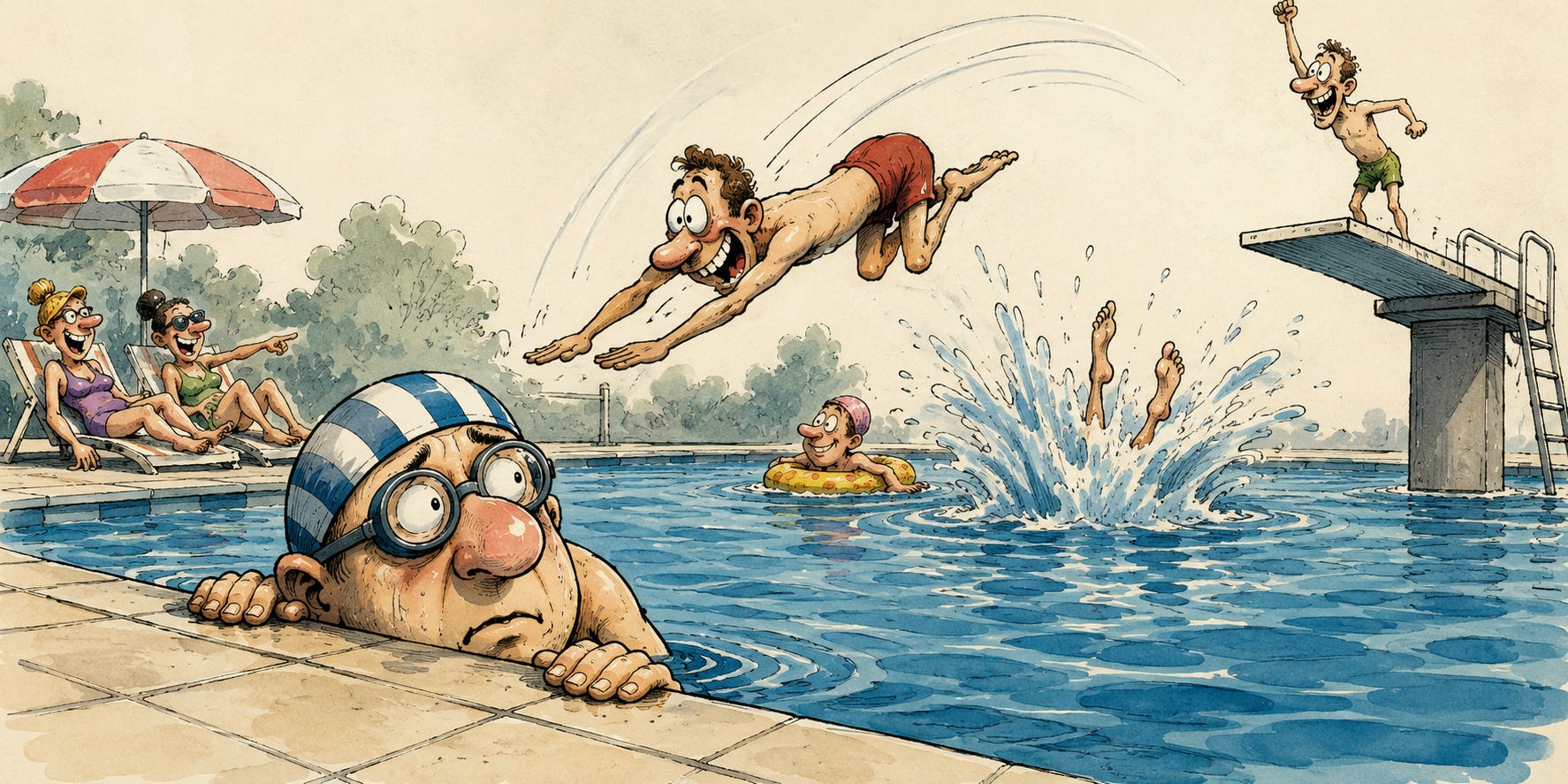
Today’s topic, Beckenrandschwimmer, can be literally translated to “pool-edge swimmer”, so someone who stays at the edge of the swimming pool instead of getting too far into the water. In German, it’s a metaphor for someone who plays it safe, hesitates, overthinks decisions, or prefers watching from the sidelines instead of taking the first step.
Los geht’s!

Part 1 - Read 👀
Read the Dialogue (out loud if you can)
Jonas: Fabian. Du hängst seit zwanzig Minuten am Beckenrand. Das Wasser ist achtundzwanzig Grad, die Sonne scheint, alle anderen schwimmen – und du klebst da wie eine Miesmuschel am Fels. Was geht da vor? ⍟
Fabian: Ich gewöhne mich ans Wasser. Das ist ein völlig ⍟ legitimer Prozess. Nicht jeder springt einfach ⍟ rein wie ein Labrador. Manche Menschen sind methodisch. Manche Menschen planen.
Jonas: Der Typ da ist gerade vom Dreimeterbrett gesprungen, hat einen Salto gemacht und lacht jetzt. Und du hast dich beim Spritzwasser erschrocken.
Fabian: Der riskiert seine Wirbelsäule für einen Moment Aufmerksamkeit. Außerdem hab ich sehr empfindliche Ohren.
Jonas: Du hast eine Badekappe auf. Und eine Schwimmbrille. Fabian, das ist dein Muster – nicht nur hier. Der neue Job, den du nicht angenommen hast, weil du noch abwarten wolltest. Die Wohnung, die vielleicht nicht optimal lag. Immer hängst du am Rand und schaust zu, wie andere schwimmen.
Fabian: Das ist eine sehr tiefgründige Analyse für ein Freibad.
Jonas: Die zwei Frauen da drüben zeigen übrigens auf dich – und nicht bewundernd. Einmal loslassen, einmal schwimmen. Wenn's dir nicht gefällt ⍟, gehst du wieder an den Rand. Aber wenigstens hast du's probiert.
Fabian: Und wenn ich untergeh?
Jonas: Das Wasser geht dir bis zur Brust.
Fabian: Okay. Ich lass los ⍟. Kurz noch. Gleich.
Jonas: Fabian.
You just saw what conversational German looks like. The next parts are where passive understanding turns into real training reps: 2. listen → 3. understand → 4. write → 5. speak. That’s what makes conversational German start feeling more natural!

Part 2 - Listen 👂
Hear the Dialogue (switch to slow version if the original is too quick.)
Audio 🎧
Slow Audio ⏳

Part 3 - Understand 💡
Read the explanations & translation (Go through the explanations and translation. Take your time, this is where things click.)
A) Explanations 💬
⍟ was geht da vor? – A natural spoken phrase used to ask what is going on or what someone is up to, often with a hint of mild exasperation or bewilderment, widely usable whenever behaviour seems inexplicable or a situation needs explaining. (English: “what’s going on there?” or “what’s all this about?”, literal: “what is going on there?”)
⍟ völlig – A very common spoken intensifier used to emphasise that something is completely or entirely the case, stronger than “sehr” and widely usable across all registers to reinforce an adjective or adverb without sounding formal. (English: “completely” or “totally” or “absolutely”, literal: “fully”)
⍟ einfach – One of the most versatile spoken particles in everyday German, used here to convey that something is done without hesitation or complication, adding a sense of effortlessness or casualness that “simply” in English often fails to fully capture. (English: “just” or “simply”, literal: “simply”)
⍟ wenn’s dir nicht gefällt – A practical spoken construction used to soften a suggestion or push by reassuring someone that they can always back out if the experience turns out to be unwanted, widely usable whenever someone needs a low-stakes reason to try something new. (English: “if you don’t like it” or “if it’s not for you”, literal: “if it doesn’t please you”)
⍟ ich lass los – A short spoken phrase used to announce the moment of letting go, literally or figuratively, common in any context involving releasing a grip, giving up control, or finally committing to something after hesitation. (English: “I’m letting go” or “I’ll let go”, literal: “I let go”)
B) Translation 🔄
Jonas: Fabian. You've been hanging on the edge of the pool for twenty minutes. The water is twenty-eight degrees, the sun is out, everyone else is swimming – and you're stuck there like a mussel on a rock. What's going on?
Fabian: I'm acclimatising to the water. That's a completely legitimate process. Not everyone just jumps in like a Labrador. Some people are methodical. Some people plan.
Jonas: That guy over there just jumped off the three-metre board, did a somersault, and is laughing now. And you flinched at a bit of splashing.
Fabian: He's risking his spine for a moment of attention. Besides, I have very sensitive ears.
Jonas: You've got a swimming cap on. And goggles. Fabian, this is your pattern – and not just here. The new job you didn't take because you wanted to wait and see. The flat that maybe wasn't in the perfect location. You always hang on the edge and watch everyone else swim.
Fabian: That's a very profound analysis for an outdoor pool.
Jonas: Those two women over there are pointing at you by the way – and not admiringly. Let go once, swim once. If you don't like it, you go back to the edge. But at least you tried.
Fabian: And what if I go under?
Jonas: The water comes up to your chest.
Fabian: Okay. I'm letting go. Just a moment. In a sec.
Jonas: Fabian.

Part 4 - Write ✍️
Writing Practice (this step is easy to skip, but it’s where real progress happens)
Answer ONE of these:
Was bedeutet es für dich, ein Beckenrandschwimmer zu sein?
In welchen Situationen gehen Menschen lieber auf Nummer sicher?
Wann lohnt es sich, mutiger zu sein und ein Risiko einzugehen?
👉 Reply to this email or comment below.
Part 5 - Speak 🗣️
Spoken Conversation Practice (This is the part that gets you speaking more naturally, faster.)
Have a short 3–5 minute conversation with your favorite AI (ChatGPT, Claude, Gemini, etc.).
Follow today’s topic
Or choose your own
Ask the AI for corrections and feedback afterwards
AI isn't a substitute for real conversations with people, but it's a great way to practise when no conversation partner is available.
Wo bist du manchmal ein Beckenrandschwimmer? 🏊
Share it with someone who's still standing at the edge of the pool. 👀

LG
Marwan